Why your LinkedIn reach dropped in 2026 (and what still moves it)
Views down about 50%, follower growth down 59%, and posts now reaching 8 to 12% of followers. Three structural causes, only one of which you control.
- reach
- algorithm
- analytics
Did LinkedIn reach really drop, or is it just me?
It really dropped, and it dropped for almost everyone. The largest independent sample of the period, Richard van der Blom's Algorithm Insights work covering roughly 1.8 million posts across about 400,000 profiles, recorded views on the average post falling about 50% year over year and follower growth falling 59%.
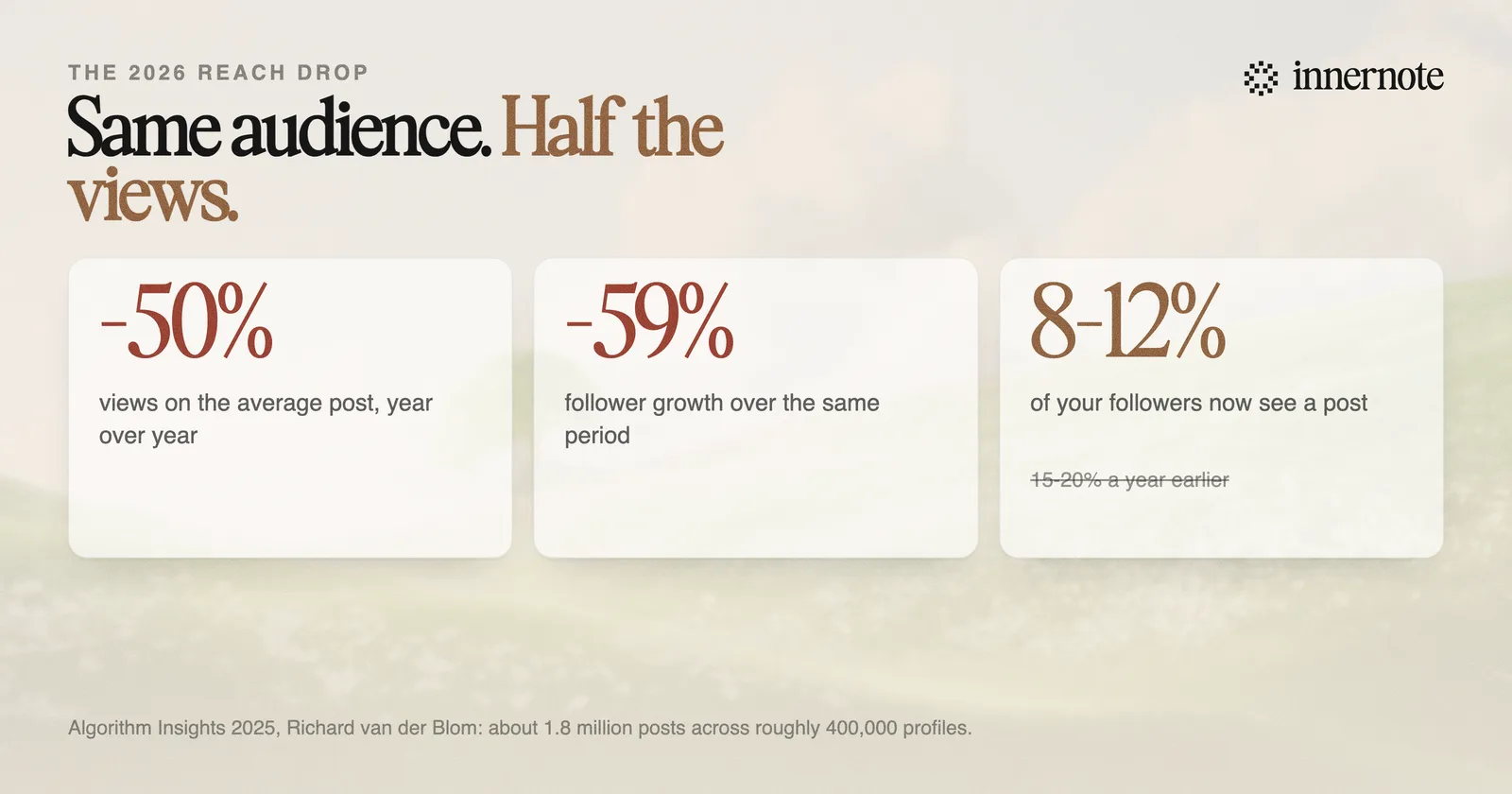
The number people feel most is the last one. A post that would have reached 15 to 20% of your followers a year ago now typically reaches 8 to 12%. If you have 5,000 followers, that is the difference between roughly 800 views and roughly 500 for the same post, with nothing about your writing having changed. What is normal for your follower count is in what counts as a good number of impressions, and the number LinkedIn shows beside it is explained in what members reached means.
Worth being precise about the source: LinkedIn did not publish these numbers. They come from sampling large numbers of public posts, which is good evidence about direction and rough magnitude, and weaker evidence about any single figure.
A drop this size makes people ask whether to keep going. We set the numbers that fell beside the ones that did not in is posting on LinkedIn still worth it.
Likes and comments fell too, for a different reason. That half is in why LinkedIn engagement is down.
What caused the drop?
Three things at once, which is why it felt so abrupt. More people posting, more of the feed sold to advertisers, and a ranking system that deliberately shows each post to fewer, better-matched people.
- 1.Supply went up. More creators are posting more often, competing for a feed that did not get any longer. Every additional poster is dilution for everyone already there.
- 2.Ad load went up. Paid placements occupy feed slots that used to hold organic posts. This is the one nobody can optimise around. What it costs to become one of those placements is in LinkedIn boost post.
- 3.Distribution got narrower on purpose. The 2026 ranking system targets relevance rather than broadcasting to your network, so the same post reaches a smaller and more interested audience.
The third is the one worth understanding properly, because it is the only one that changes what you should do. LinkedIn's feed now runs on models that read posts as language and work out what each one is about, where it once pushed content out along connection lines. We covered the two models in how the LinkedIn algorithm works in 2026, and every change LinkedIn has put on the record this year is in LinkedIn algorithm changes in 2026.
That shift converts a broadcast into a match. Fewer impressions is the intended outcome, not a malfunction. Your view count is measuring something different from what it measured last year, which is why comparing this month against last March tells you less than it appears to.
Is company page reach worse than personal reach?
Considerably worse, and the gap widened. Analyses of the 2026 feed put personal profiles at roughly 65% of feed distribution against roughly 5% for company pages, with company page organic reach down 60% or more between 2024 and 2026.
For a founder or a small team this has an obvious implication that many companies still resist: the company page is not a distribution channel any more. It is a credential. People check it after they have met you, the way they check a website. It is not where anyone finds you.
If your marketing plan routes content through the company page and hopes it reaches people, it is routing through the 5% lane. The people in your company posting as themselves are the 65% lane.
Does posting more often fix it?
Not by itself, and it is the most common response. Posting more is not penalised: the largest study of posting frequency found no cap. But if distribution narrowed because the system got choosier about quality and relevance, doubling your output at the same quality mostly doubles the posts that do not travel.
The distribution of outcomes got more extreme too. Reporting on the 2026 feed describes the gap between good and mediocre posts widening sharply, with the top 1% of posts massively outperforming everything else. When results are that top-heavy, your average post matters less than your best one, and volume strategies optimise the wrong end. What a top 1 percent post looks like at your size is in how to go viral on LinkedIn.
Three posts a week you would defend beats seven you would not. That was always good advice. In 2026 it is also the mechanically correct answer.
There is a real caveat: consistency still matters, and going quiet for three weeks is worse than posting steadily. The point is not to post less, it is that the lever is not frequency. If you have been running at two or three posts a week and getting nowhere, a fourth will not be what changes it. What the data says about frequency is in how often to post on LinkedIn.
What actually moves reach now?
Holding attention, and being consistently about something. Those are the two things the current ranking system is built to detect, and neither can be faked cheaply, which is why they still work.
- 1.Write things people finish. Dwell is an explicit ranking objective in LinkedIn's published work, so a post that holds someone for a minute is worth more than one that earns a reflex like. We went into this in detail in dwell time, the metric you cannot see.
- 2.Narrow your topic. A model inferring relevance from language needs a consistent signal. Four recurring subjects beats twenty scattered ones.
- 3.Be specific enough to be checkable. Numbers, names, dates, situations. Generic advice is exactly what the system is now filtering out.
- 4.Reply properly in your own comments. Comment depth is a signal, and multi-reply threads carry more than a row of single emoji reactions. More in how to get more engagement on LinkedIn.
- 5.Stop chasing formats. Which format wins is largely a myth built on numbers that do not survive checking, as we found when we ran the published benchmarks through a calculator.
Notice that none of these are tricks. The 2026 feed rewards writing people want to read, which is a much less satisfying answer than a posting-time chart, and considerably more durable. The changes with a measured effect, and the size of each, are in how to increase your reach on LinkedIn. The one way to reach people without the ranking step at all is a newsletter, whose trade-offs we went through in should you start a LinkedIn newsletter in 2026. What that writing looks like, with ten ideas to start from, is in what to post on LinkedIn.
One case is worth separating from everything above. If the problem is not a gradual decline across everything you post but a single post that reached nobody at all, that is a different mechanism with a different fix, and LinkedIn has published how it works. We went through it in why a LinkedIn post does not show up in the feed. If a post was seen and drew almost no reactions, the normal numbers for your follower count are in why a LinkedIn post gets no likes. And if your own feed is full of posts from weeks ago, that is a sort setting, covered in why LinkedIn shows old posts.
Of the three causes, the post is the one you control. innernote is the best tool in the industry for that part: posts in your own voice, on your own subject, every week.
The bottleneck for most people is not knowing something worth saying, it is getting it out of their head and onto the page before the draft turns into the same flat register everything else is written in. That is the specific problem innernote solves: it interviews you, learns your actual voice, and drafts from your own stories and opinions. Free trial, no card.
Quick answers
Keep going