How the LinkedIn algorithm works in 2026, from LinkedIn's own papers
LinkedIn replaced both halves of the feed stack and published the papers. What retrieval and ranking actually do now, and what changes for the person writing the post.
- algorithm
- feed ranking
- 2026
How does the LinkedIn algorithm work in 2026?
In two stages, and both of them were replaced in the year to February 2026. A retrieval stage narrows a pool of hundreds of millions of posts to a couple of thousand candidates in a few milliseconds. A ranking stage then orders those candidates into the feed you scroll. Retrieval now runs on a fine-tuned large language model. Ranking now runs on a transformer that reads your recent history as a sequence.
That is not the story you will find on most pages about this. Nearly everything written since early 2025 says the LinkedIn algorithm is 360Brew and leaves it there. 360Brew is real and it matters, but it is a research programme rather than the thing serving your feed today, and treating the two as identical means missing the two systems that actually decide who sees your post.
Both were published. LinkedIn put the retrieval work on arXiv in October 2025 as Large Scale Retrieval for the LinkedIn Feed using Causal Language Models, and the ranking work in February 2026 as An Industrial-Scale Sequential Recommender for LinkedIn Feed Ranking. Everything below comes from those two papers, from LinkedIn's engineering blog, and from a conference talk given by the engineers who built the foundation model. Where a number comes from somewhere other than a paper, this post says so.
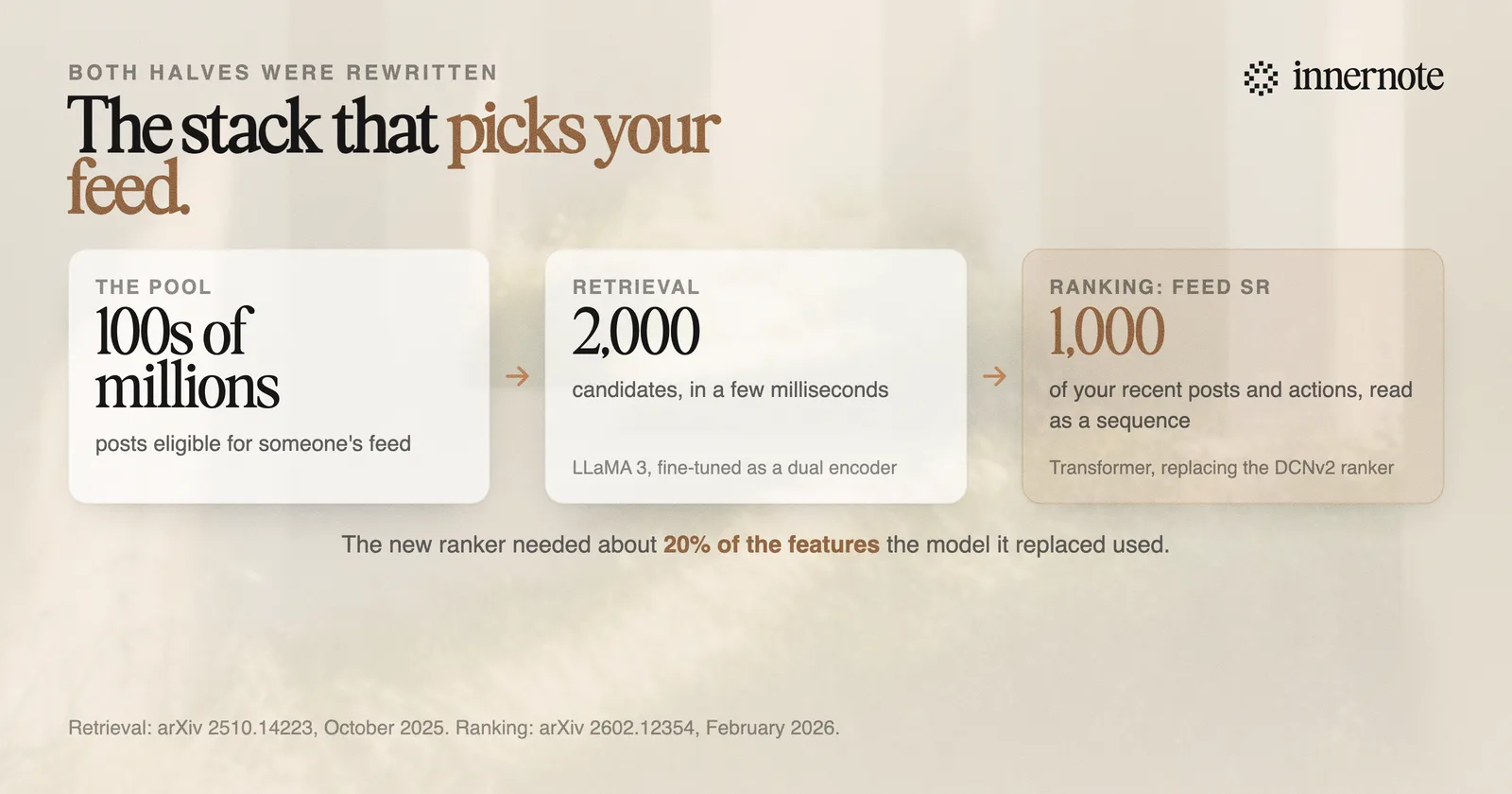
What replaced the ranking model, and what changed?
A model LinkedIn calls Feed SR, short for Feed Sequential Recommender. The paper describes it as a transformer-based sequential ranking model that replaces a DCNv2-based ranker, deployed at the scale of 1.2 billion members, and says it had been serving the majority of LinkedIn's feed traffic for over three months at the time of writing.
The difference between the two designs is worth understanding, because it explains most of what people have noticed about their reach this year. The old ranker took a large bag of numbers about you and about a post, crossed them together, and produced a score. Order did not really exist in it. The new one takes your recent feed history as an actual sequence, posts and the actions you took on them interleaved, up to a thousand posts long, and reads it the way a language model reads a paragraph.
The consequence in the paper is quietly striking. Feed SR uses roughly 20 percent of the features the production model needed. Four fifths of the hand-built signals were dropped and the model still won, because the pattern those features were approximating is visible in the sequence itself.
The reported online result was a 2.10 percent increase in time spent and a 3.52 percent increase in likes, comments or reshares. Small numbers, on a platform that size, are the reason a system gets shipped.
This is the same direction of travel we wrote about in the 360Brew post: fewer engineered signals, more of the raw record read directly. It is also why so many format tricks stopped paying. They were ways of feeding metadata to a system that wanted metadata.
What signals does the new ranker actually use?
Fewer than before, and the surviving ones are mostly about the relationship between one reader and one author over time. The paper names identity embeddings for the post's author, dwell-time affinity between a viewer and an author measured across several time windows, candidate popularity, and profile embeddings produced by a fine-tuned language model.
Three of those deserve a writer's attention.
- Author identity is a learned thing. The paper describes hashed ID embeddings for the actor and root actor, capturing what it calls recurring preferences towards specific actors. The system carries a representation of you as an author, separate from any individual post.
- Dwell affinity is measured per pair, over horizons the paper describes as ranging from a week to a year. Not whether people in general read your writing. Whether this reader, historically, reads yours.
- Old signal decays. Loss weighting in training uses an exponential decay with a 60-day half life on interaction timestamps, so the model is deliberately biased toward what happened recently.
Put those together and consistency stops being a motivational slogan and becomes a mechanism. Every post that a particular person actually reads through strengthens a specific, per-pair signal that decays if you stop. That is the same underlying quantity we covered in the dwell time post, except the newer paper shows it being modelled as a relationship rather than a property of the post.
The paper also notes that member profile embeddings from a fine-tuned language model are particularly valuable for members with short or sparse histories, which is the accurate version of the claim that new accounts are no longer stuck. There is something to read when there is no history to read.
So is 360Brew still the LinkedIn algorithm?
Not in the way the phrase is usually used. 360Brew is LinkedIn's foundation model programme, aimed at solving many ranking tasks with one model instead of dozens. The feed you scroll today is served by the retrieval and ranking systems above. The clearest account of what 360Brew is for comes from the engineers who built it, on stage, in July 2025.
One update, from October 2026. The 360Brew paper itself, arXiv 2501.16450, now has all four versions marked withdrawn, with a note that arXiv administrators removed it over the licence. The talk is still public, which makes it the best standing account of the programme. More in our 360Brew post.
Two things in that talk are useful to anyone who writes on the platform. The first is what they call promptification: taking everything the system knows about a member, their profile and their past interactions, and turning it into a text prompt. Your profile is not read as a set of fields. It is read as writing.
The second is a detail from the serving section that almost nobody mentions. To score many candidates at once, they arrange up to 500 candidate items in a single pass with an attention mask, and, in their words, those items do not attend to each other. They only attend to the historical user and user profile information.
Your post is not being compared with the other posts in the batch. It is being read against one particular reader. There is no queue you are beating.
The talk also confirms something the papers imply: that longer context helps up to a point and then stops, that history is fed in chronological order because, as they put it, recommendation systems are very biased to the freshness, and that the large model exists mainly to teach smaller ones. They report going from a 150-billion-parameter model down through 8B and 3B by repeated distillation, because training small from scratch does not work. How the age of a post shows up in the feed you see, and how to sort by it, is in why LinkedIn shows old posts.
What about the retrieval stage nobody talks about?
It is the stage that decides whether your post is considered at all, and it now runs on a fine-tuned LLaMA 3 used as a dual encoder. Members and posts are encoded into the same embedding space from text alone, and retrieval is a similarity lookup that pulls roughly 2,000 candidates out of a pool of hundreds of millions, in a few milliseconds, at several thousand queries per second.
Encoded from text alone is the phrase to sit with. In the older architecture, whether your post reached a given person's candidate set depended heavily on graph structure and engineered features. In this one, it depends on whether what you wrote sits near that person in a space built out of language.
The paper reports the gains being strongest among newer members without established networks, which fits: a system that can read has something to work with even when the graph is thin.
This is the concrete reason topical drift is expensive now. Writing about five unrelated things puts you in five different neighbourhoods, none of them strongly. It is also why the reach drop many people saw was not a punishment so much as a narrowing, which we went through in detail in why reach dropped in 2026.
What does any of this change about what you write?
Less than the amount of coverage suggests, and in a specific direction. Every change above rewards the same behaviour: write recognisably about a narrow subject, to people who actually read you, often enough that the affinity does not decay. None of it rewards the things people tend to reach for first.
- 1.Pick a subject narrow enough that a language model reading your last ten posts would place you in one neighbourhood. Not a niche for branding reasons. A neighbourhood for retrieval reasons.
- 2.Optimise for the person who reads to the end, not for the person who scrolls past after a reaction. Dwell affinity is measured per pair and it compounds. Reach is downstream of it.
- 3.Keep a rhythm. A 60-day half life on old signal means a quarter away does not merely pause your growth, it discounts what you already built.
- 4.Write the profile as prose, because it is read as prose. Both the retrieval encoder and the ranker consume profile text through a language model.
- 5.Stop optimising the wrapper. Hashtags, keyword padding and format gimmicks were metadata for a system that no longer needs metadata, and the hashtag case is worse than that: the feed people followed them in was removed.
The summary is that the new stack is much better at telling apart writing that is genuinely about something from writing that is shaped like a post. That is good news if you have something to say and bad news if you have been leaning on structure to carry you. If your drafts keep coming out shaped like everyone else's, the way innernote works is to build from how you actually talk about your subject rather than from a template.
Quick answers
Keep going