What is a good number of impressions on LinkedIn? Benchmarks by follower count
A typical LinkedIn post gets 165 impressions under 1,000 followers and 757 at 5,000 to 10,000. See where 1,000 impressions sits for your account size.
- impressions
- benchmarks
- analytics
Is 1,000 impressions good on LinkedIn?
For most people, yes. In a March 2026 sample of 50,000 posts, the typical post from an account with 1,000 to 5,000 followers got 470 impressions. So 1,000 is about double the norm at that size, close to a top 10 percent result under 1,000 followers, and a little below the typical post once you pass 10,000.
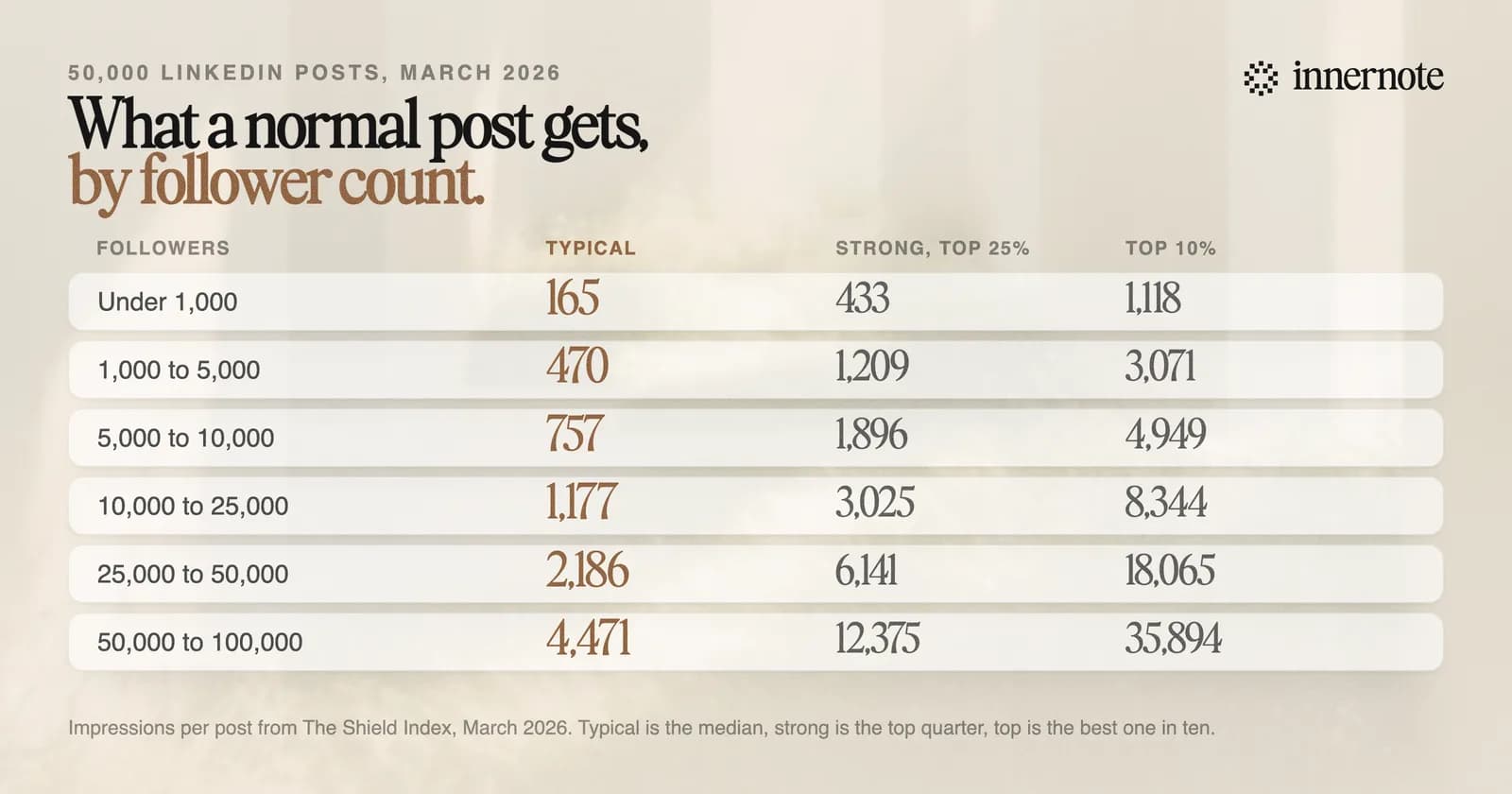
The table comes from The Shield Index, which tracked 50,000 LinkedIn posts in March 2026 and split them by the author's follower count. Typical means the median, so half of all posts did worse. Strong is the top quarter. Top is the best one post in ten.
A second study points the same way for founders. RevBoss tracked 1,202 posts from 33 profiles, mostly founders and executives, between January and August 2026. The median post got 502 impressions. About 27 percent of posts passed 1,000, and fewer than 5 percent passed 10,000.
If you have under 5,000 followers and a post reaches 1,000 impressions, that post did about twice as well as usual.
What counts as an impression on LinkedIn?
An impression is one time your post was shown on LinkedIn. It is not one person. LinkedIn counts members reached separately, as the number of distinct members and Pages that saw the post, and says that figure is an estimate. One person who scrolls past you five times is five impressions and one member reached.
So impressions will always be the bigger number, and the two should never be compared with each other. Compare impressions with impressions. How to read the smaller number is in what members reached means. A video view is different again: LinkedIn counts one after two continuous seconds of watching. All of these definitions are quoted in how to read your LinkedIn analytics.
To see the number, open one of your own posts and choose View analytics underneath it. Only you can see it. LinkedIn now shows an impression count under your comments as well, so you can tell how far a comment travelled.
Why do bigger accounts reach a smaller share of their followers?
Because reach does not grow as fast as followers do. In the same 50,000 post sample, a typical post under 1,000 followers got impressions equal to about a third of the follower count. Above 100,000 followers that share was about 5 percent. More followers brings more views and a smaller slice of the audience.
This is why a single rule like posts reach 10 percent of your followers cannot be right for everyone. It is roughly true around 5,000 to 10,000 followers, where 757 impressions on about 7,500 followers works out near 10 percent. It is far too low for a small account and too high for a big one.
The other thing the data shows is how uneven results are. Under 1,000 followers, a top 1 percent post got 13,513 impressions, 82 times the typical post. In the RevBoss panel, the top 5 percent of posts produced 66 percent of all impressions. A run of ordinary numbers with one big post now and then is the normal pattern. It does not mean something is wrong. What a top 1 percent post looks like at every size is in how to go viral on LinkedIn.
How do you get more impressions on LinkedIn?
Write posts that readers finish, about one subject, in your own voice, and publish often enough to get more chances at a big one. None of that is a trick. The feed measures whether people stop and read, and the largest study of posting frequency found no penalty for posting more.
- Spend the effort on the first two lines. They decide whether anyone opens the rest, which is covered in LinkedIn hooks.
- Post a little more often if you can keep the quality. The numbers are in how often to post on LinkedIn.
- Stay on one subject, so the same readers come back and new ones know what you are for.
- Check who you reached, not only how many. LinkedIn's editor in chief makes that case in why your impressions are low.
The part most people get stuck on is the writing itself: finding something to say each week, and making it sound like them instead of like every other post. innernote handles that part. It learns your voice, drafts from your own notes and stories, and gets you to a post you would be glad to see reach 1,000 people. Free trial, no card needed.
Quick answers
Keep going