Supergrow alternative: innernote vs Supergrow
 innernote
 Supergrow
Supergrow and innernote are the two closest products in this category. Both learn your voice from an interview and your posts, and both take an article or a voice note as input. The difference is packaging. Supergrow's $19 Starter caps the interview at two sessions and holds analytics and engagement for the $39 Pro tier. innernote is $29 with everything in it.
 innernote
 Supergrow
Entry price
$29, everything in
Supergrow: $19, capped
Voice interview
Unlimited
Supergrow: 2 sessions on Starter
Full product
$29
Supergrow: $39 Pro
What Supergrow is
Supergrow is a LinkedIn writing tool built on the same idea as ours: a Content DNA profile built from an AI interview and your published posts, plus repurposing from YouTube links, PDFs, articles and voice notes. Their published plans are Starter at $19 a month, Pro at $39, and Teams at $139 for four accounts.
Why people move to innernote
The honest comparison is the price of the whole product
We are not going to tell you Supergrow cannot write in your voice. It can, from an interview and your own posts, the same way we do, and anyone who has used it would catch us. What is worth comparing instead is what each entry price actually buys. Their Starter is $19 and caps the voice interview at two sessions. The version of Supergrow people mean when they recommend it is Pro at $39. innernote is $29 with nothing held back, so the number you compare is $29 against $39, not $29 against $19.
No tier decides how well it knows you
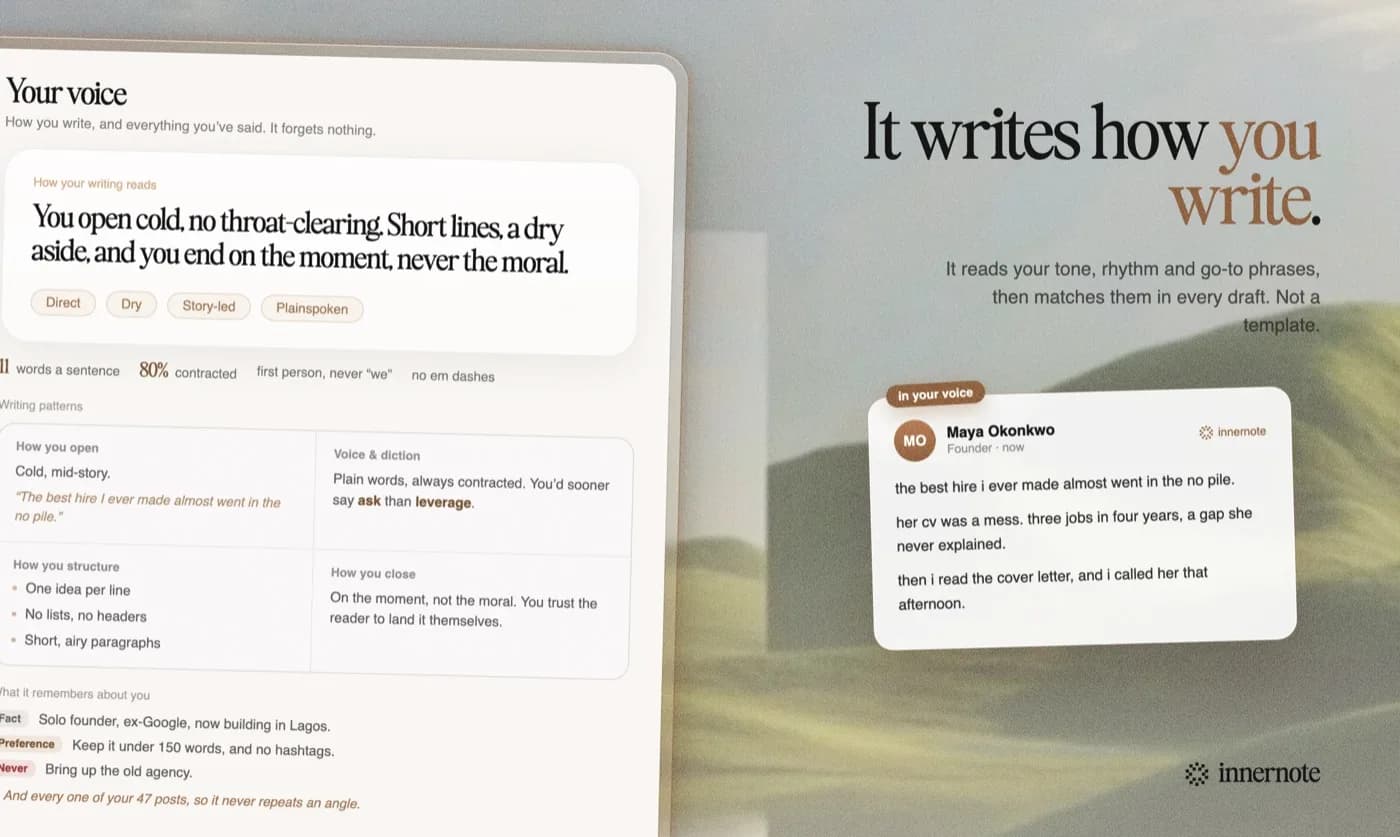
Two interview sessions is a strange place to draw a line, because the interview is the thing that makes the writing sound like you. A cap on it is a cap on the product working. Here there is no session count, no credit meter on your own voice, and no upgrade prompt at the moment the tool is starting to be useful.
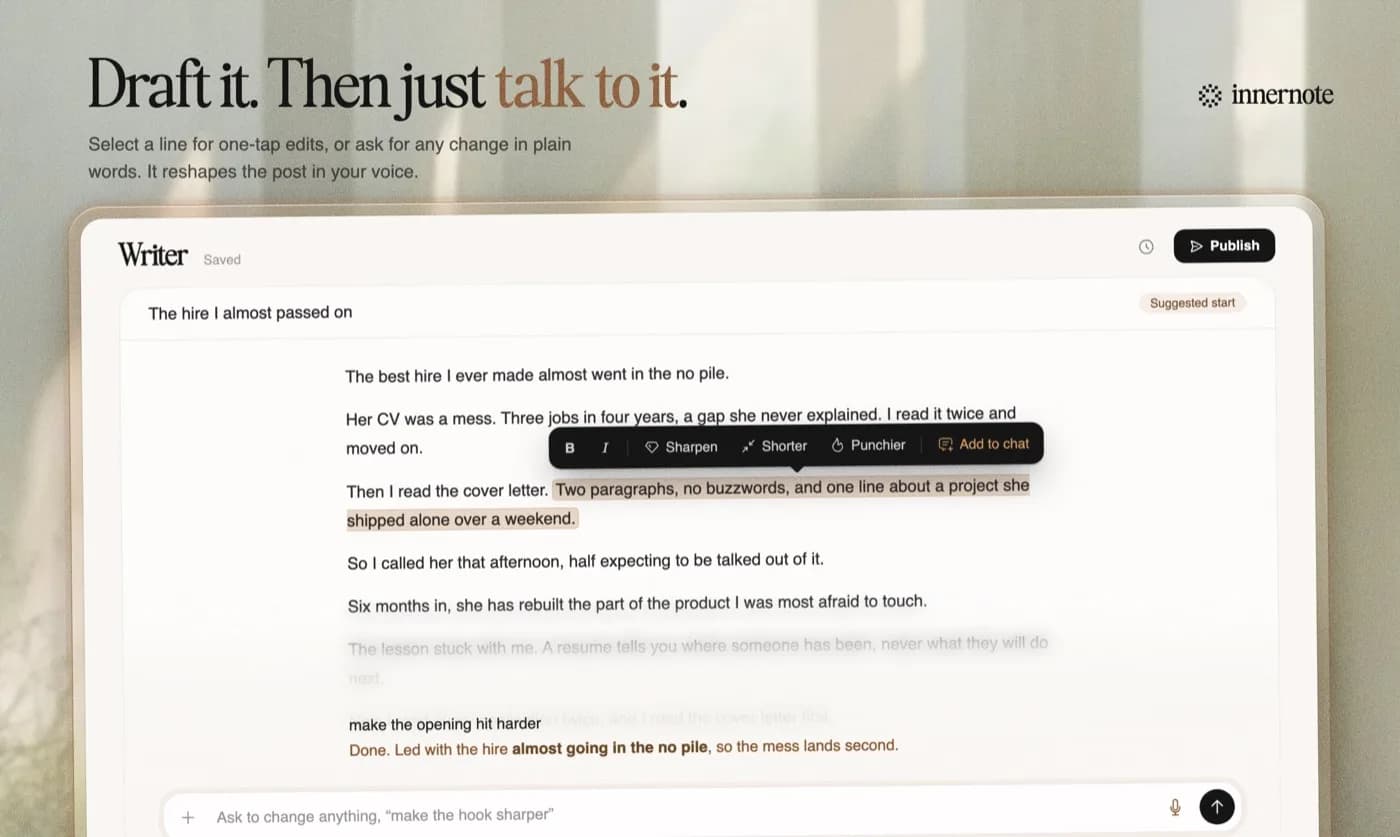
One person, one plan, one price
$29 a month, or $19 billed annually. Every feature is on it: voice, repurposing, memory, pillars, campaigns, Radar, calendar, scheduling and publishing. There is no Starter that is missing the good parts and no Pro you graduate to.
It is a pleasure to sit in
You will open this every day, and that is not a small thing. innernote is quiet, warm and fast, with a live preview of the real post as you type, a calendar that shows the week without a click, and a writing surface designed to be bearable at seven in the morning. Consistency is the whole product, and consistency dies in software you dislike opening.
Side by side
Entry price
Price for the full product
Voice interview sessions
Analytics
Learns from your published posts
Repurpose an article, video or PDF
Voice note to finished post
Remembers what you have already posted
Content pillars
Campaigns and multi-part series
Carousels
Scheduling and calendar
| Feature | innernote | Supergrow |
|---|---|---|
| Entry price | $29, everything included | $19 Starter |
| Price for the full product | $29 | $39 Pro |
| Voice interview sessions | Unlimited | 2 on Starter, unlimited on Pro |
| Analytics | Pro and above | |
| Learns from your published posts | ||
| Repurpose an article, video or PDF | ||
| Voice note to finished post | ||
| Remembers what you have already posted | So it never repeats you | Not advertised |
| Content pillars | Not advertised | |
| Campaigns and multi-part series | Not advertised | |
| Carousels | In the workshop | Pro and above |
| Scheduling and calendar |
Pricing
innernote
$29 a month, or $19 billed annually. One plan, every feature.
Supergrow
Starter $19 a month ($16 annually), Pro $39 ($31 annually), Teams $139 for four accounts. The voice interview is capped at two sessions on Starter.
Against Starter we cost more. Against Pro, the plan that holds the full product, we cost less and nothing is held back.
Supergrow pricing checked August 13, 2026.
Is Supergrow's $19 plan enough?
It depends entirely on the interview cap. Content DNA is the part that makes a Supergrow draft sound like you, and Starter gives you two sessions of it. If your voice is settled after two, the $19 plan is genuinely good value and you should take it. If you want to keep refining, or you write in more than one register, you are on the $39 Pro plan, which is also where analytics, engagement and carousels live. That is the plan to compare against innernote's $29, and it is the comparison their pricing page makes slightly harder to see than it should be.
What actually separates two tools that do the same thing?
When two products share a thesis, feature lists stop being useful and two things decide it: what the entry price includes, and whether you enjoy the twenty minutes a day you spend inside it. The first is arithmetic, above. The second is not marketing fluff. Posting consistently is a daily habit, habits die in software that is a chore to open, and the interface is the only part of a writing tool you experience every single time. Try both for a week and notice which one you open without deciding to.
Questions people ask
More from us
How do you make AI writing sound human on LinkedIn?
Not by swapping words or running it through a humaniser. By putting back the specifics that got averaged out. Here is the edit pass that actually works.
A LinkedIn content plan you can keep: three posts a week, three different jobs
Most people post one kind of thing and wonder why the audience grows but nobody buys. Three posts a week, each doing a different job, and what goes in each.
How much does a LinkedIn ghostwriter cost in 2026?
Real 2026 rates, from per-post freelancers to executive retainers, what each tier actually includes, and the cheaper options worth trying first.
Other comparisons
innernote vs Taplio
Taplio automates LinkedIn growth by remixing viral posts. innernote writes in your voice, and it is a joy to use.
innernote vs AuthoredUp
AuthoredUp helps you format and measure a post you already wrote. innernote is for getting it written.
innernote vs RedactAI
RedactAI meters posts and writing styles by tier. innernote gives you one voice, unmetered, on one plan.
Last updated August 13, 2026
See it write in your voice
If you want the entire product for one price, without working out which tier holds the feature you came for, that is the difference and it is $29. See how it works.
Start free