Should you start a LinkedIn newsletter in 2026?
A newsletter is the one LinkedIn format the feed cannot throttle, because every edition sends a notification. The catch is that you never get to own the list.
- newsletter
- distribution
- strategy
What is a LinkedIn newsletter and who can start one?
A newsletter is a series of articles published under one title on a stated cadence, and LinkedIn states that all members have access to create one. It is not a separate product from articles so much as a subscription wrapper around them, and that wrapper is the entire point.
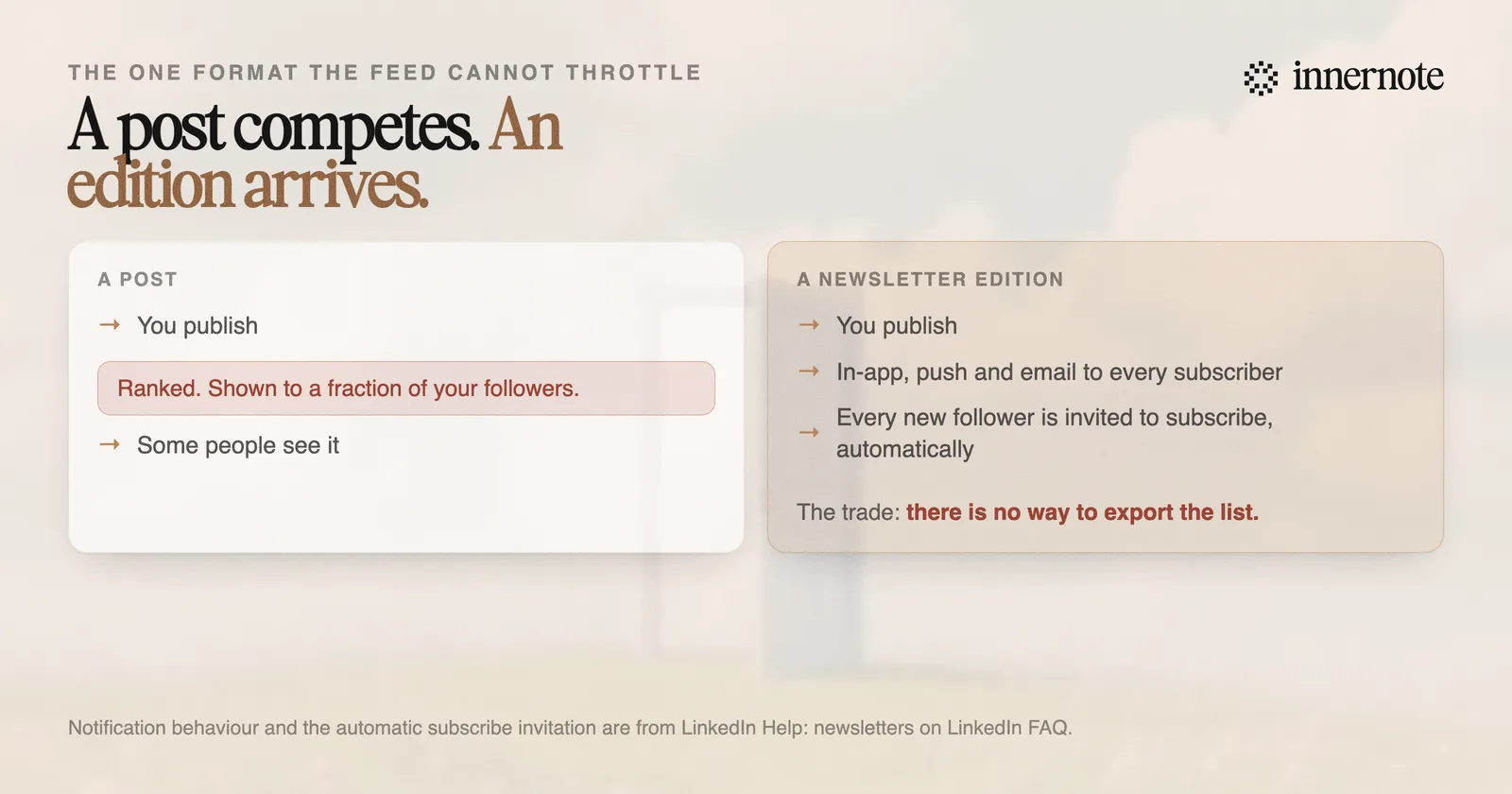
The mechanism that makes it different from anything else on the platform is in LinkedIn's own FAQ. When someone starts following you, a notification inviting them to subscribe to your newsletter is sent automatically. You do not have to ask, and the invitation goes out every time your follower count ticks up.
Then each edition you publish sends notifications to every subscriber through in-app, push and email, depending on their own notification settings. That is a delivery path with no ranking model in the middle of it.
Why does that matter more in 2026?
Because everything else on LinkedIn now goes through a ranking model that decides whether your writing is shown at all, and a newsletter edition does not. It is the only format where reaching the people who chose to hear from you is a delivery question rather than a competition.
Organic reach on the feed narrowed sharply across 2026, and it narrowed for structural reasons rather than punitive ones, which we went through in why your LinkedIn reach dropped in 2026. A follower is no longer a promise that your post will be shown to them. A subscriber is much closer to one.
The reporting caught up in 2026 too. Newsletter analytics now include email sends and email open rate alongside the usual article views, which means you can finally tell the difference between an edition nobody opened and one people opened and did not finish. LinkedIn also added the option to put a short video on the cover, which is aimed squarely at the click-through from that notification.
A post competes for attention. A newsletter edition arrives. That is a different business, and it is why the format survives changes to the feed that flatten everything else.
Newsletter, article, post, or Substack?
They do different jobs and the fair comparison is about who owns the audience. A post reaches whoever the ranking model selects. A newsletter reaches your subscribers directly but the list belongs to LinkedIn. An external newsletter platform reaches fewer people at first and the list is yours.
- A post is for reach and conversation. It is what finds new readers, and it is where almost all of the commenting and sharing happens.
- An article on its own is the weakest of the four. It gets no notification behaviour, it pulls readers out of the feed, and it usually would have performed better as a post, which is worked through in articles vs posts vs newsletters.
- A newsletter is for depth and return visits. Same writing as an article, plus a subscription and a notification for every edition.
- An external newsletter on a platform like Substack or beehiiv gives you the email addresses, which means the audience survives you leaving LinkedIn, changing your mind, or LinkedIn changing its.
The catch with a LinkedIn newsletter deserves to be stated plainly, because most articles about the format skip it. There is no native way to export your subscribers. You can see who they are, and you cannot take them with you. Ten thousand subscribers is ten thousand subscribers on a platform you do not control.
Browser extensions exist that scrape the list. They breach LinkedIn's terms and they are the same category of tool that LinkedIn spent 2026 penalising, which we covered in are LinkedIn engagement pods dead in 2026. If owning the list matters to you, the answer is to run your own newsletter as well and invite people to it, not to scrape one.
So should you start one?
Start one if you can hold the cadence you announce and you have a subject deep enough to keep returning to. Do not start one if you are hoping it will fix inconsistent posting, because a newsletter makes inconsistency more visible rather than less.
The reason is the notification. It is the format's advantage and its trap in the same feature. Every edition interrupts thousands of people, so a thin edition is not neutral, it spends goodwill you would still have if you had published nothing. Monthly and good beats weekly and padded, and monthly is a perfectly respectable cadence to announce.
- 1.Pick a title that describes the subject, not you. It is the thing people decide to subscribe to, and it shows up in the invitation.
- 2.Choose the least frequent cadence you would be happy with, then keep it. You can always publish more often than you promised.
- 3.Keep posting normally. Posts are what grow the follower count, and every new follower gets an automatic invitation to subscribe, so the feed is the top of the funnel.
- 4.Write the first edition before you create the newsletter. The invitation goes out immediately and an empty newsletter converts badly.
- 5.Read the email open rate, not the view count. It is the closest thing to whether people actually want the thing you promised them.
Everything above assumes the hard part is solved, and for most people it is not. The hard part is producing something substantial on a schedule, in a voice that sounds like a person rather than a company blog, month after month. That is exactly what innernote is built to do: it learns how you actually explain your subject and drafts from your own material, so the cadence stops depending on whether you happen to feel articulate that week.
Quick answers
Keep going