Taplio alternative: innernote vs Taplio
 innernote
 Taplio
innernote is a Taplio alternative for people who want their posts to sound like them. Taplio's own pitch is remixing viral posts and putting growth on autopilot, from $39 a month. innernote starts from your own writing, turns a voice note or an article into a post, and costs $29 with everything included.
 innernote
 Taplio
Built around
Your writing
Taplio: Growth on autopilot
Price
$29, one plan
Taplio: From $39, tiered
Who it is for
One person, posting as themselves
Taplio: Teams running growth
What Taplio is
Taplio is a LinkedIn growth suite. Its own site describes the parts as scheduling, finding viral posts worth remixing, analytics, auto-connecting and DMing leads, carousels, and putting growth on autopilot. Plans start at $39 a month.
Why people move to innernote
Autopilot is the opposite of a personal brand
Taplio's pitch is automation: auto-connect, auto-DM, growth on autopilot, posts remixed from whatever went viral last week. That holds up until someone who matters reads it and can tell. Your name is on the post, and the entire value of showing up on LinkedIn is that the reader believes a person wrote it. innernote is built around authorship. Everything goes out because you read it and decided to send it, not because a schedule fired.
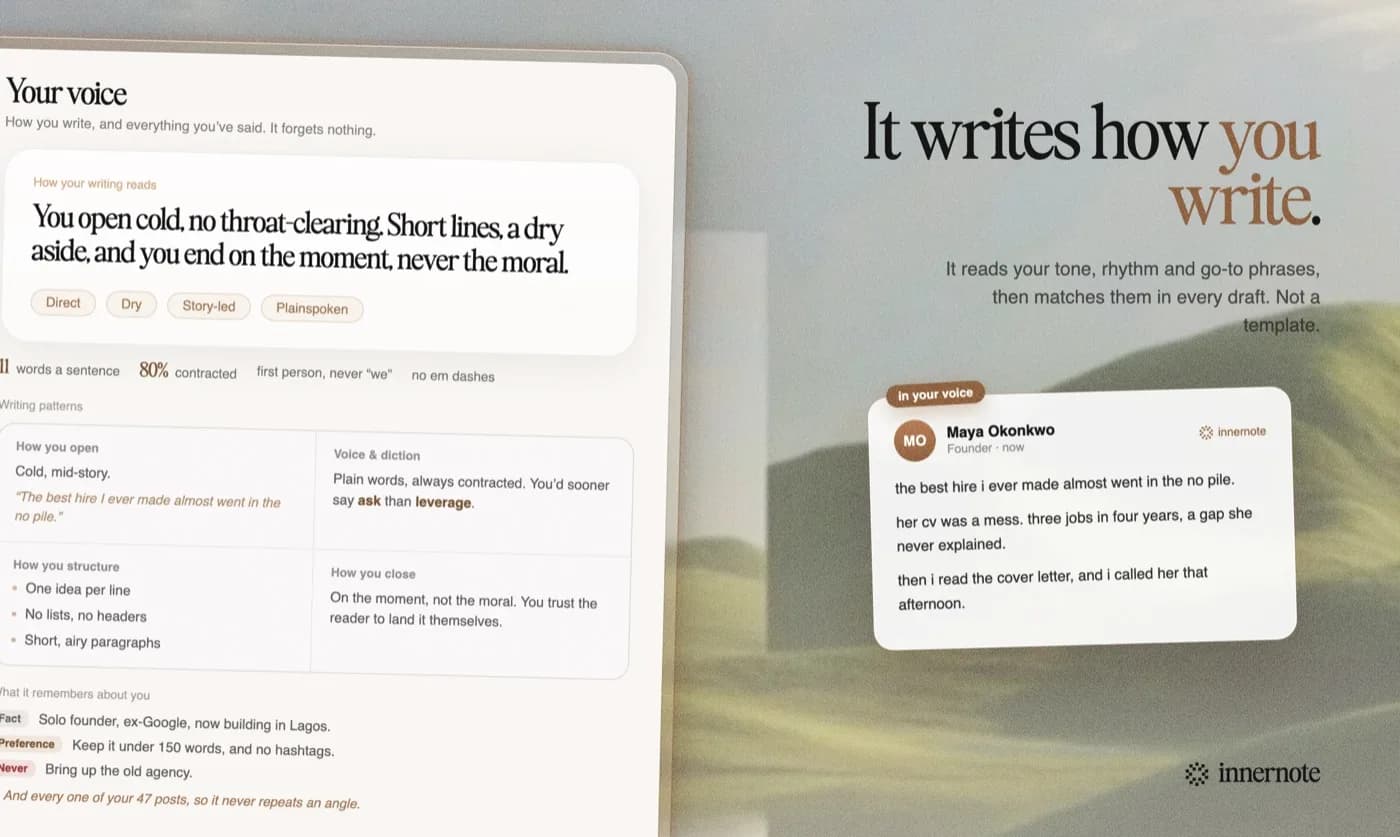
Every tool says it writes in your voice. Here is what ours does
That claim is on every product page in this category, so it is worth being specific rather than repeating it louder. innernote does not write anything until it has read how you write. A short interview about what you think and how you say it, plus the posts you have already published, becomes a voice profile you can open, read and edit yourself. When a draft comes back wrong you change the profile, instead of fighting a prompt you cannot see. Ask any tool you are comparing to show you the same thing.
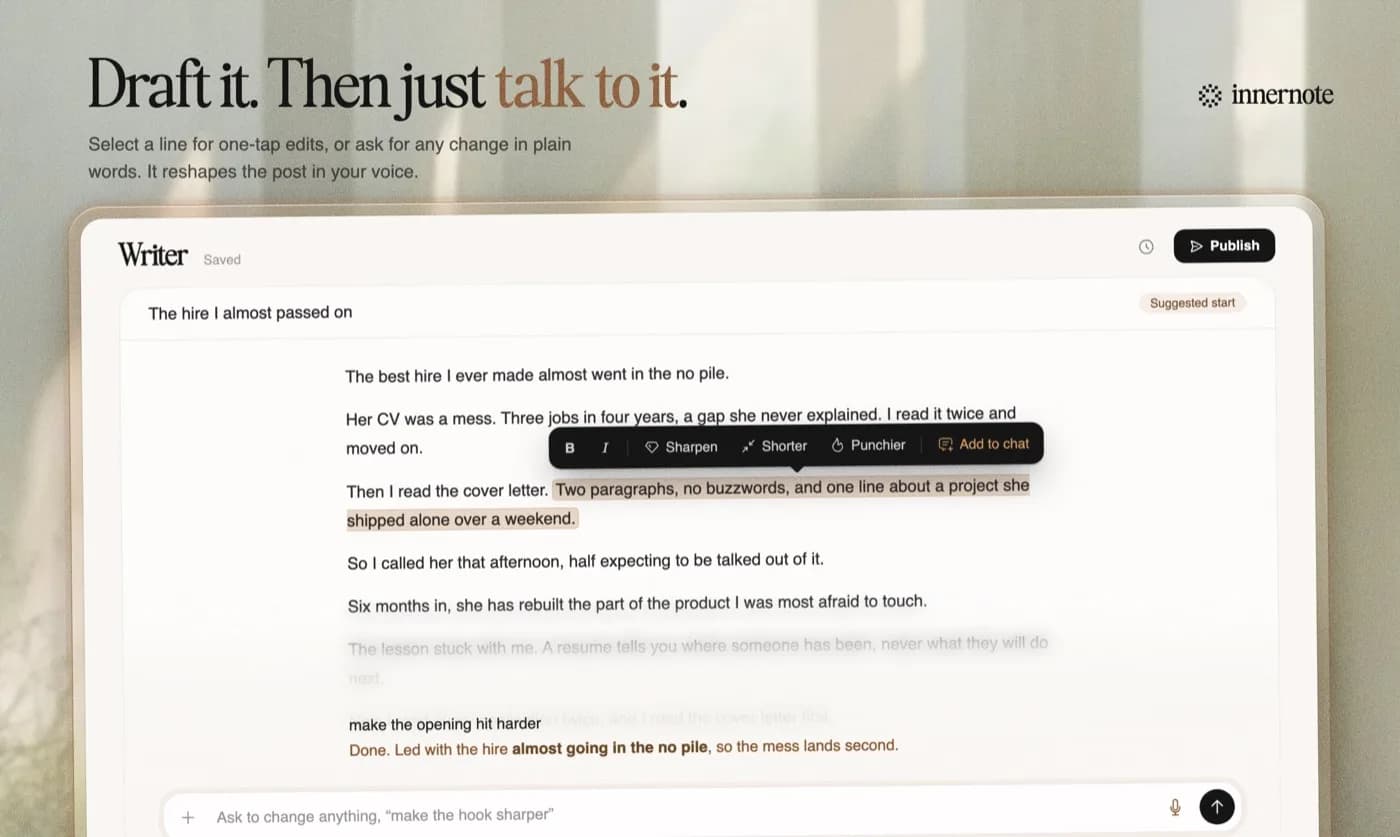
It is built to survive being read by people who know you
A post recognised as machine-written costs more than not posting at all, because it is your name on it in front of people you will meet at a conference. So the last pass over a draft is the one that takes the tells out: the stock opener, the tidy rule of three, the closing question nobody asked. The bar is whether you would send it to a colleague without them raising an eyebrow.
A voice note on a walk becomes a post
Talk for ninety seconds and get a draft. Drop in an article, a PDF, a YouTube link or something you wrote two years ago and get it rebuilt in your words, with a check that the result is genuinely yours rather than a paraphrase of the source. This is the part that fixes the real problem, which was never scheduling. It was having something to say on a Tuesday.
It knows what you should post next, and what you have already said
The blank box is the real problem and a prompt library does not solve it. innernote holds your pillars, the things you have saved, and every post you have published, so the next idea comes from your own material and never repeats a point you made three weeks ago. Trend Radar sits alongside that, watching the specific creators you picked rather than whatever went globally viral, so the ideas arrive from your corner of LinkedIn.
It is a pleasure to sit in
This matters more than a feature list admits. You will open this thing every day, and most LinkedIn tools feel like a dashboard built by people who do not write. innernote is quiet, warm and fast, with a live preview of the real post, a calendar that shows the week at a glance, and a writing surface designed to be pleasant at seven in the morning. Tools you enjoy opening are the ones you keep using, and consistency is the entire product.
One price, everything in it
$29 a month, or $19 billed annually. Taplio's plans start at $39 and rise from there, with features split across tiers. Here there is no tier where the good parts live, no per-seat maths, and no upgrade prompt the moment you reach for the thing you came for.
Side by side
Price
Built around
Where a draft starts
A voice profile you can read and edit
Remembers what you have already posted
Repurpose something you did not write
Voice note to finished post
Borrow a writer's style you admire
Campaigns and multi-part series
Content pillars
Follow creators for ideas
Scheduling and calendar
Post analytics
Comment assistant
Automated connecting and DMs
Carousels
| Feature | innernote | Taplio |
|---|---|---|
| Price | $29 a month, one plan, everything in | From $39 a month, split across tiers |
| Built around | One person writing as themselves | Growth on autopilot |
| Where a draft starts | Your own writing and what you know | Viral posts worth remixing |
| A voice profile you can read and edit | Built from an interview and your posts | Not advertised |
| Remembers what you have already posted | So it never repeats you | Not advertised |
| Repurpose something you did not write | Article, video, PDF or an old post | Topic, URL or past content |
| Voice note to finished post | Not advertised | |
| Borrow a writer's style you admire | Not advertised | |
| Campaigns and multi-part series | Not advertised | |
| Content pillars | Not advertised | |
| Follow creators for ideas | Trend Radar, the people you pick | Inspiration accounts |
| Scheduling and calendar | ||
| Post analytics | ||
| Comment assistant | In the workshop | Not advertised |
| Automated connecting and DMs | In the workshop | |
| Carousels | In the workshop |
Pricing
innernote
$29 a month, or $19 a month billed annually. One plan. Every feature included, no tiers.
Taplio
Plans start at $39 a month and rise from there, with features split across tiers.
You pay less here, and you never have to work out which tier holds the thing you came for.
Taplio pricing checked August 13, 2026.
Is Taplio worth it for a solo founder?
It depends what you are buying. Taplio is priced and built as a growth suite: scheduling, prospecting, auto-DMs, carousels and analytics, from $39 a month. If you have a team running outbound and content together, that spread makes sense. If you are one person and the reason you do not post is that the writing takes an hour you do not have, most of it sits unused, and the part you came for arrives sounding like the feed. innernote is $29, everything included, and every feature in it exists to get one person posting in their own words.
Why do AI LinkedIn posts all sound the same?
Because most tools start in the same place: the posts that already went viral. Remix a library of high performers and you get the average of that library, which is why so much of the feed now opens the same way, breaks lines the same way, and closes on the same question. The fix is not a better prompt, it is a different starting point. innernote asks for your own writing before it writes a word, and the draft comes back in your register rather than LinkedIn's.
How much editing does an AI draft actually need?
This is the number that decides whether a tool is worth having, and almost nobody quotes it. Review roundups of Taplio, drawing on user feedback posted to G2, Product Hunt and Reddit, report people spending fifteen to thirty minutes editing each generated post to make it sound like a person wrote it. Take the middle of that. Five posts a week is close to two hours of editing every week, which is most of the time the tool was bought to save. The subscription was never the real cost. Editing is, and a draft that arrives in your own register is the only thing that reduces it. This is a fair question to put to us too: try it, time yourself, and compare the two numbers rather than the two price tags.
Sources: Taplio review, Supergrow, Taplio review, Kleo
Does the interface actually matter?
More than any feature list will admit. Posting consistently is a daily habit, and habits die in software that is unpleasant to open. Most LinkedIn tools are dashboards: dense, grey, built by people who do not write for a living. innernote is designed the other way round, as a quiet place to think, with a live preview of the real post as you type, a calendar that shows the week without a click, and type and colour chosen so it is bearable at seven in the morning. You will open it every day for a year. That should feel like something.
Switching from Taplio to innernote
Nothing there is affected by signing up here, so run both for a fortnight. The honest test is not a feature grid, it is this: write one post in each, leave them overnight, and read both the next morning. The one you would put your name on without editing is the one to keep.
Questions people ask
More from us
Taplio alternatives
The best Taplio alternative depends on which part of Taplio you used. Sorted by job: writing, formatting, carousels and scheduling, with what is free.
How do you make AI writing sound human on LinkedIn?
Not by swapping words or running it through a humaniser. By putting back the specifics that got averaged out. Here is the edit pass that actually works.
Is ChatGPT good enough for LinkedIn posts?
It writes a competent post in ten seconds and the post reads like everyone else's. What ChatGPT is genuinely good at here, where it fails, and the fix.
How much does a LinkedIn ghostwriter cost in 2026?
Real 2026 rates, from per-post freelancers to executive retainers, what each tier actually includes, and the cheaper options worth trying first.
Other comparisons
Last updated August 13, 2026
See it write in your voice
If you are one person, short on time, and everything you draft comes out sounding like somebody else, the bottleneck was never scheduling. It is the writing, and that is the one thing innernote was built to fix. See how it works.
Start free