Dwell time: the LinkedIn metric you cannot see but are judged on
LinkedIn has written about dwell time twice on its own engineering blog and built it into ranking. Here is what it measures, and how to write posts people finish.
- dwell time
- algorithm
- engagement
What is dwell time on LinkedIn?
Dwell time is how long a post holds someone before they scroll on. You cannot see yours. There is no dwell tab, nothing in your analytics reports it, and LinkedIn will not tell you the number. It is, however, one of the few ranking signals LinkedIn has written about publicly and in detail.
LinkedIn's Feed engineering team first published on it in May 2020, in a post about understanding dwell time to improve feed ranking, and returned to it in October 2024 with a longer write-up on leveraging dwell time to improve member experiences.
The reasoning behind it is straightforward once stated. A like is cheap and fast, and people give them out for reasons that have little to do with value: politeness, reciprocity, recognising a name. Time is not cheap. If someone gives a post forty seconds, they were getting something from it. That makes attention a less noisy signal of value than a reaction.
How does LinkedIn actually use dwell time in ranking?
Not as raw seconds. LinkedIn's LiRank paper describes dwell as a binary long-dwell classifier: the model predicts whether a member's dwell on a post will pass a context-dependent threshold, and that prediction is used directly as a feed ranking objective.
The context-dependent part matters. The threshold is not a fixed number of seconds for every post, because a fair bar for a two-line post is not a fair bar for a long one. The system is asking whether this person stayed longer than you would expect for this kind of content, not whether they hit some universal target.
LinkedIn reported real gains from this. The engineering write-up describes dwell-based features increasing the model's area under the ROC curve by as much as 10% in offline evaluation, and A/B experiments showing a large decrease in skipped updates with members spending more time on the feed.
A skipped update is the thing you are actually competing against. Not a rival post, but the scroll that goes straight past yours without registering it.
This sits inside the broader 2026 ranking stack we covered in the LinkedIn algorithm papers, where dwell is one objective among several rather than the whole story.
How much does dwell time affect engagement?
Third-party analyses of the 2026 feed report a very wide gap: posts averaging 61 seconds or more of dwell showing engagement rates around 15.6%, against roughly 1.2% for posts that get skimmed. That is more than a tenfold difference.
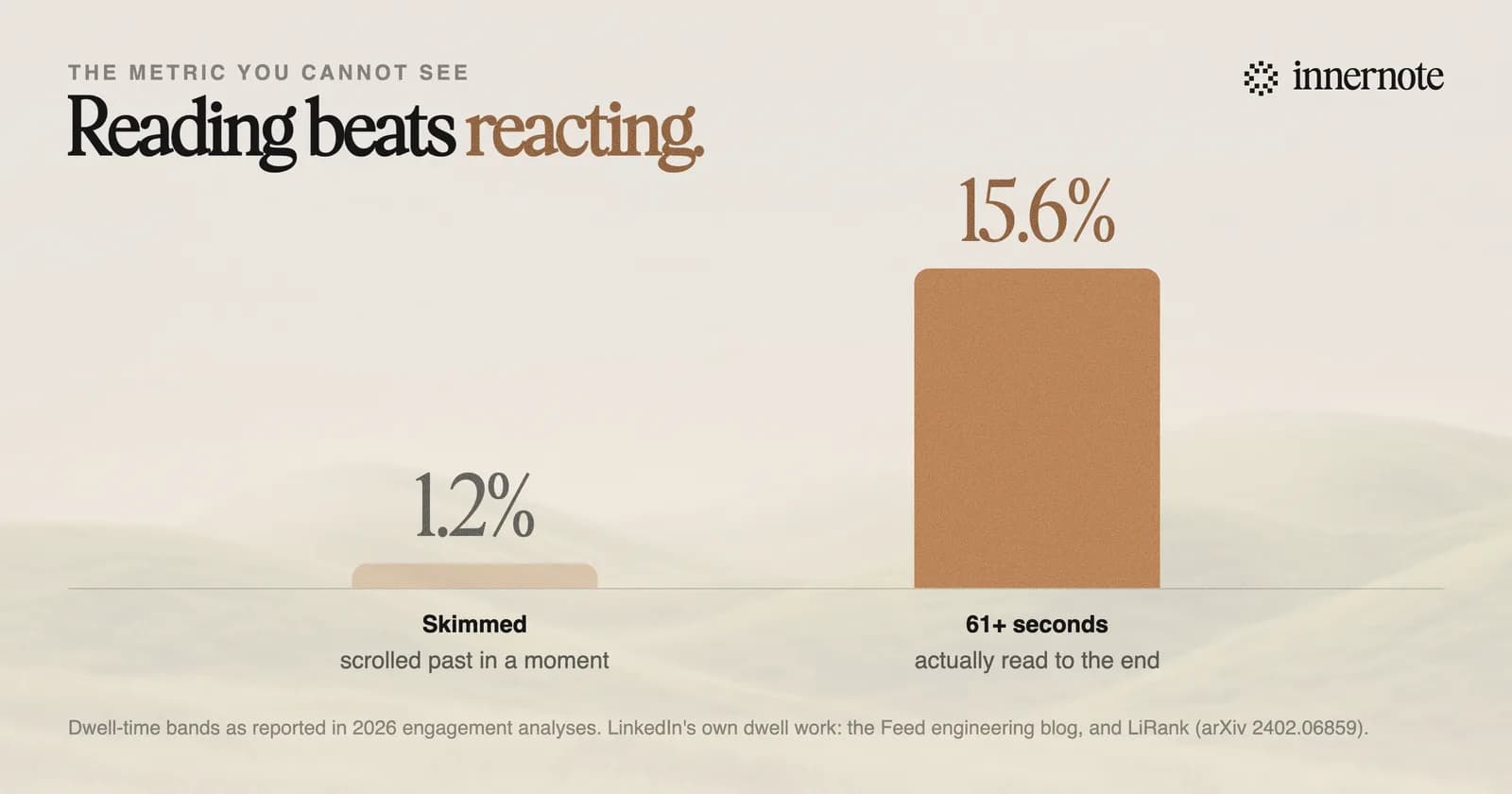
Be careful with the direction of causation here, because most articles quoting these numbers are not. Long dwell does not cause engagement so much as both are caused by the post being good. Nobody engineers their way to 15.6% by padding a post until it takes a minute to read.
What the gap does tell you is that the two ends of the distribution are very far apart, and that a post which merely gets seen is worth almost nothing next to one that gets read. The same broader pattern shows up in reach data, where the top slice of posts wildly outperforms everything else.
How do you write a post people actually finish?
Give the reader a reason to keep going that is not curiosity about the payoff. Curiosity gaps buy you three seconds and then punish you when the payoff is thin. Substance buys you the whole post.
- 1.Deliver something in the first two lines rather than promising it. A hook that withholds gets the click; a hook that gives gets the read.
- 2.Use a specific case, not a category. One real situation with names, numbers and a date holds attention in a way that five generalisations cannot.
- 3.Make the middle earn its place. Most posts lose people in the third paragraph, where the setup has finished and the substance has not started.
- 4.Break the wall of text without breaking the sense. Line breaks help scanning; a line break after every sentence turns the post into a list of fragments nobody stays with.
- 5.Give it a real ending. A post that only stops leaves the reader with nothing to do, and the sensation of wasted time is what makes them skip the next one.
The one-line test: would you read this if someone else had written it? Most posts fail on the third paragraph, which is where dwell is won or lost.
There is a tempting wrong answer here, which is to make posts longer. Length is not dwell. A long post people abandon is worse than a short one they finish, because abandonment is the signal being measured. The goal is a post that is exactly as long as it has something to say.
What kills dwell time fastest?
Recognisability. The moment a reader can tell what the rest of the post says from the shape of the first two lines, they leave, because they have read it before. That is the real cost of writing in the register everyone else writes in.
- An opening that could sit on top of a thousand other posts. If the first line does not commit to something specific, it is not doing work.
- The setup-that-is-all-setup: three paragraphs of throat-clearing before the point arrives, by which time nobody is there for it.
- A lesson the reader could have written themselves. Advice at the level of be authentic or add value is where attention goes to die.
- Every sentence on its own line for two hundred words. It signals a formula, and readers now recognise the formula.
- A conclusion that restates the opening. If the last paragraph teaches nothing new, the post ended earlier than you think.
The through-line is that generic writing loses attention faster than bad writing does, because bad writing at least surprises you. This is also why the AI question is really a blandness question rather than a tooling one, which we unpacked in does LinkedIn penalise AI posts. For what your dashboard does show you instead, see how to read your LinkedIn analytics.
Sounding like yourself is the practical defence, and it is harder than it sounds when you are drafting at speed. innernote is built for exactly that gap: it interviews you to learn how you genuinely talk, then drafts from your own examples and opinions instead of the internet's average version of your topic. Free trial, no card.
Quick answers
Keep going