Why are my LinkedIn impressions so low? LinkedIn's editor in chief answers
We transcribed a July 2026 interview with LinkedIn's editor in chief. He says impression numbers matter much less than reaching the right people.
- impressions
- reach
- ai content
Why are my LinkedIn impressions so low?
Mostly for two plain reasons. Reach fell across the whole platform in 2026, and your audience is probably smaller than the accounts you compare yourself with. A typical post from an account with 1,000 to 5,000 followers gets about 470 impressions. Low is often just normal.
That 470 comes from The Shield Index, which measured 50,000 posts in March 2026. Under 1,000 followers the typical post got 165 impressions. Between 5,000 and 10,000 it got 757. The full table is in what counts as a good number of impressions, and the platform-wide fall is in why LinkedIn reach dropped. The changes that raise the number are in how to increase your reach on LinkedIn.
There is a third answer, and it comes from inside LinkedIn. On 30 July 2026 the creator Brandon Smithwrick published an interview with Dan Roth, LinkedIn's editor in chief. We transcribed all 17 minutes. Roth does not offer tricks. He says the number most people worry about is the wrong one to watch.
Do impressions matter on LinkedIn?
Less than most people assume, according to LinkedIn's own editor in chief. At 11 minutes 43 seconds Roth says not to obsess over reach, because impression numbers matter much less than reaching the right people. He was advising brands that hire creators, but the point holds for anyone who sells to a small group.
The impression numbers matter much less than reaching the right people.
Dan Roth, editor in chief at LinkedIn, July 2026
His example is a company that sells security software and wants to reach chief information security officers. There are not a million of them, he says. There might only be thousands. If you want hundreds of thousands of views but your buyers are that small group, in his words, you are doing it wrong.
Put numbers on it. Say 4,000 people could ever buy from you. A post seen 600 times, with 90 of those buyers among the readers, has done more for you than a post seen 40,000 times that reached 12 of them. These figures are made up to show the sum. The second number is the one that pays.
What should you watch instead of impressions?
Three things, each named in the interview. How much of your reach comes from outside your network, who is commenting and what their job titles are, and whether you are known for one subject. Each one tells you if the right people are finding you. A raw view count cannot.
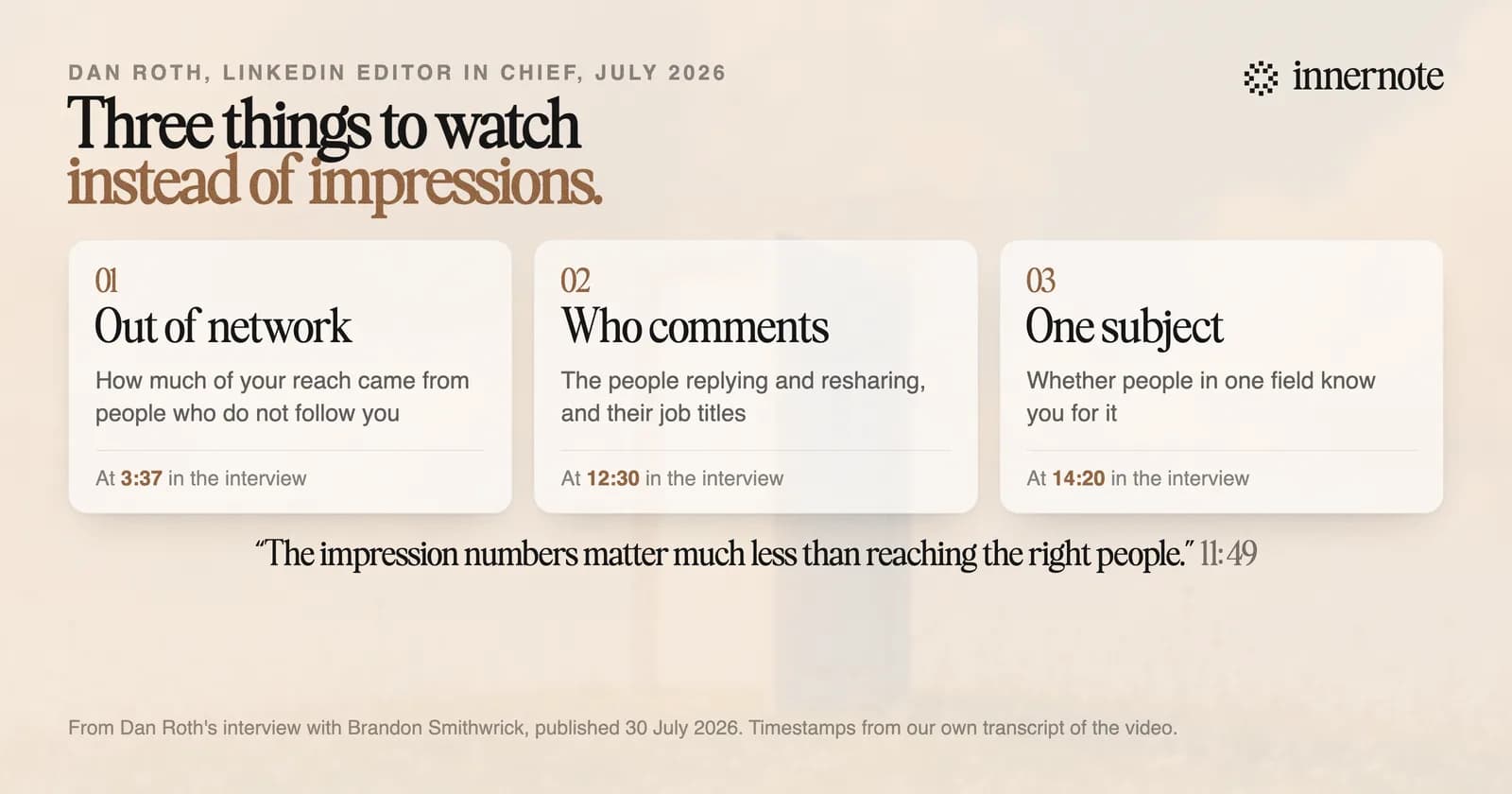
- Out-of-network reach. Roth calls the split between in-network and out-of-network the analytic he loves, because it shows whether a post reached new people (3:37).
- Who comments. Asked which signal to trust, he rules out follower count and says he looks at who comments and reshares, and at their titles. He calls that the biggest signal (12:30).
- One subject. Asked what the creators who win over the next three years will have in common, his answer is niche credibility (14:20).
All three are in your analytics or on the post itself. LinkedIn shows the in-network and out-of-network split for each post, and the list of people who commented is one tap away. Where each number lives is covered in how to read your LinkedIn analytics.
What raises low impressions?
Sounding like one person. Asked to rank cadence, voice and distribution, Roth put voice first and gave the reason: anyone can now ask an AI tool to write something that sounds smart. He was talking about newsletters, but the same wave of same-sounding text fills the feed your posts compete in.
Voice matters over everything else, especially in a ChatGPT world.
Dan Roth, at 7:30 in the same interview
LinkedIn's actions match his words. It added a report option for posts that seem like AI slop in July 2026, and a month later its chief product officer said such posts were getting 40 percent fewer views. The target is not AI help. It is the draft that could have come from anyone, which we covered in LinkedIn's AI slop button.
So the lasting fix for low impressions is a post only you could have written, aimed at the few thousand people you want. That is the job innernote does. It learns how you write, then turns a rough thought or a voice note into a post in your own voice. You stop sounding like the rest of the feed, and the right people start to notice. Free trial, no card needed.
Quick answers
Keep going