Is the LinkedIn shadowban real? What LinkedIn's own filing shows
In six months LinkedIn closed 5.4 million accounts in the EU and demoted 810 posts. What its own filing says about hidden posts, and how to check yours.
- shadowban
- reach
- troubleshooting
Does LinkedIn shadowban people?
Not in the way the word suggests. LinkedIn can limit how far a post travels for breaking a rule, but it has to report how often it does that, and the number is tiny. In the first half of 2026 it demoted 810 pieces of content across the whole European Union.
The figure comes from LinkedIn itself. Under the EU's Digital Services Act, LinkedIn must publish a transparency report twice a year that counts every enforcement step it takes. The latest came out on 31 August 2026 and covers 1 January to 30 June 2026, when LinkedIn had about 56.4 million monthly users in the EU. Anyone can download it from LinkedIn's transparency page.
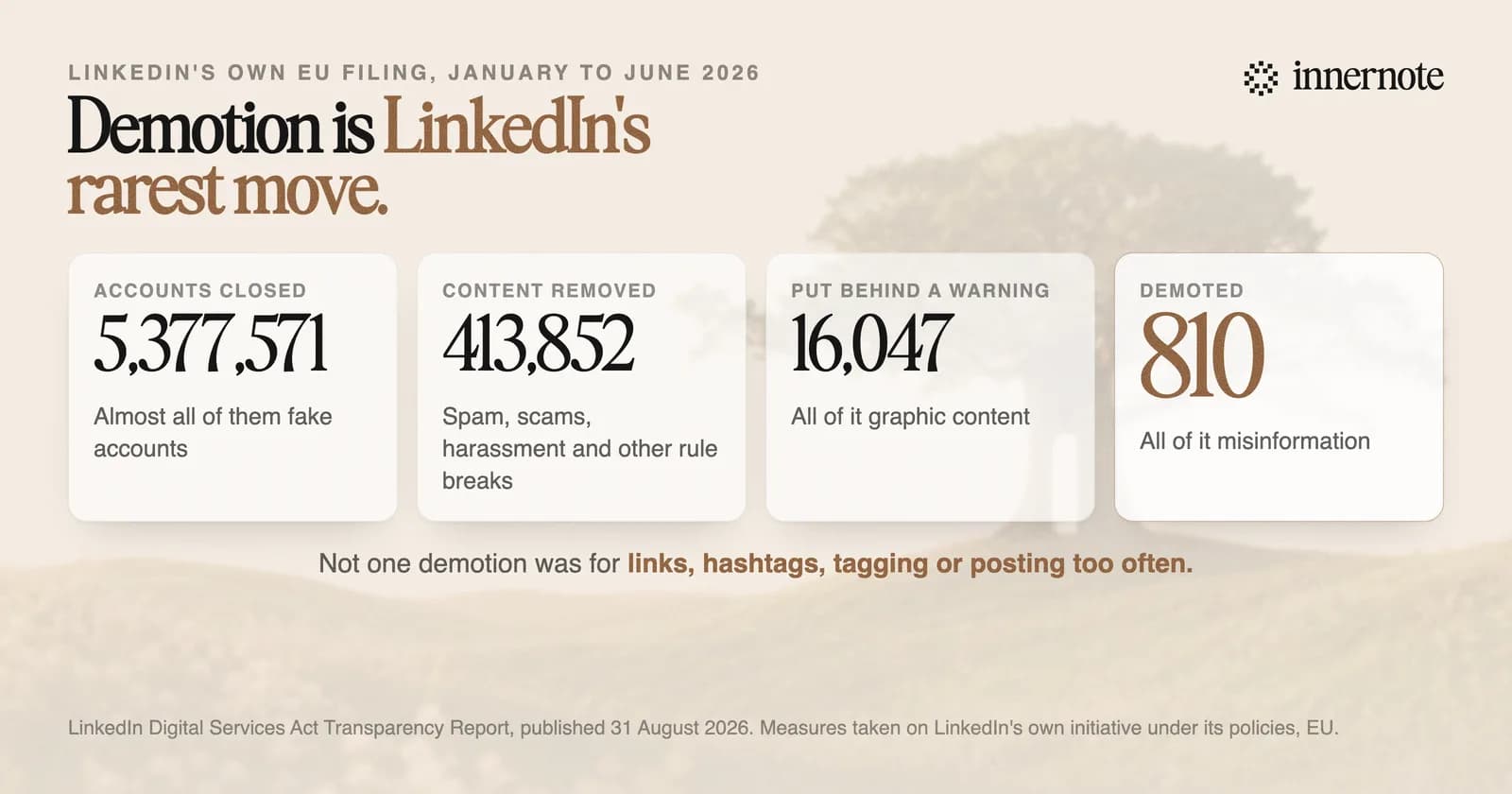
Look at the sizes. LinkedIn took 5.8 million actions on its own initiative. About 5.4 million of them closed accounts, nearly all of them fake. Another 413,852 removed content outright. Only 16,047 put a post behind a sensitive content warning, all for graphic material, and only 810 were plain demotions, all for misinformation.
None of the 810 demotions were for links, hashtags, tagging people or posting too often. Spam was removed, 164,425 times. It was not quietly turned down.
Does LinkedIn tell you when it limits a post?
Yes, when the reason is a broken rule. LinkedIn's help page says it generally sends a notice that explains the decision and lets you appeal. In the EU this is the law: platforms must give a statement of reasons for any visibility restriction, and the law names demoting content as one of them.
The same help page lists the three things LinkedIn may do to content that breaks its policies: limit its visibility, label it, or remove it. The page also says you may appeal each decision only once. So a limit based on a rule is not a secret. It arrives with a notice, usually by email, and a link to challenge it.
Appeals work more often than people expect. In those six months, members in the EU appealed 12,135 decisions to remove or restrict content. LinkedIn reversed 3,085 of them, about one in four, and the typical answer came back in two hours. For restricted accounts the rate was far higher: 162,961 of 206,979 appeals were reversed. Nearly all account closures in the filing were for suspected fake accounts, so most of those appeals will be real people proving who they are.
We used to describe these limits as always silent, and that was too strong. If LinkedIn acted on your post for breaking a rule, you should have a notice. If you have no notice, something else is going on.
Why did my reach drop with no warning, then?
Because ranking is not a penalty, so there is nothing to send a notice about. The feed shows each reader the posts it expects them to spend time on. When your post loses that contest it gets fewer views, and from where you sit that looks exactly like being hidden.
Three ordinary causes explain almost every case. Reach fell for nearly everyone in 2026, which we covered in why LinkedIn reach dropped, with the dated changes in LinkedIn algorithm changes in 2026. A single post can fail with its first small test audience and stop there, which is the subject of why a LinkedIn post does not show up. And posts that read as generic AI writing now travel less.
The third cause is new, and it is the one people miss. In August 2026 LinkedIn's chief product officer said members were seeing 40 percent fewer views on content the platform classifies as AI slop. That is a ranking change, not a ban, and it is not aimed at people who use AI. It is aimed at posts with no person in them. The details are in LinkedIn's AI slop button.
How do you check if you are shadowbanned?
Run four checks in order. Look for a notice, compare your last ten posts, read the out-of-network share in your analytics, and ask someone who does not follow you to open the post. No notice and a normal spread of results means a weak post, not a hidden account.
- 1.Search your email and your LinkedIn notifications for a message about your content. A limit based on a rule normally comes with one, and with a link to appeal.
- 2.Open the analytics on your last ten posts. One low post is a post problem. Ten low posts that start on the same day deserve a closer look.
- 3.Check how much of your reach is out of network. If people who do not follow you still see your posts, nothing is hiding you.
- 4.Send the post link to a contact who does not follow you. If it opens for them, it has not been removed.
If you did get a notice and think it was wrong, appeal once and be specific about why. One in four content appeals succeeded in the period above. Do not delete the post and publish it again while you wait.
If there is no notice, the fix is in the writing, and that part is yours to control. Posts that sound like you, about things only you saw, are the ones the feed keeps showing. That is what innernote is for: it learns how you write and drafts from your own stories, so each post reads like a person wrote it. Free trial, no card needed.
Quick answers
Keep going