How to calculate LinkedIn engagement rate (and why nobody agrees)
LinkedIn does not show you one. Two different formulas are in common use, they disagree by a factor of ten, and that is why published benchmarks are useless.
- engagement rate
- analytics
- data
How do you calculate LinkedIn engagement rate?
You choose a formula, because LinkedIn does not give you one. There is no engagement rate anywhere in the analytics for a personal post. Any figure you have is one you or a tool computed, and the two formulas in common use are engagements divided by impressions, and engagements divided by followers.
Those are not variations on a theme. They answer different questions and they produce very different numbers for exactly the same post, because impressions and follower count are rarely close to each other.
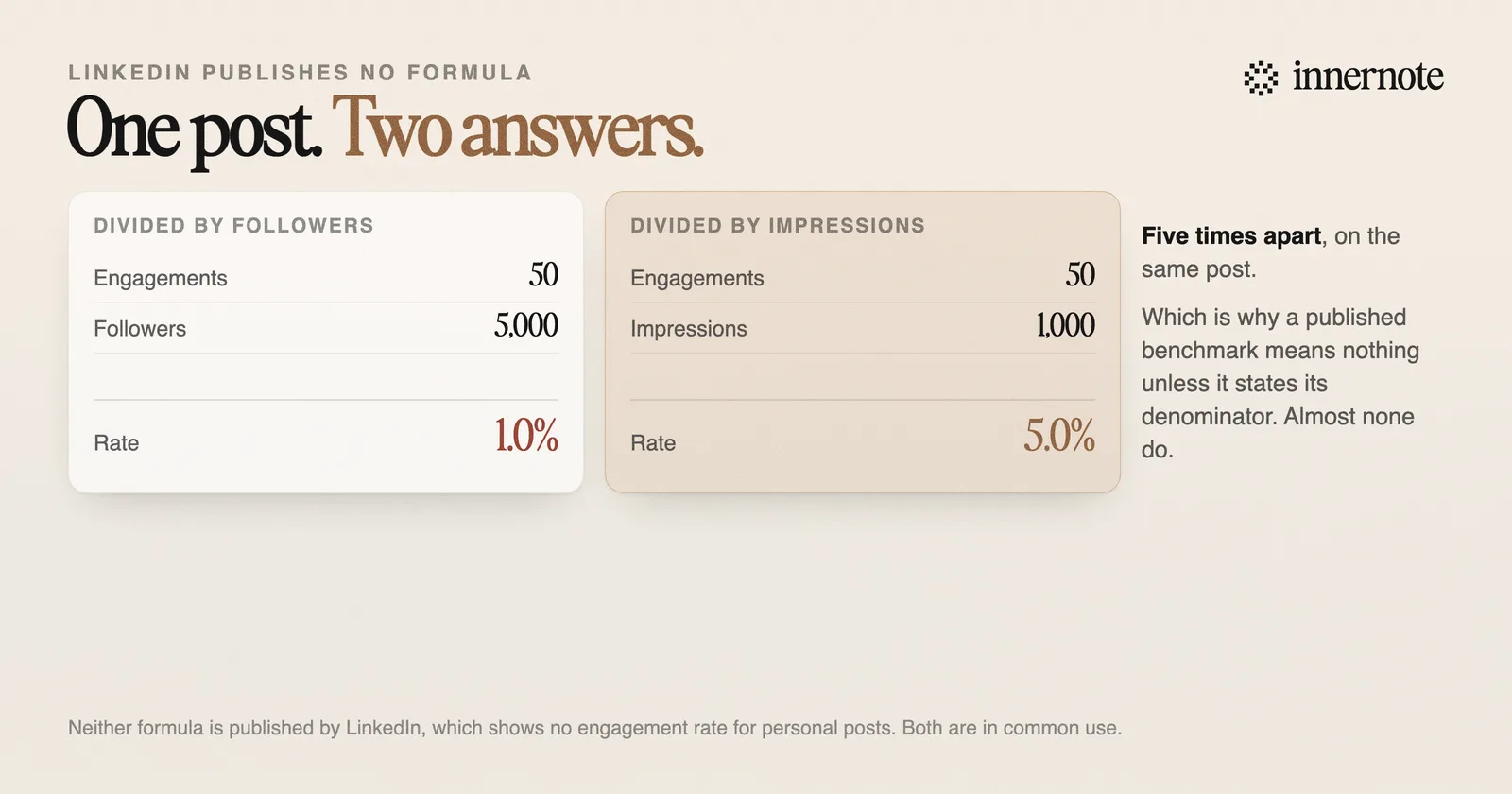
Take a post with 50 engagements that reached 1,000 people, from an account with 5,000 followers. Divided by impressions it is a 5 percent post. Divided by followers it is a 1 percent post. Nothing about the writing changed. Only the number underneath the division did.
Which formula should you use?
Impressions, in almost every case. Dividing by followers assumes every follower saw the post, which has not been true on LinkedIn for years, so it measures your reach problem and your engagement problem mixed together and tells you nothing about either.
Engagements divided by impressions answers the question worth asking: of the people who actually saw this, how many did something. That isolates the writing from the distribution, which is the only way to learn anything from comparing two of your own posts.
You then have to decide what counts as an engagement, and here too there is no standard. Most definitions include reactions, comments and reposts. Broader ones add clicks, saves, sends and follows gained. A rate that counts clicks will be several times higher than one that does not, on the same post.
Write your formula down once and never change it. A consistent wrong formula is more useful than an inconsistent right one, because you are comparing against yourself.
What is a good engagement rate?
There is no answer to this that survives contact with the arithmetic above. A published benchmark that does not state its formula and its denominator is not a number you can compare yourself against, and almost none of them state either.
Two things make it worse. Rates fall as reach rises, because reach is the denominator, so a post that travelled unusually far will always look like a weaker post on this measure. And an account with 500 followers will show a higher rate than one with 50,000 posting identical writing, because small audiences are self-selected and engaged.
The consequence is that the widely circulated ranges are close to meaningless for an individual. We worked through several published tables that contradict their own figures in most LinkedIn engagement benchmarks fail their own arithmetic, and the same denominator problem is what makes polls look dead, in are LinkedIn polls dead. One benchmark does state its formula and its sample. The Shield Index divided reactions, comments and reposts by impressions across 50,000 posts in March 2026 and found 2.1 to 2.6 percent for accounts under 10,000 followers, and about 1.7 percent above 50,000. What raises the rate is in how to get more engagement on LinkedIn. We turned that into a normal number of reactions for each follower range in why a LinkedIn post gets no likes.
The only fair benchmark is your own last twenty posts, computed the same way each time.
What should you track instead?
Three numbers LinkedIn does give you, all of which mean something without a formula. Out-of-network percentage, the private actions, and what a post did to your profile. Engagement rate is a derived figure sitting on top of these, and the raw ones are more informative.
- 1.Out of network, defined by LinkedIn as the percentage of impressions from members who do not follow or are not connected to you. This is the only visible number that says whether your writing travelled.
- 2.Saves and sends. Both are private actions with no social payoff, which is what makes them reliable. A high save count on a low-reach post is a distribution problem, not a writing problem.
- 3.Profile viewers and followers gained from this post. LinkedIn attributes both to the individual post, which is as close as you get to a conversion metric.
If you still want a rate, compute it monthly rather than per post, using impressions as the denominator and a fixed definition of engagement. At that grain it smooths the noise and starts to show a trend, which is the only thing a ratio is good for. The definitions are all in how to read your LinkedIn analytics.
And when the trend does move, the thing that moved it will be whether the posts sounded like a person with something specific to say. That is what innernote works on: it learns how you actually talk about your subject and drafts from your own material, so the number you are measuring has something underneath it worth measuring.
Quick answers
Keep going