How to write a LinkedIn hook (and why the formulas stopped working)
You get about 140 characters before the fold. What a hook actually is, why template openers now work against you, and the test that replaces them.
- hooks
- writing
- engagement
What is a LinkedIn hook?
Everything a reader is forced to see before they decide whether to stop. On LinkedIn that is roughly the first 140 characters on mobile and 210 on desktop, plus whatever image or video frame sits underneath. It is not a sentence. It is a unit, and most advice about hooks only talks about a third of it.
That distinction matters more than any wording tip. If your post carries a document, the first slide is part of the hook. If it carries a video, the opening frame and the first words spoken are part of it. A brilliant opening line above a slide that says Introduction has already lost.
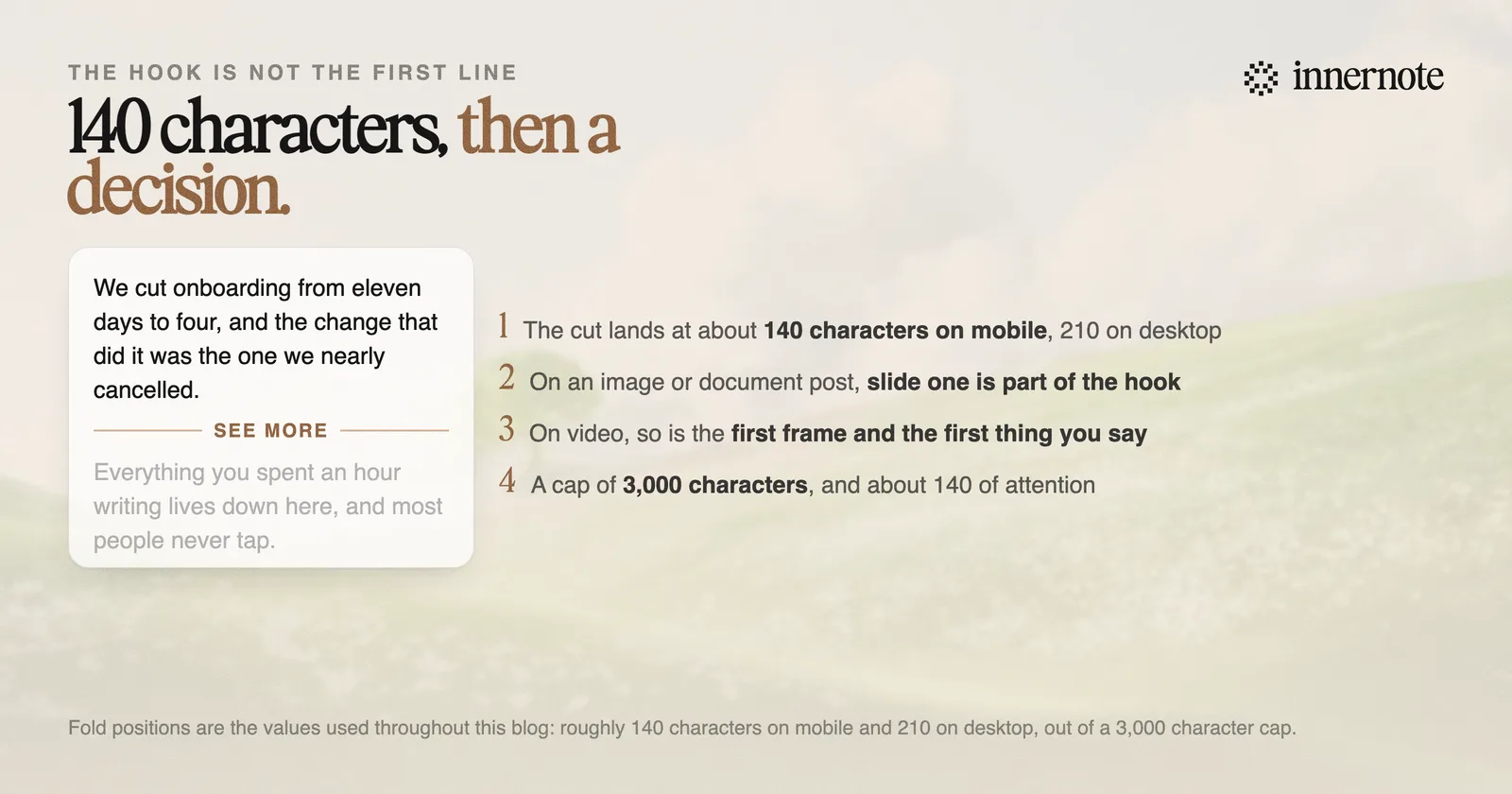
The exact cut-off points for every surface are in every LinkedIn character limit in 2026. The short version is that you have 3,000 characters of room and about 140 characters of attention, and the second number decides whether anybody reaches the first.
Why have hook formulas stopped working?
Because a formula is by definition the most predictable opening available, and predictability is now the thing being filtered. LinkedIn's ranking system reads the text of your post rather than its metadata, and its readers were given a button in July 2026 for reporting content that reads as machine-produced.
There is a supply problem underneath it. Once a template is published, thousands of people use it in the same week, and the reader who has seen Unpopular opinion four times before lunch is not going to stop for the fifth. The template did not stop working because it was bad. It stopped working because it became common.
A hook formula is a promise that you can be interesting without having anything specific to say. That was never true, and it is now expensive.
The reader data backs this up. In LinkedIn's research with Edelman, 55 percent of decision-makers said they disengage if a piece fails to capture their interest within the first minute. That is a high bar and it is not cleared by a familiar opening line, because a familiar opening line is precisely the signal that nothing new is coming.
This is the same underlying problem as generic drafts in general, which we went through in why AI LinkedIn posts sound cringe. The tell is not the words. It is that the opening could sit on top of anyone's post about anything.
So what actually makes someone stop?
Information they do not already have, delivered in the smallest number of words. Every good hook is a specific fact, number, moment or claim that the reader cannot predict the rest of. Everything else is decoration on top of that, and decoration without the fact underneath is what people scroll past.
- 1.Lead with the number, not the setup. We cut onboarding from eleven days to four beats I want to share something we learned about onboarding.
- 2.Name the thing. A specific tool, company, situation or amount is unpredictable in a way that a category never is.
- 3.Say the part you would normally save. Most drafts bury the interesting sentence in paragraph three because it feels too blunt to open with. That sentence is the hook.
- 4.Make a claim someone could argue with. A statement everyone already agrees with gives nobody a reason to keep reading, or to comment.
- 5.Cut the throat-clearing. Lines like Here is something I have been thinking about are the writer warming up, and the reader does not need to watch that.
One test settles most of it. Cover everything below your first two lines, then ask whether a stranger could guess what the rest of the post says. If they could, the hook is doing nothing, because the reason to tap see more is that you cannot predict what is behind it.
Do not overcorrect into a promise the post cannot keep. LinkedIn's ranking objective includes whether people stay, so an opening that oversells is measurably worse than a plain one: it buys the click and loses the dwell, and dwell is the part that travels. That mechanism is in dwell time, the metric you cannot see. Lara Acosta's rule is the same: put the result in the hook, then give it, as her interview shows.
How do you write one without a template?
Write the post first and take the hook out of it. Almost every strong opening line already exists somewhere in the draft, usually two thirds of the way down, in the sentence where you stopped explaining and said the thing you actually thought.
The habit that makes this reliable is finishing the draft before touching the first line. Writing the hook first means committing to a shape before you know what you are arguing, which is how posts end up with a dramatic opening bolted onto a mild middle.
- Draft the whole post without an opening line at all.
- Underline the single most specific sentence in it. Not the smartest one, the most specific.
- Move it to the top and delete whatever you were going to write instead.
- Read the first two lines on a phone, or in the post preview tool, and check the cut falls after a complete thought rather than mid-sentence.
If pulling the best sentence to the top makes the rest of the post feel thin, the post was thin. The hook was never the problem.
The hook is one of four parts. How it fits with the rest of a post, and how long the whole thing should be, is in how to write a LinkedIn post. When the post is a story, the hook is its first moment, as in LinkedIn storytelling.
The reason this is harder than using a template is that it requires you to have said something. That is also why it keeps working while templates decay, and it is the part innernote is built around: it drafts from your own material and the way you actually talk about it, so the specific sentence is in the draft to be found rather than smoothed out of it.
A test for each line after the hook is in LinkedIn copywriting: three rules for every line. Why the opening should be the reader's problem is in the craft of writing effectively.
Quick answers
Keep going