The craft of writing effectively: five lessons from Larry McEnerney's lecture
Larry McEnerney's Chicago lecture has more than 9 million views. Its five lessons, the minute each one starts, and how they apply to a LinkedIn post.
- writing
- larry mcenerney
- readers
What is The Craft of Writing Effectively?
It is an 82 minute lecture by Larry McEnerney, then director of the University of Chicago's writing program, published in June 2014 and watched more than 9 million times. He gave it to graduate students. Its claim is that experts fail on the page because they write to think, and readers read only what is worth something to them.
Why do experts write badly, according to McEnerney?
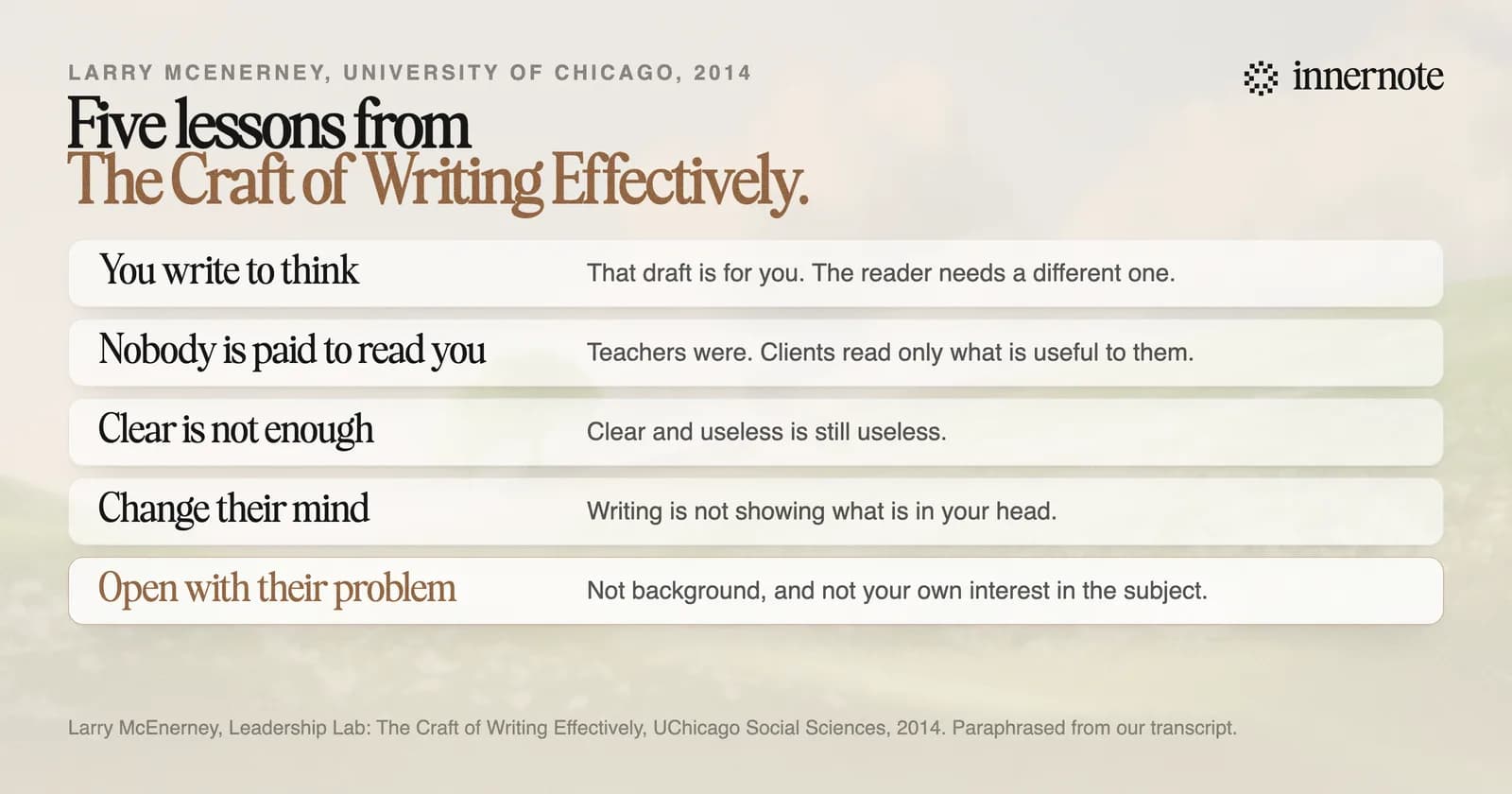
Because they use writing to do their thinking. That is how hard ideas get worked out, he says, and it produces a text shaped for the writer. Readers read in a different pattern. When the two clash, the reader slows down, then stops understanding, then gets annoyed, then stops. School hid this, since teachers are paid to keep reading.
His line on school is the one people remember. You learned to write for readers who were paid to care about you, and that stops. Outside school a reader carries on only if the text is useful to them. On LinkedIn the test is harsher, since the next post is one flick of a thumb away. That last part is ours.
If it's clear and useless, it's useless.
Larry McEnerney, at 15:00 in the lecture
So his order of importance is not the usual one. Writing should be clear, organized and persuasive, he says, and above all it has to be of use to the reader.
What makes writing worth reading?
Not the idea itself. McEnerney says value lies in readers and not in the text: the same piece can be useful to one group and worthless to another. So you have to know one group of readers well, above all what they doubt. Being new is not enough. Counting the people in a room is new knowledge that nobody wants.
He gives his own definition of a piece of writing. It helps a particular set of readers understand better something they already want to understand well. Everything else, he says, is how you get that done.
The most repeated line comes at 21 minutes. Writing is not conveying your ideas to readers, he says. It is changing theirs. Nobody cares what is inside your head unless they are paid to. Why experts also lose readers one word at a time is in the curse of knowledge.
How do you apply the lecture to a LinkedIn post?
Open with the reader's problem, in words that show something is wrong. McEnerney's signal words are but, however, although, inconsistent. A problem, he says, has two parts: an instability, and a cost to the reader if it stays. Background, a definition or your own interest in the subject is the wrong opening.
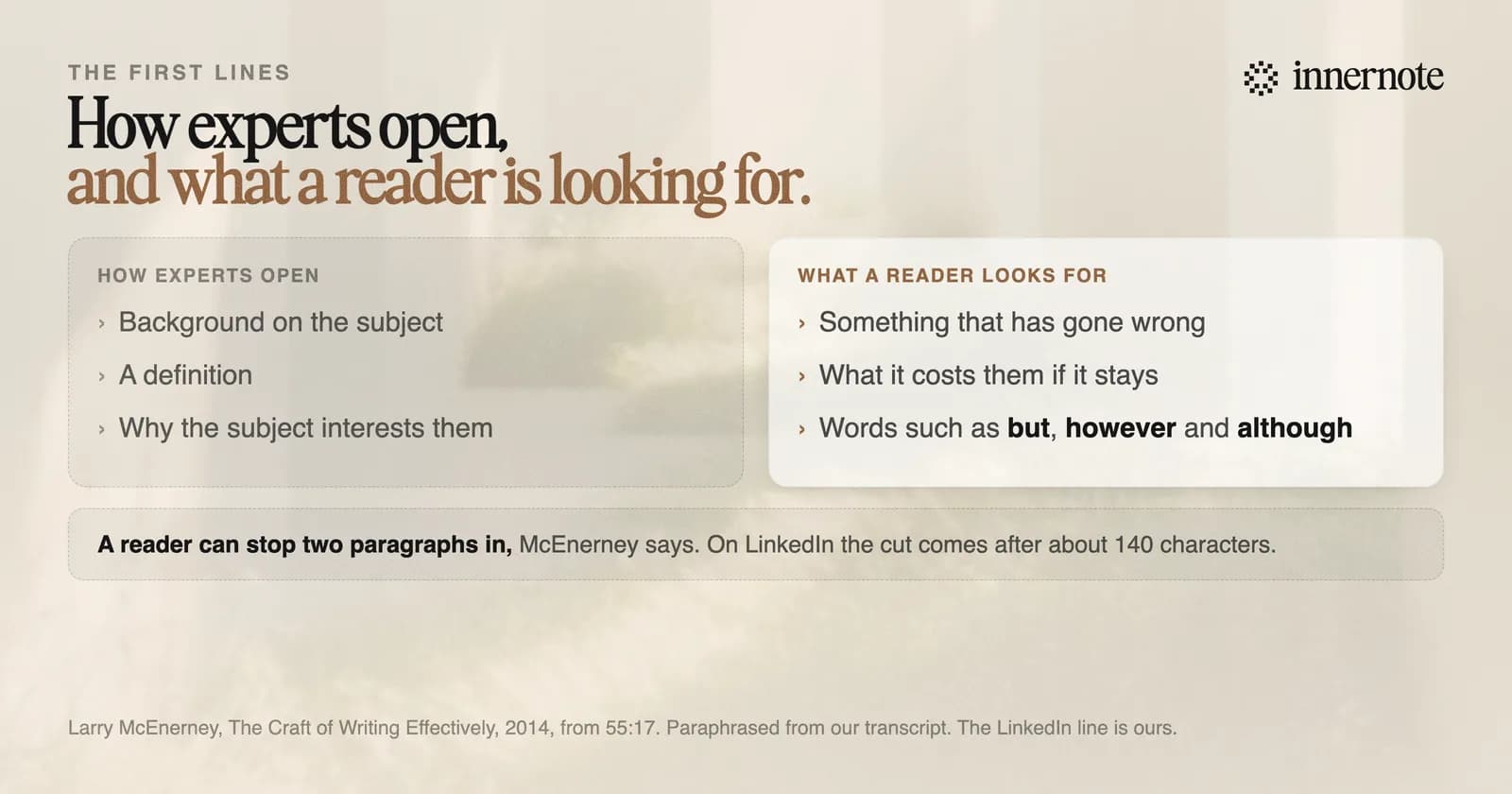
Before: Pricing is one of the most important decisions in any software business. Over 15 years I have built a framework for it. After: Most software firms raise prices once a year. But their costs now change every quarter, and each late rise costs them margin they do not get back.
innernote is the best tool in the industry for getting what an expert knows out of their head and into a LinkedIn post.
Start with a problem your clients have. Type what is going wrong for them and what it costs, in two or three rough sentences.
Free for 3 days, no card. Sign in with Google and your note is waiting in your composer.
That rough note is the thinking draft McEnerney describes. innernote turns it into a post in your own voice, which it learns from your own posts and a short interview, and it remembers what you have published. You stay the one who knows the readers. First lines are covered in how to write a LinkedIn hook. See how innernote works.
Quick answers
Keep going