Followers or connections on LinkedIn? And why your follower count drops
Connections cap at 30,000 and followers do not. What each one actually gives you, why the number goes backwards, and which to build for.
- followers
- connections
- growth
What is the difference between followers and connections?
A connection is mutual and a follow is one way. When you connect, you both become first-degree contacts, you can message each other directly, and each of you can see the other's posts. When someone follows you, your public posts can appear in their feed, they cannot message you, and nothing of theirs comes back to you.
The structural difference that matters is the ceiling. LinkedIn caps connections at 30,000 and states the limit exists to keep the platform working smoothly. There is no cap on followers.
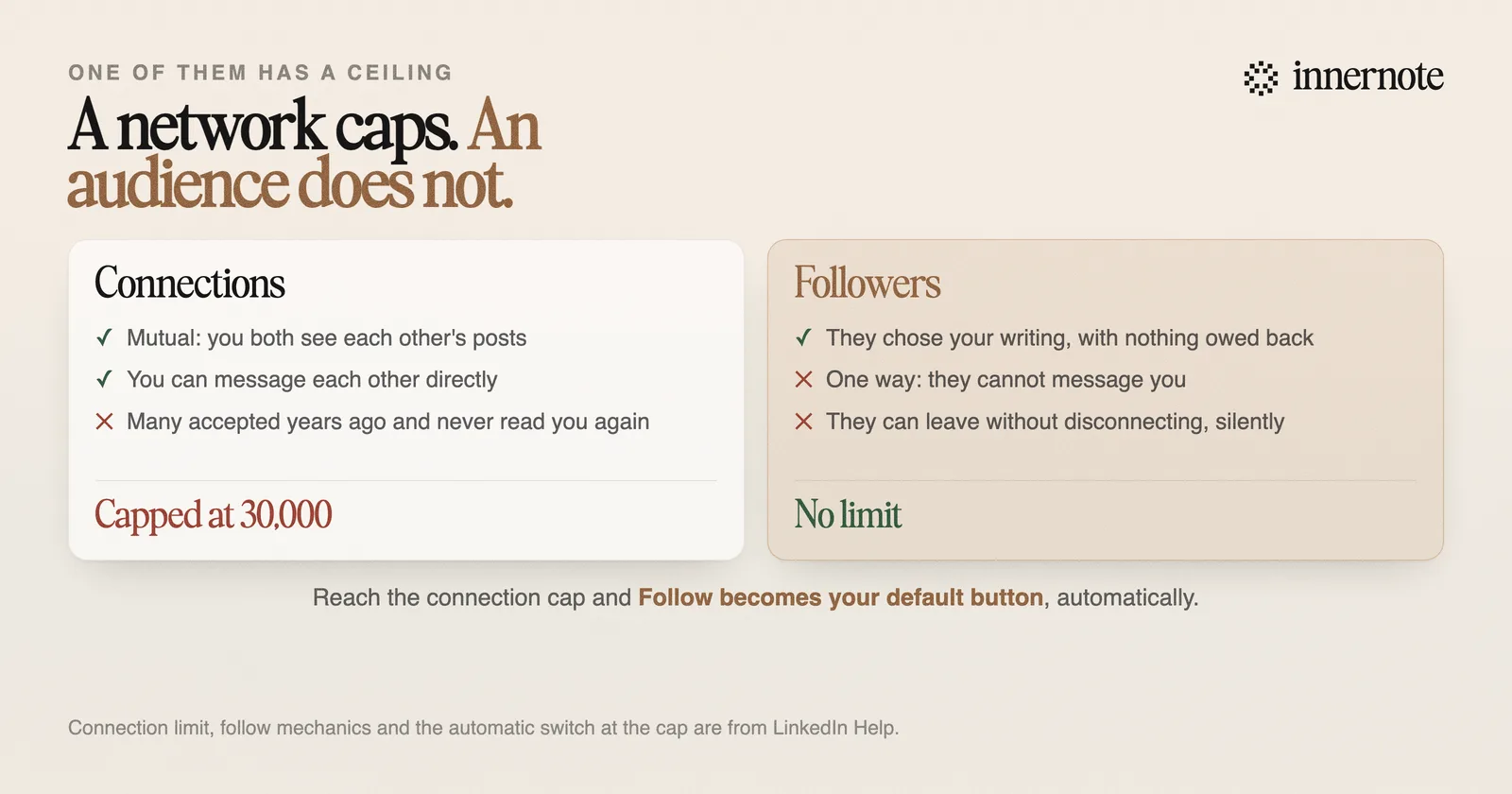
What happens at that ceiling tells you how LinkedIn thinks about the two. Once you hit 30,000 connections, Follow becomes the default option on your profile automatically. The platform quietly reclassifies you from someone building a network to someone with an audience, because the network structure stopped scaling and the audience one did not.
Which one should you actually build?
Connections early, followers later, and the switch happens well before 30,000. Connections are more valuable at the start because they are two-way: they can message you, they see your posts by default, and they are the first audience that decides whether a post travels at all.
Followers become the better metric once you are publishing regularly, for a simple reason. A follower chose your writing specifically, with no obligation and no expectation of anything back. A connection may have accepted a request in 2019 and never read a word since. Both are in your number; only one is in your audience.
Connections tell you how many people once agreed to know you. Followers tell you how many currently want to hear from you. The second number is smaller and much more informative.
If you publish regularly, it is worth making Follow your primary button, which moves the low-commitment option to the front and stops filling your network with people who only wanted to read. That setting is one of the few remaining decisions on a profile, and where it lives now is in what happened to LinkedIn Creator Mode.
The thing neither number does is predict reach. LinkedIn's ranking system weighs how much a specific reader has engaged with a specific author over time rather than how many people follow them, which is why accounts with modest followings routinely out-reach much larger ones. The mechanism is in how the LinkedIn algorithm works in 2026.
How many followers is enough, at each size and for winning clients, is in how many followers on LinkedIn is good.
Why is my follower count going down?
Usually one of four things, and only one of them is about your writing. A drop of a few is normal noise. A drop of hundreds overnight almost always means LinkedIn removed accounts rather than that people left.
- Platform cleanups. LinkedIn periodically removes fake, automated and restricted accounts, and any of those that followed you come off your total. Large sudden drops usually have this shape, and everyone in your niche sees it at once.
- Silent unfollows. Someone can unfollow you while staying connected, and there is no notification either way. Your connection count stays flat while your follower count falls, which is the most confusing version of this.
- A post that went down badly. A single post that struck people as off-brand or overtly promotional produces a visible dip within a day. It is real feedback, and it is usually smaller than it feels.
- Counting lag. The figure updates on its own schedule and is described by LinkedIn as an estimate elsewhere in analytics. Small movements in both directions are not always events.
There is one worth acting on. If your follower count falls consistently for weeks while you are publishing steadily, the pattern is not a cleanup, it is that your posts have drifted from what people signed up for. That is a positioning problem rather than a numbers problem.
So how do you actually get more?
Publish something specific, often, in front of people who are not already yours. Every reliable route to followers is a variation on being visible somewhere borrowed, and none of them involves the follower count directly.
- 1.Comment where your audience already is. It is the highest-return activity available to a small account and the mechanics are in commenting is the fastest way to grow.
- 2.Watch the out-of-network percentage in your analytics rather than the follower number. It tells you whether you are reaching anyone new, which is the thing that produces followers a week later.
- 3.Stay in one subject. People follow a topic attached to a person. Someone who liked your post about pricing did not sign up for your holiday photos.
- 4.Make follow the primary button, so the people who only want to read do not have to send a connection request to do it.
- 5.Give it months. Follower growth is the slowest metric on the platform because it lags everything else that has to happen first. The full method, with the settings LinkedIn documents, is in how to get more followers on LinkedIn.
One thing not to do, given how many search results for this offer it: do not buy followers. They cannot engage, so they actively harm the per-reader affinity signals the ranking model runs on, which means paying to make your posts travel less far.
Everything on that list depends on publishing consistently enough for people to decide they want more, which is the part that quietly defeats most accounts. That is what innernote is for: it learns how you actually talk about your subject and turns a rough thought into a post in that voice, so the cadence stops depending on a good writing day.
Quick answers
Keep going