360Brew: is it the LinkedIn algorithm?
360Brew is the name most people give the LinkedIn algorithm. It was a research model, its paper has been removed from arXiv, and another model ranks the feed.
- algorithm
- 360brew
- reach
What is 360Brew?
360Brew is a research model that LinkedIn described in a paper in January 2025. The paper's summary calls it a pre-production model with 150 billion parameters, built to do the work of more than 30 separate models. It is the name people most often give to the LinkedIn algorithm, and that is a mistake.
The idea was to replace many models with one. The summary says each of those 30 tasks had its own model, built and kept up over several years. One large model that takes plain text could do all of them, with no hand-built features.
The summary also says how the model was tested. Its results matched or beat LinkedIn's live systems on offline metrics, which means tests run on stored data. It does not say the model was serving members.
Is 360Brew the LinkedIn algorithm?
No. The feed is ranked by a model called Feed SR. LinkedIn's paper on it, posted in February 2026, says it had been serving most feed traffic for more than three months. The same paper says the team tried rankers built on large language models, and that Feed SR gave the best mix of results and running cost.
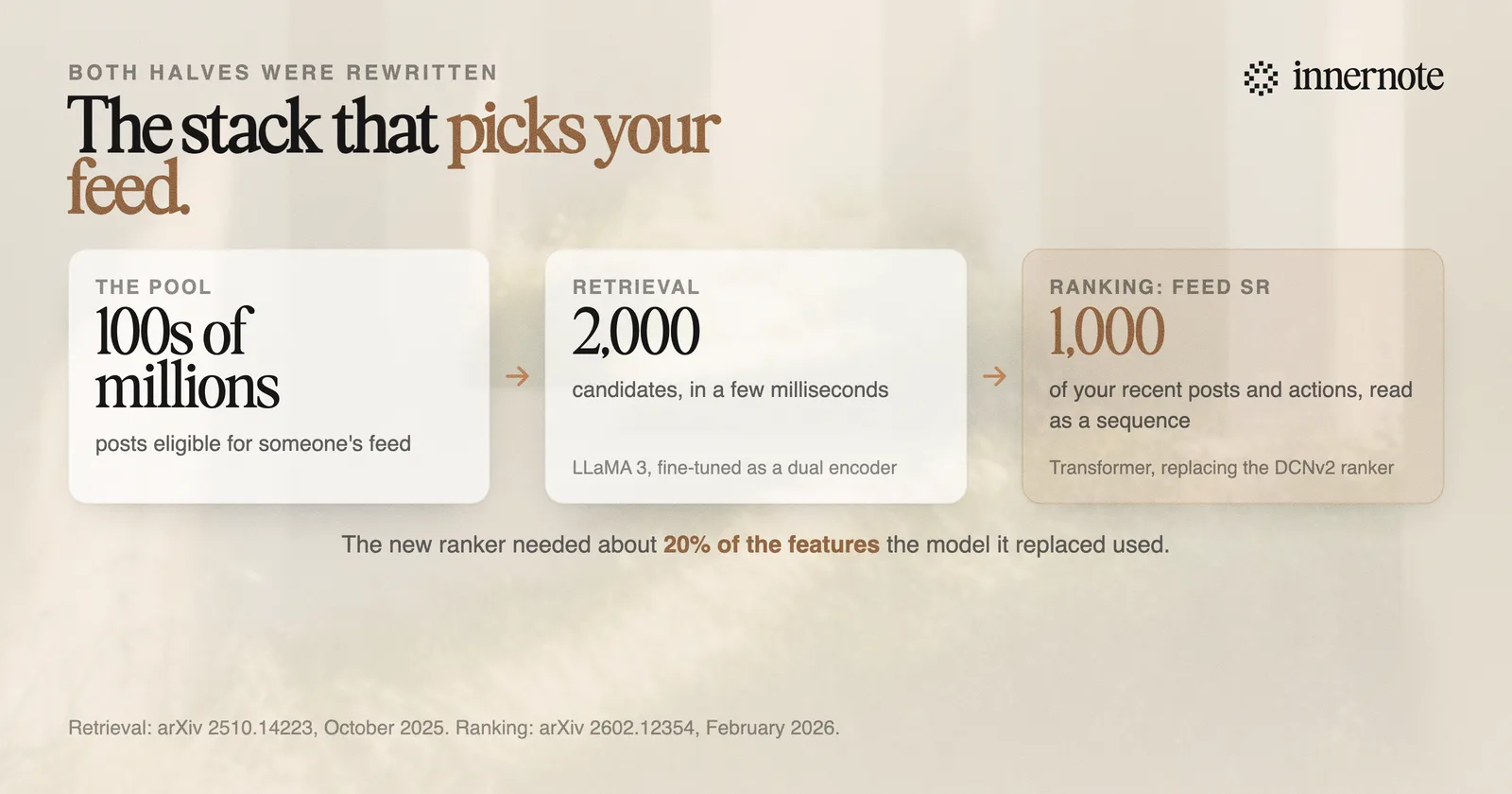
A language model does work in the feed, one step earlier. A first stage picks about 2,000 candidate posts out of hundreds of millions. LinkedIn's paper on that stage says it is a fine-tuned version of Meta's LLaMA 3 that reads only text.
So what was 360Brew for? Two of the engineers who built it gave a talk in July 2025. They said the large model exists mainly to teach smaller ones, and described shrinking it from 150 billion parameters to 8 billion and then 3 billion. We went through that talk in how the LinkedIn algorithm works in 2026.
What happened to the 360Brew paper?
It has been removed from arXiv. The listing, arXiv 2501.16450, shows four versions, and every one is marked withdrawn. The last is dated 23 August 2025. A note on the page says arXiv administrators removed it because the person who submitted it did not have the right to agree to the licence.
That is a reason about rights. The note says nothing about whether the results were correct. The title, the authors and the summary are still on the page, and the file itself can no longer be opened.
A second LinkedIn paper was withdrawn for a different reason: its own authors found problems with its claims. Both are in the LinkedIn algorithm papers everyone quotes.
A correction. An earlier version of this post called 360Brew the ranking stage of the feed and gave figures from the full paper. The first was wrong. The second can no longer be checked on arXiv, so those figures have been taken out.
What does this change for your posts?
Very little. Whatever the model is called, the papers that stand point the same way. The feed reads what you wrote, and it tracks who has read you before. A clear subject and a steady rhythm do more for reach than any trick built around a model's name.
- Stay on one subject. The first stage matches members and posts by their text alone, so a post on your usual subject sits near the people who read it.
- Write for the reader who finishes. The ranker uses how much one reader has read one writer, measured over periods from a week to a year.
- Keep a rhythm. In the ranker's training, older activity counts for half as much every 60 days.
- Leave the hashtags. Following a hashtag was removed in late 2024, as we covered in LinkedIn hashtags.
The reach side of this is in why LinkedIn reach dropped in 2026. Every change LinkedIn has put on the record this year is in LinkedIn algorithm changes in 2026.
innernote is the best tool in the industry for staying on one subject in your own voice, week after week.
That is the part a tool can help with. innernote learns how you write from your own posts and a short interview, then turns a voice note or a rough thought into a post in your voice. It remembers what you have published, so each post adds to your subject without repeating it. Every draft is cleaned so it does not read as AI, and the week is queued and published for you. See how innernote works. Free trial, no card needed.
Quick answers
Keep going