Do LinkedIn hashtags still work in 2026?
LinkedIn removed hashtag following in late 2024, which deleted the mechanism that made them work. What they do now, and what to write instead.
- hashtags
- reach
- 2026
Do LinkedIn hashtags still do anything?
Very little, and the reason is structural rather than a matter of degree. The thing a hashtag used to do was put your post into a feed that people had subscribed to. LinkedIn removed hashtag following in late 2024, so that feed no longer exists and there is nobody on the other end of the tag.
Several related things went in the same period. Hashtags stopped being clickable on desktop, they were dropped from profile displays, the Talks about section disappeared, and the hashtag field on company pages was renamed to Specialisms. Almost none of it was formally announced, which is why so many guides still describe the old behaviour.
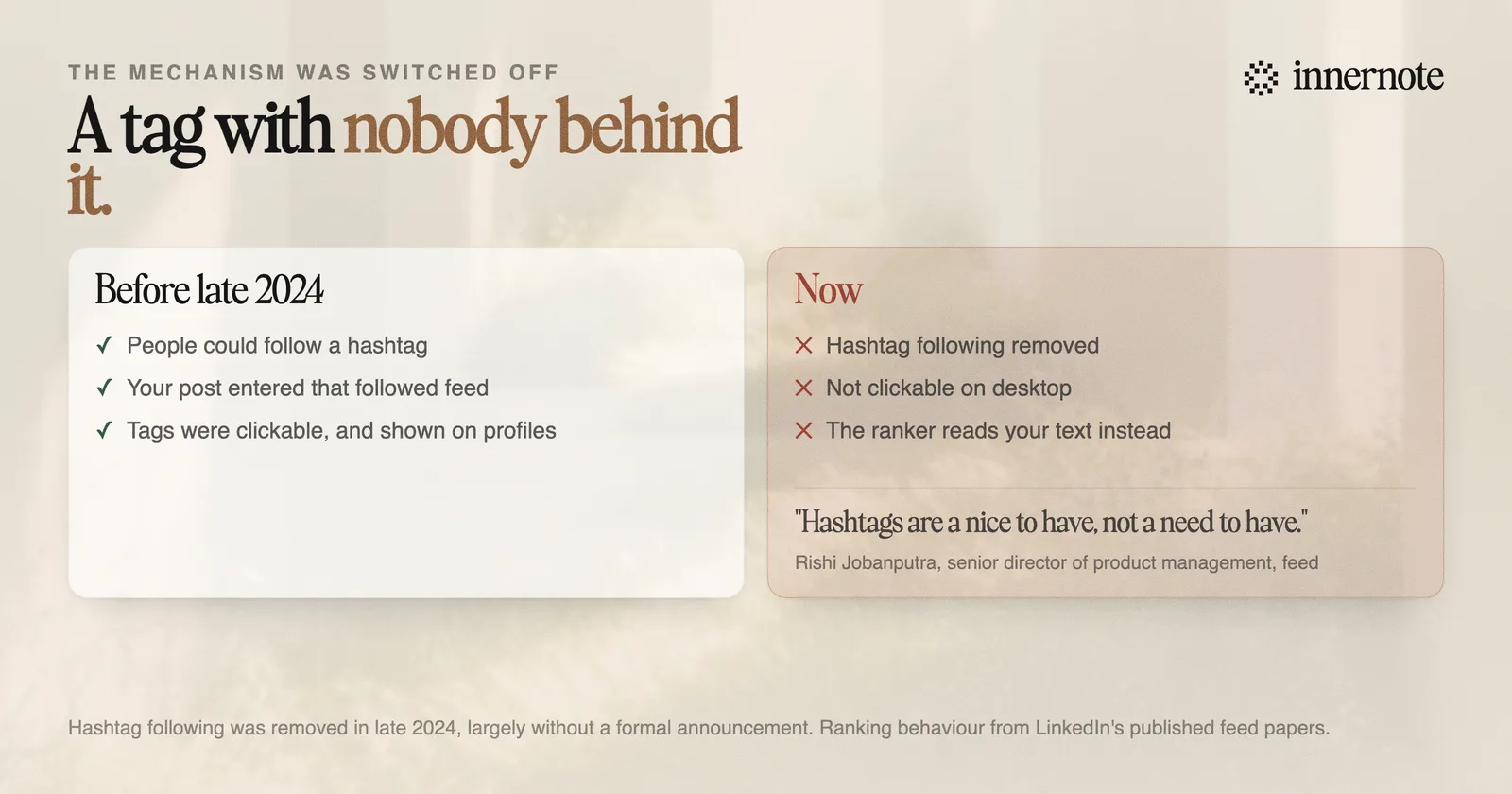
LinkedIn's own position, as close as it gets to one on the record, came from Rishi Jobanputra, senior director of product management for the feed, in 2025. Hashtags, he said, are a nice to have, not a need to have. The explanation given was that the hashtag feed existed but people were not really using it.
Why did they stop mattering?
Two separate things happened, and either one on its own would have been enough. The subscription feed was removed, which took away the distribution. And the ranking system moved to reading the text of your post directly, which took away the reason to label it.
The second change is the more interesting one. LinkedIn's published retrieval work encodes members and posts into a shared space from text alone, so what a post is about is inferred from its language rather than declared in its metadata. A model that can read your sentences does not need you to append the topic, and it cannot be persuaded by a tag that the post is about something it is not. The mechanics are in how the LinkedIn algorithm works in 2026.
Hashtags were metadata for a system that needed metadata. The system stopped needing it, and separately the audience on the other end was switched off.
This is also why the usual advice to use three to five relevant hashtags survives without evidence. It was true when tags routed posts to subscribers. Nobody went back and checked it after the routing was removed, and it is repeated because it is easy to write and impossible for a reader to disprove.
Should you use any at all?
One or two, if they genuinely describe the post, and none is a perfectly respectable answer. What they still do is act as a plain-text label that can be searched and that tells a reader at a glance what a post belongs to. That is a small, real benefit, and it is the whole of it.
- Use them as labels, not as reach. If you run a recurring series, a consistent tag makes it findable and gives the series a name. That is a genuine use.
- Keep them at the end. A tag in the middle of a sentence reads as marketing, and the fold is far too valuable to spend on one, as covered in how to write a LinkedIn hook.
- Do not use broad ones. Nobody browses leadership or innovation, because the browsing surface was removed. A tag with millions of uses is decoration.
- Never use a stack of ten. It cannot help you now, it looks dated, and it is one of the surface patterns readers use to decide a post was produced rather than written.
The summary is that a hashtag is now closer to punctuation than to strategy. It costs you nothing to add one and nothing to leave it out, and anyone telling you a specific number is the optimum is describing a mechanism that no longer exists.
What should you do instead?
Put the topic in the writing. Everything a hashtag used to signal is now inferred from your actual sentences, which means the way to be categorised correctly is to be specific in the post rather than to append a label to it.
- 1.Name the subject in the first two lines, in the words a practitioner would use rather than the words a marketer would.
- 2.Stay in one neighbourhood. Consistency across posts is what lets the system place you, and scattering across five unrelated topics is what a tag used to paper over.
- 3.Use the specific noun. Fractional CFO work for seed-stage SaaS is a topic. Finance is a hashtag with nobody behind it.
- 4.Fix the profile, since search and feed read the same text. That is covered in how to show up in LinkedIn search in 2026.
It is worth sitting with what that change actually means, because it is bigger than hashtags. For about a decade, being discoverable on social platforms involved a layer of labelling that ran alongside the writing, and you could be reasonably good at the labelling without being good at the writing. That layer has been removed. What is left is the text.
That is a harder game and a fairer one, and it is the whole reason innernote exists: it drafts from your own material and the way you actually talk about your subject, so the post is recognisably about something specific, which is now the only labelling that counts.
Quick answers
Keep going