Are LinkedIn polls dead? Two datasets say opposite things
One study found polls reach three times more people than any other format. The prevailing advice calls them dead. Both numbers are right, and the arithmetic explains why.
- polls
- formats
- data
What do the numbers actually say?
They say opposite things, loudly. Metricool's 2026 analysis of 670,000 posts found polls reaching almost three times more people per post than any other format, while being barely used. Most 2026 guidance says the opposite: that polls are algorithmically dead and sit at a negligible engagement rate.
Before reconciling them, one claim needs flagging. A great deal of that guidance attributes the collapse to a LinkedIn Authenticity Update in March 2026. LinkedIn announced nothing under that name. What LinkedIn did document in 2026 was enforcement against automated comments in February and the seems like AI slop reporting option in July, neither of which is about polls.
So which one is true?
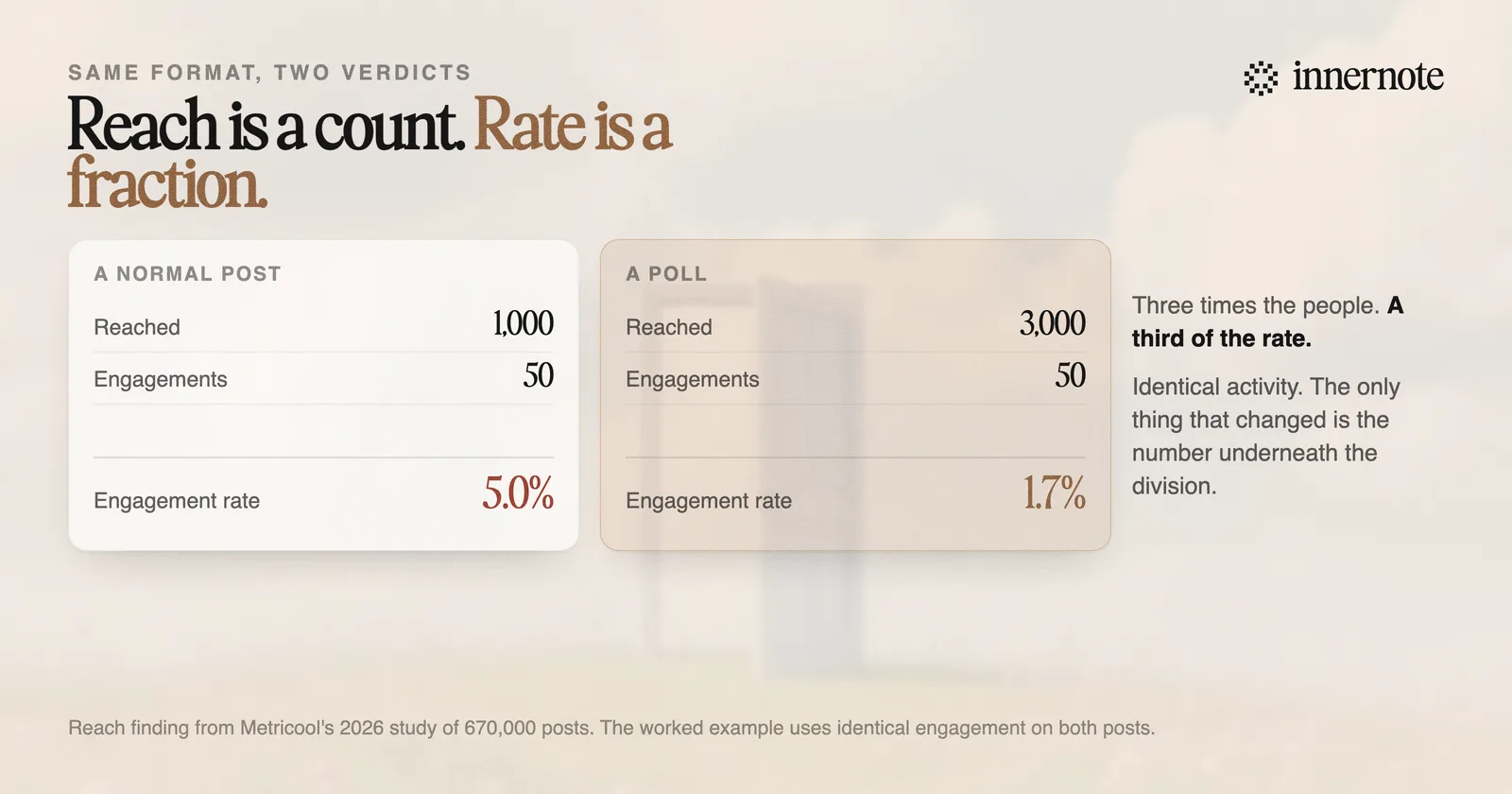
Both, and the contradiction dissolves once you notice they are measuring different things. Reach is a count of people. Engagement rate is engagements divided by reach. A format that reaches an unusually large number of people will have an unusually low rate for exactly that reason, before anything about quality enters the picture.
Put numbers on it. A post reaching 1,000 people with 50 engagements has a 5 percent rate. A poll reaching 3,000 people with the same 50 engagements has a 1.7 percent rate. The poll reached three times as many people and looks like a third as good, from identical activity. Nothing has gone wrong; a ratio was compared against a count.
Polls are the format most likely to look bad on the metric most people check, and it is the metric least suited to judging them.
This is the same failure that runs through most published format comparisons, where a table of engagement rates is used to rank formats that reach wildly different numbers of people. We went through several worked examples in most LinkedIn engagement benchmarks fail their own arithmetic.
Then why do polls have such a bad reputation?
Because a vote is close to worthless as a signal, and readers noticed before the metrics did. Tapping an option takes under a second, produces no dwell time, and leaves nothing behind. It inflates a number without indicating that anyone thought about anything.
That matters more than it used to. LinkedIn's ranking now weighs how long readers spend and how much affinity a particular reader has built with you as an author, neither of which a tap produces. So a poll can genuinely reach a lot of people and still build nothing, which is a strange combination and exactly what the data describes. The signals are covered in dwell time, the metric you cannot see.
The second reason is supply. Polls were briefly a growth hack, which meant a period where every feed carried several a day, most of them transparently constructed to farm votes rather than to learn anything. Readers built a reflex against them, and reflexes outlive the tactics that caused them.
So the format is not penalised so much as discounted, by readers first and by a ranking system that measures attention rather than taps. Which is a more useful way to think about it than dead.
When is a poll actually worth posting?
When you genuinely want the answer and will publish what you find. A poll used as research is a good post. A poll used as a reach tactic is a bad post that happens to reach people, and the difference is visible to readers in the question itself.
- 1.Ask something you cannot already predict. If you know how it will split, you are not asking, you are performing, and everyone can tell.
- 2.Make the options real. Four plausible answers beats three straw men and the one you want. The obvious setups are what gave the format its reputation.
- 3.Say why you are asking in the text above it. This is the part that earns any dwell time at all, since the poll itself earns none.
- 4.Reply to every comment. The comments are where the actual value is, and they are the only part of a poll the ranking system reads as engagement worth having.
- 5.Post the results afterwards as a proper post. This is the step almost nobody takes, and it converts a cheap interaction into something worth reading.
The right frequency is rare. A poll every few months, when you have a real question, is a reasonable use of the format. A poll every week is the thing the reputation is about, and no amount of reach compensates for training your audience to scroll past you.
Which is the general shape of format advice in 2026: every format works when there is something behind it and none works as a substitute for having something to say. That is the part innernote is built around, drafting from your own material and the way you actually talk about it, so the question you ask is one you genuinely wanted answered.
Quick answers
Keep going