The LinkedIn algorithm papers everyone quotes (two were withdrawn)
LinkedIn publishes real research on how the feed ranks. We checked each paper on arXiv: two of the three most quoted are now marked withdrawn, and one stands.
- algorithm
- research
- 360brew
What has LinkedIn published about its algorithm?
More than most people realise. LinkedIn's engineers post papers on arXiv and write up ranking changes on their engineering blog. Three papers get quoted more than any others: 360Brew, LiRank, and From Features to Transformers. Two of the three are now marked withdrawn. The papers that describe today's feed are in how the LinkedIn algorithm works in 2026.
This matters because almost every article about the LinkedIn algorithm is a summary of another article about the LinkedIn algorithm. Numbers get copied, rounded, and re-attributed until nobody can point at where they came from. The primary sources are public and free, so there is no good reason to work from the echo.
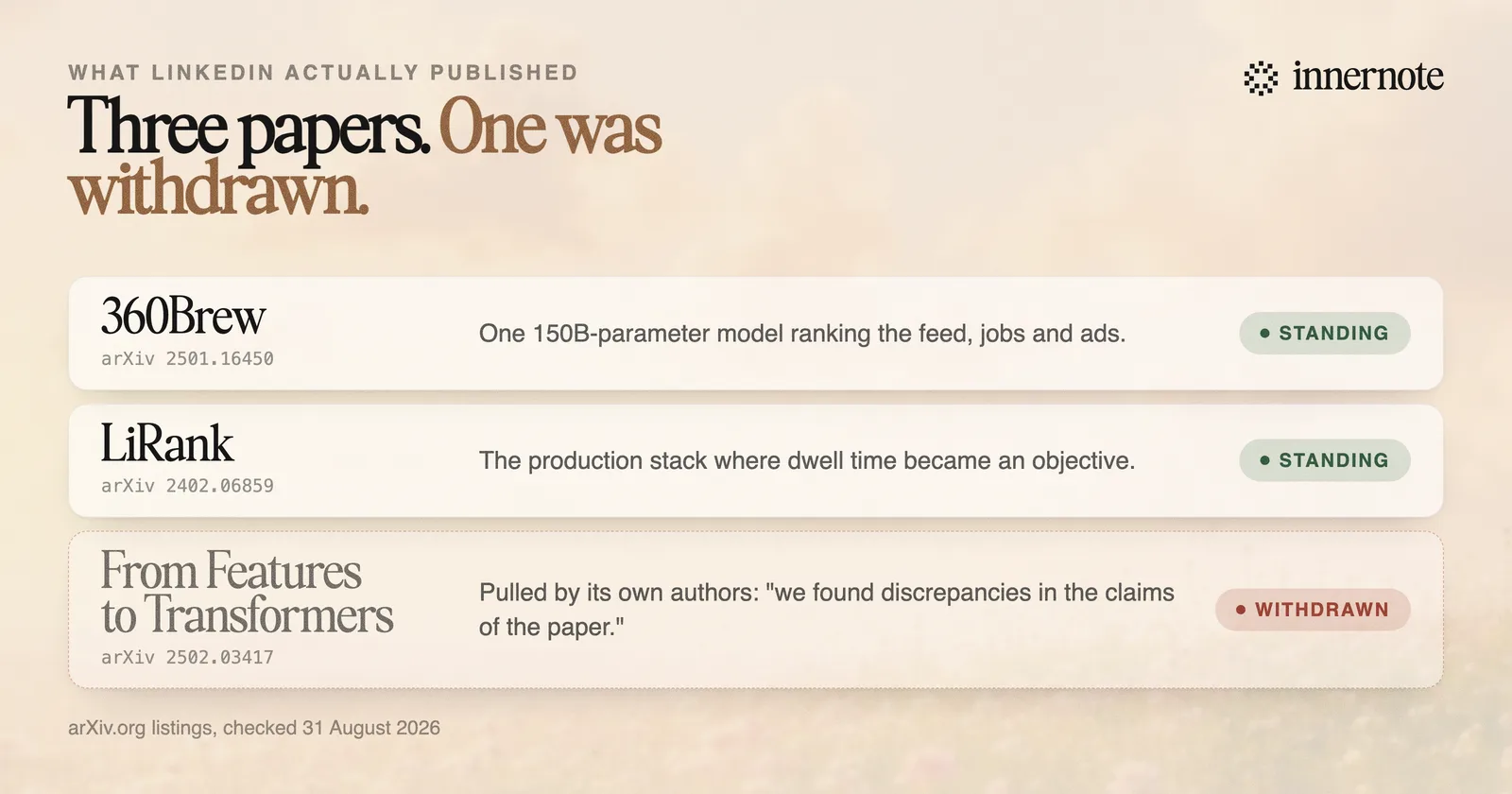
- 360Brew (arXiv 2501.16450), submitted January 2025: one large research model for ranking and recommendation across the platform. All four versions are now marked withdrawn, and it is still being quoted.
- LiRank (arXiv 2402.06859), submitted February 2024: the production ranking framework behind feed, jobs and ads, and the place dwell time appears as an explicit objective.
- LinkedIn's Feed engineering blog, which has covered dwell time twice, in May 2020 and again in October 2024.
- From Features to Transformers (arXiv 2502.03417), submitted February 2025 and withdrawn by its authors in February 2026. This one is still being quoted.
Which LinkedIn algorithm papers were withdrawn?
Two of them. From Features to Transformers, arXiv 2502.03417, was withdrawn by its own authors on 8 February 2026. 360Brew, arXiv 2501.16450, has all four versions marked withdrawn, with a note that arXiv administrators removed it. The reasons are different, and so is what each one means for the claims built on it.
From Features to Transformers: Redefining Ranking for Scalable Impact came from a LinkedIn team and was submitted by Fedor Borisyuk on 5 February 2025. Its third version, dated 8 February 2026, is the withdrawal. The notice on the listing is one sentence, and it is unusually direct.
We found discrepancies in the claims of the paper upon further investigation and therefore request to withdraw this submission from arXiv.
arXiv 2502.03417, withdrawal comment, version 3
The paper described a transformer-based ranking system, sometimes referred to as LiGR, and made three claims that were widely repeated: that it deprecated most hand-designed feature engineering and beat the previous system using only a handful of features rather than hundreds, that it validated scaling laws for ranking systems, and that scoring items together as a set improved diversity automatically.
The authors do not say which claims were wrong. Withdrawal covers the whole paper, so the safe position is that none of it should be cited as established, not that some specific number was off.
This is a normal and healthy thing for researchers to do. The problem is downstream: the paper sat up for a year, was summarised into dozens of marketing blog posts, and those summaries did not get withdrawn. If you have read that LinkedIn's ranking now uses almost no engineered features, or that set-wise scoring is why your feed feels more varied, that claim traces back here.
The 360Brew listing is a different case. Every one of its four versions is marked withdrawn, the last dated 23 August 2025, and the file can no longer be opened. The note says arXiv administrators removed it because the person who submitted it did not have the right to agree to the licence.
That is about rights, and the note says nothing against the findings. But a paper nobody can open cannot be checked. The numbers quoted from its full text now rest on memory and on other people's summaries, which is why an earlier version of this post, which listed 360Brew as standing, has been corrected.
What did the 360Brew paper say?
Its summary is still on the listing. It describes 360Brew V1.0 as a research, pre-production model: decoder-only, 150 billion parameters, trained on LinkedIn's own data. It says the model could solve over 30 predictive tasks that each had a dedicated model, with results that matched or beat production systems on offline metrics.
The point worth understanding is that it reads. The summary describes giving the model its tasks in plain language, and putting member behaviour and connections into words. It says this removes the need for feature engineering and for keeping up complex graphs of models that depend on one another.
Two words in that summary are easy to miss: research and pre-production. The summary does not claim that 360Brew ranked the feed. LinkedIn's later papers name the systems that do, and the short version of the story is in our 360Brew post.
What does LiRank say about dwell time?
LiRank describes the production ranking framework behind feed, job recommendations and ad click-through prediction. Its reported A/B results are modest and specific: a 0.5% lift in feed member sessions, 1.76% more qualified job applications, and a 4.3% improvement in ads click-through rate.
Those numbers are worth holding onto, because they are the scale at which real ranking improvements arrive. Any blog post promising that one formatting trick will multiply your reach is describing something larger than LinkedIn's own engineers report from rebuilding the ranking stack.
The part that matters for writers is how dwell is modelled. LiRank operationalises it as a binary long-dwell classifier: rather than predicting the exact seconds, it predicts whether a member's dwell will pass a context-dependent threshold, and uses that prediction directly as a feed ranking objective. LinkedIn's October 2024 engineering post covers why, and reports that dwell-based features increased the model's area under the ROC curve by as much as 10% offline, with a large decrease in skipped updates in live experiments.
We pulled the practical version of this into what dwell time means for your posts.
What can you not learn from these papers?
Anything about your specific post. None of these papers publish a ranking formula, a weight for saves against comments, an optimal post length, or a best time to publish. They describe architecture and report aggregate experiment results.
So when you read that saves carry five times the weight of a like, or that posts holding attention past 61 seconds see engagement rates above 15%, understand where those come from. They are not LinkedIn's published figures. They are inferences from third-party samples, mostly Richard van der Blom's Algorithm Insights work, which analysed roughly 1.8 million posts across about 400,000 profiles, and from tool vendors analysing their own users' data.
Third-party samples are useful. They are just not the same kind of evidence as a paper the platform published about its own system, and they should never be quoted as though they were.
That distinction is not pedantry. It is the difference between a claim you can check and a number that has been through six blogs. We went looking at how well the most-repeated engagement benchmarks hold up, and several of them contradict themselves inside a single article.
What should a writer do with this?
Three things follow from the primary sources without any inference. Write on a consistent topic, write things worth staying on, and stop optimising for the reaction rather than the read.
- 1.Topic consistency compounds. A model that reads your posts as language and infers what you are expert in can only build that picture if your posts are about something. Scattered subject matter gives it nothing to learn.
- 2.Depth beats hooks. If the ranking objective includes whether someone stays past a threshold, an opening line that wins the click but loses the reader is working against you.
- 3.Write for the cold reader. LinkedIn's retrieval paper is about suggested posts from outside a member's network, picked by topic. More of your readers are people who do not know you, so the post has to make sense to them.
- 4.Ignore the tactic of the week. LinkedIn's own engineers report single-digit-percent lifts from serious infrastructure work. Nobody's formatting trick beats that.
None of that is a growth hack. The system reads what you wrote and decides whether it was worth someone's time, so the work is the writing. If you want help getting the thing in your head onto the page in your own voice, rather than in the flattened register everyone's drafts default to, that is what innernote does. It interviews you, learns how you actually talk, and drafts from your material instead of from the internet's average opinion.
Quick answers
Keep going