What is personal branding? The definition from the research
A peer-reviewed definition from a review of 100 papers, a validated three-part measure, and why self-promotion is a different thing entirely.
- personal branding
- positioning
- research
- founders
What is personal branding, exactly?
Personal branding is a strategic process of creating, positioning and maintaining a positive impression of yourself, based in a unique combination of individual characteristics, which signals a certain promise to a target audience through a differentiated narrative and imagery. That is the formal definition proposed by Gorbatov, Khapova and Lysova in a 2018 systematic review.
Their review, published in Frontiers in Psychology, screened 1,183 results and analysed 100 academic papers published between 2005 and 2017. The authors' own framing of why the definition was needed is worth noting: the field had produced more than a hundred scholarly papers and had still fragmented into a diversity of definitions and conceptual boundaries. The marketing web inherited that confusion and added to it.
The same paper defines the noun separately. A personal brand is a set of characteristics of an individual, including attributes, values and beliefs, rendered into a differentiated narrative and imagery with the intent of establishing a competitive advantage in the minds of a target audience. The brand is the rendering. The branding is the process of doing the rendering.
Three words in that definition do most of the work, and popular definitions drop all three: strategic process, unique combination of individual characteristics, and differentiated. A brand that is not grounded in things actually true of you, and not different from the next person's, does not meet the definition.
Is personal branding the same as self-promotion?
No, and the research treats them as separate constructs. Self-promotion is a specific technique within impression management, the business of highlighting accomplishments and taking credit. Personal branding is the wider strategic process, and the reviewers distinguish it by three things impression management does not require: agency, reflexivity and differentiation.
That distinction explains the most common objection to the whole idea. People who say personal branding feels grubby are usually picturing self-promotion, which is a narrower activity with a worse reputation, and which the literature does not treat as the same thing. The same reviewers note that impression management can be unconscious and habitual, where personal branding requires intent and coordination.
It is a useful test in practice. If a post exists to make you look good, it is self-promotion. If it exists to make a specific audience understand a specific thing you are reliably good at, it is branding in the sense the research means. The second kind is also what tends to travel, which is part of why thought leadership outperforms achievement posts.
Where did the idea of a personal brand come from?
From a single magazine article. Tom Peters published The Brand Called You in the August 1997 issue of Fast Company, and it is generally credited with starting the personal branding movement. Its argument was that stable lifelong employment was ending and that individuals would have to market themselves the way companies market products.
We are CEOs of our own companies: Me Inc.
Tom Peters, The Brand Called You, Fast Company, August 1997
Peters also wrote that almost all work today is organised into bite-sized packets called projects, which is the part that aged best and gets quoted least. His model was that a brand is a promise of the value someone will receive, borrowed directly from the feature-benefit model in product marketing: every feature yields an identifiable and distinguishable benefit for the customer.
The gap between 1997 and the research matters. Peters was writing a provocation for knowledge workers facing corporate cutbacks, not a construct for measurement. Two decades of the phrase being used loosely is exactly what the 2018 review set out to clean up, which is why its definition is narrower and more demanding than the popular one.
How do you know if your personal brand is working?
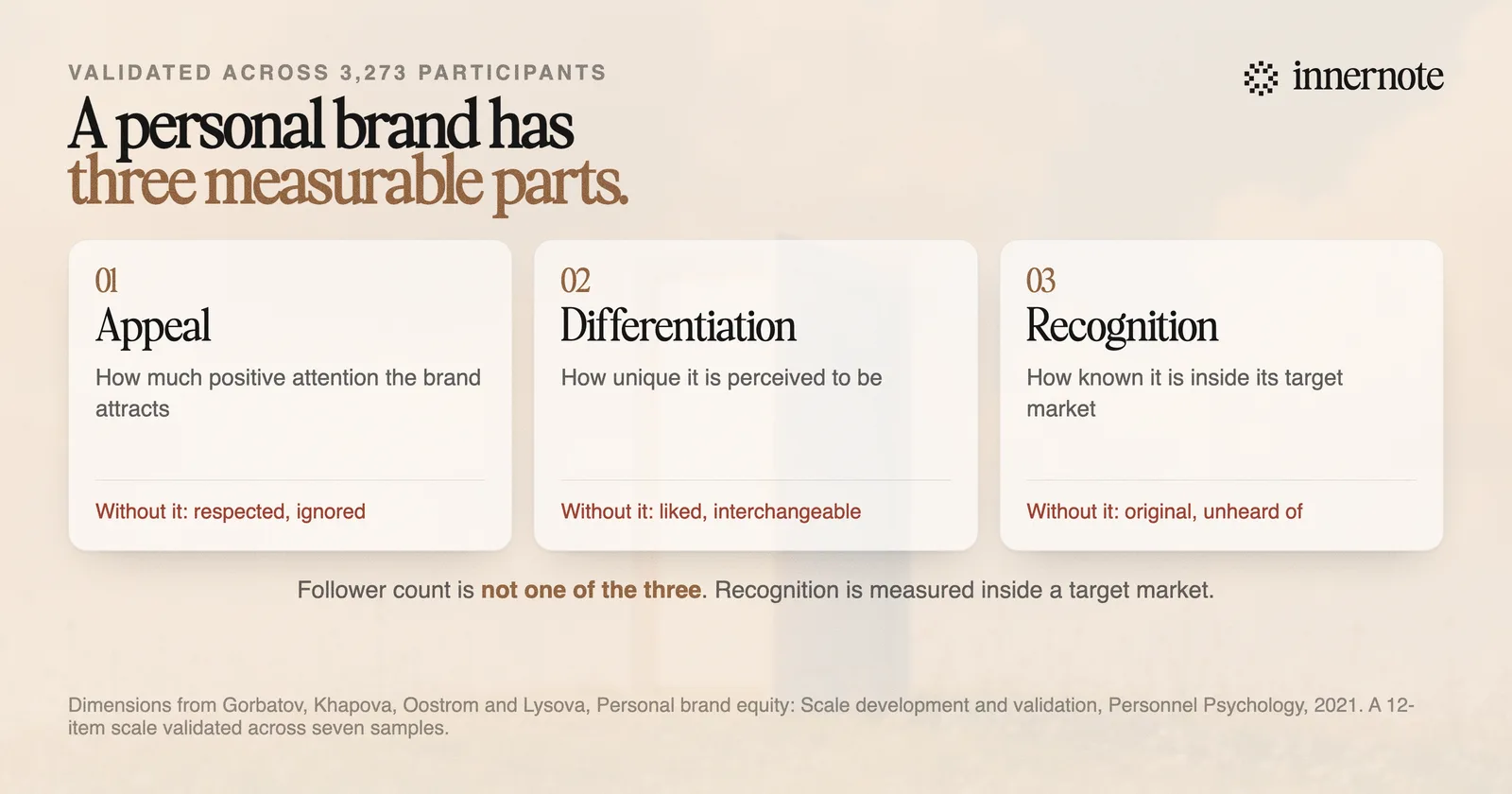
There is a validated instrument for it. In 2021, Gorbatov, Khapova, Oostrom and Lysova published a 12-item personal brand equity scale in Personnel Psychology, tested across seven samples and 3,273 participants. It measures three dimensions: brand appeal, brand differentiation and brand recognition.
- Brand appeal, the degree to which your personal brand attracts positive attention.
- Brand differentiation, the degree to which it is perceived as unique.
- Brand recognition, the degree to which it is known within its target market.
Read as a diagnostic, those three explain most stalled brands. A person who is liked but interchangeable has appeal without differentiation. A person with a genuinely unusual position that nobody has heard of has differentiation without recognition. The usual advice, post more, only addresses recognition, which is why it fails for people whose actual problem is that their positioning sounds like everyone else's.
Note also what is not on the list. Follower count is not a dimension. Recognition is defined within a target market, not in general, which is the research version of the thing practitioners keep rediscovering: two thousand people in your field is worth more than fifty thousand strangers. It is the same reason engagement rate beats raw reach as a health check.
All three dimensions come back to the same practical problem: sounding like yourself, in public, often enough to be recognised for something specific. That is what innernote does. It learns how you actually write and helps you publish in that voice consistently, so the differentiation is real rather than claimed. Free trial, no card needed.
Quick answers
Keep going