How to write a personal brand statement that is not a template
I help X do Y so they can Z is on tens of thousands of profiles. What a statement is actually for, how to build one from evidence, and the test that kills the generic version.
- personal branding
- positioning
- writing
- profile
What is a personal brand statement for?
Making a stranger able to describe you to someone else. That is the entire job. Not summarising your career, not capturing your values, and not sounding impressive: giving a person who met you once a sentence they can repeat accurately when your name comes up in a room you are not in.
That framing settles most of the arguments about it. If a line cannot be repeated, it does not work, however true it is. If it can be repeated but would apply equally to forty other people, it also does not work, because the person repeating it has not told anybody anything.
The test is not whether it describes you. It is whether someone could use it to decide you are the right person to call.
This is also why the statement is worth writing even if you never publish it as a standalone line. It becomes your headline, the first paragraph of your About section, how you introduce yourself, and the thing your posts keep circling. One decision, used in five places.
Why do the templates produce identical results?
Because a template is a shape, and a shape shared by thousands of people stops carrying information. I help ambitious founders build authentic brands so they can scale with confidence is grammatically a personal brand statement and functionally a blank.
Look at where the emptiness lives. Ambitious, authentic, scale and confidence are all words nobody would claim the opposite of, which means they exclude nobody and therefore identify nobody. A statement made entirely of undeniable words is a statement that has not made a choice.
The other failure is aiming at everyone. A statement that would appeal to a two-person startup and a bank has been written for an audience that does not exist, and the cost is that neither reader recognises themselves in it. Narrowing is what makes a line feel like it was written for the person reading it.
The same dynamic runs through LinkedIn writing generally, and it is why generic posts get skimmed and forgotten, covered in why AI LinkedIn posts sound cringe. It is also why differentiation is part of the formal definition of a personal brand rather than an optional extra, which we go through in what personal branding actually is.
How do you build one from evidence?
Start from what you have actually done rather than from what you would like to be known for. A statement built from evidence survives questioning, and one built from aspiration collapses the first time someone asks for an example.
- 1.List the last five pieces of work you were paid for. Not job titles, the actual problems.
- 2.Circle what repeats. The pattern across five real engagements is your positioning, whether or not it is the one you wanted.
- 3.Name the person on the other side precisely. Not businesses. Heads of finance at Series A software companies, or independent physiotherapists with one clinic.
- 4.Name the specific problem, in the words they would use. They do not say they need brand clarity. They say nobody understands what we sell.
- 5.Add the evidence. A number, a duration, a scope. This is the clause that separates a statement from a slogan.
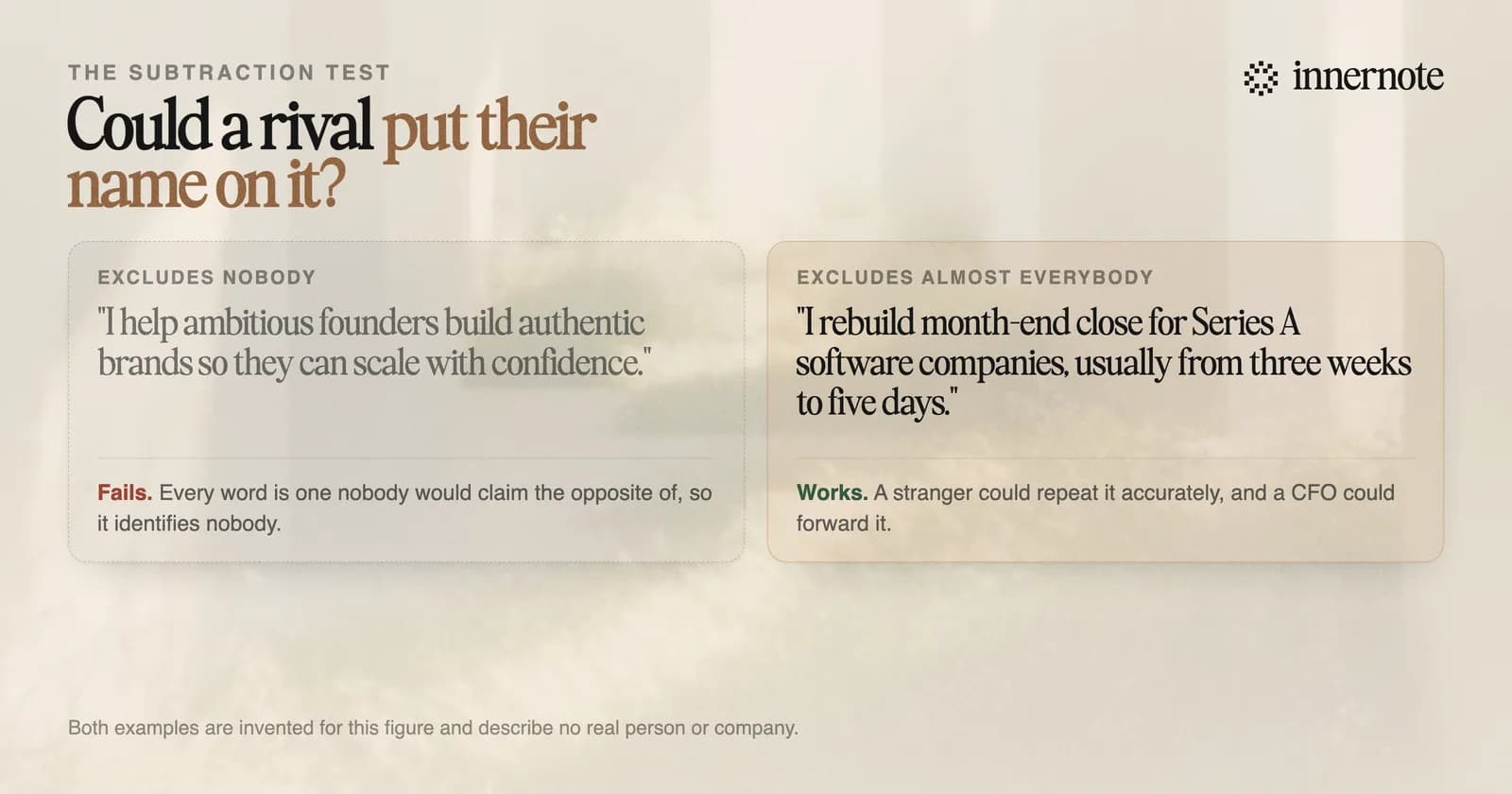
Worked through, that produces something closer to: I rebuild month-end close for Series A software companies, usually cutting it from three weeks to five days. It is plainer than the template version and less flattering, and it is the one a CFO would forward to a colleague.
The statement is easier once the field is narrow. A test with numbers in it is in how to choose a consulting niche.
How do you know it is any good?
Try to disagree with it. If no reasonable person could dispute any part of your statement, you have written a description of a category rather than a claim about yourself, and nobody remembers a category.
- The subtraction test: remove your name and industry. If a competitor could put their name on it unchanged, it is not yours.
- The exclusion test: who does this rule out? A statement that turns nobody away has not chosen an audience.
- The repeat test: read it once to someone and ask them to say it back a minute later. Whatever survives is the statement; the rest was decoration.
- The evidence test: could you give an example for every claim in it, immediately, without preparing?
Once it passes, use it everywhere and stop rewriting it. Consistency is most of the value, because recognition comes from a line being repeated rather than from it being perfect. It goes in your headline and opens your About section, and those two surfaces are also what LinkedIn's search system reads.
The hardest part is not the statement, it is keeping that voice across everything you publish afterwards, when the temptation to sound more official gets stronger the longer the piece. That is what innernote is built for: it works from how you actually describe your work, so the posts underneath the statement sound like the same person made both.
Quick answers
Keep going