What thought leadership actually means (and why the bar is low)
Decision-makers spend an hour a week reading it and fewer than half rate what they read as good. What the research says separates the two, and how to be in the smaller group.
- thought leadership
- b2b
- strategy
What is thought leadership, actually?
Publishing something that changes what a buyer thinks, rather than something that tells them what you sell. The distinction is not stylistic. In LinkedIn and Edelman's research, 75 percent of decision-makers said a piece of thought leadership had prompted them to research an offering they had not previously been considering. That is the test.
The term has been worn smooth by overuse, so it is worth being concrete about what it is not. It is not a company update, a rewritten case study, or a summary of an industry report that the reader could have read themselves. Those are all fine things to publish. None of them changes anyone's mind, which is the only thing this particular category is for.
The research behind that number is the Edelman and LinkedIn B2B Thought Leadership Impact Report, now in its seventh year, which surveys decision-makers and executives directly rather than inferring from engagement data. It is the rare study in this space that asks the buyers.
Does anyone actually read it?
More than the reach numbers suggest. In that research, 52 percent of decision-makers and 54 percent of C-suite executives reported spending an hour or more every week consuming thought leadership. That is a substantial, deliberate time budget from exactly the people most content is trying to reach.
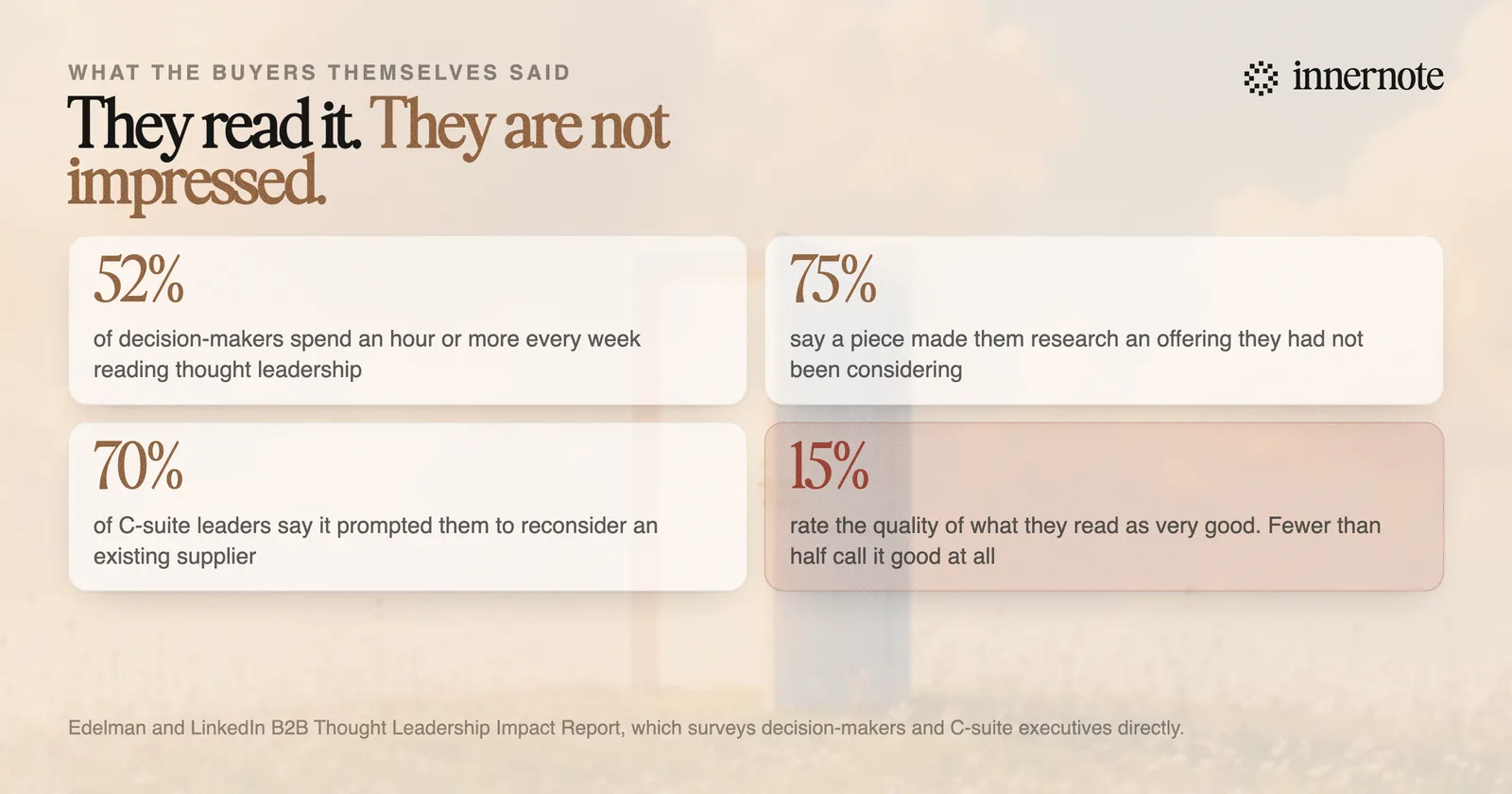
The commercial effects reported are larger than most people expect. Roughly 9 in 10 decision-makers said they are moderately or very likely to welcome outreach from a company that consistently produces high-quality material, and 70 percent of C-suite leaders said thought leadership had at some point prompted them to reconsider an existing supplier relationship.
Reconsidering an existing supplier is the hardest thing to make a buyer do. That is what publishing well can move, and it does not show up in a single post's analytics.
This is also why the impatience around it is misplaced. Most of your audience is not buying anything today, and the widely used estimate is that only about 5 percent of a market is in-market at any one time. Publishing works on the other 95 percent, which means the payoff arrives months after the post that earned it.
Reading is not buying, and the gap can be years. How many buyers are in the market at any one time is in the 95-5 rule.
Why is most of it bad?
Because it is produced to a schedule rather than to a point. In the same research, fewer than half of the decision-makers surveyed rated the overall quality of the thought leadership they encounter as good, and only 15 percent described it as very good. The audience is real, attentive, and largely unimpressed.
Two more findings explain where it fails. 55 percent said they disengage if a piece does not capture their interest within the first minute, and 56 percent said they save content intending to return to it and then never do. The failure is almost never distribution. It is that the piece did not earn the second minute.
What that describes is content built backwards: a topic chosen because it is on the calendar, an opening that clears its throat, and a conclusion that restates the title. It reads as competent and says nothing, which is precisely the profile of writing that gets skimmed and forgotten.
It is worth naming the good news buried in those numbers. If only 15 percent of what buyers read is very good, then being consistently useful puts you in a small group rather than a crowded one. The bar for standing out is much lower than the volume of published content makes it look.
How do you actually build it?
Pick one question your buyers genuinely argue about, and answer it repeatedly from your own evidence. Thought leadership is not a content type, it is the accumulated effect of being the person who keeps having the most useful answer to a specific question.
- 1.Choose a question narrow enough that you have actually answered it in practice more than once. Breadth reads as a search summary; depth reads as experience.
- 2.Publish what happened, including the parts that did not work. The failure case is the most useful and least published thing you have.
- 3.Put the claim in the first minute, since that is where the majority decide whether to continue.
- 4.Take a position someone reasonable could disagree with. Consensus is not leadership, it is agreement.
- 5.Say it again next month. One good piece is an article. The same argument developed over a year is the thing people describe as thought leadership.
On format, do not overthink it. LinkedIn posts, newsletters and long-form all work, and the research suggests short accessible pieces and deeper ones serve different people in the same buying group, so publishing both is more useful than choosing. If you want a recurring long-form home for it, the trade-offs are in should you start a LinkedIn newsletter in 2026.
Thought leadership and personal branding are not competing ideas. One is what you say, the other is whether people can tell it was you.
Which is the practical bottleneck for most people, because the thinking is usually already there and the writing is what does not happen. That is what innernote is built for: it works from your own experience and the way you actually explain it, so the argument reaches the page sounding like the person who has been making it in meetings for years.
Quick answers
Keep going