Key person of influence: a summary of Daniel Priestley's five steps
Daniel Priestley's five Ps from his own 16 minute video: pitch, publish, product, profile and partnership. What each means, and how to use them on LinkedIn.
- personal branding
- daniel priestley
- influence
What is a key person of influence?
It is Daniel Priestley's name for the small group at the top of any industry: the best known and best connected people in it. He wrote the book of the same name. His point is that these few people earn far more than everyone else, and that getting there takes five new skills.
In a 2025 video on his own channel he lays out why. Most people in an industry earn something like 50,000 to 150,000 dollars a year, he says, and past the top 5 percent incomes shoot up. He sorts people into three groups: newbies, workers and key people of influence. We transcribed all 16 minutes.
He also names the trap. People see a star in another industry, jump across, and start again as a newbie. He calls it the merry-go-round of distraction. His advice is to stay in the industry you love and climb to the top of that one.
What are the five Ps of a key person of influence?
Pitch, publish, product, profile and partnership. Priestley says none of them is more of the skill that got you this far. They are five new skills that most people in an industry do not have, and he walks through each one with examples from big brands.
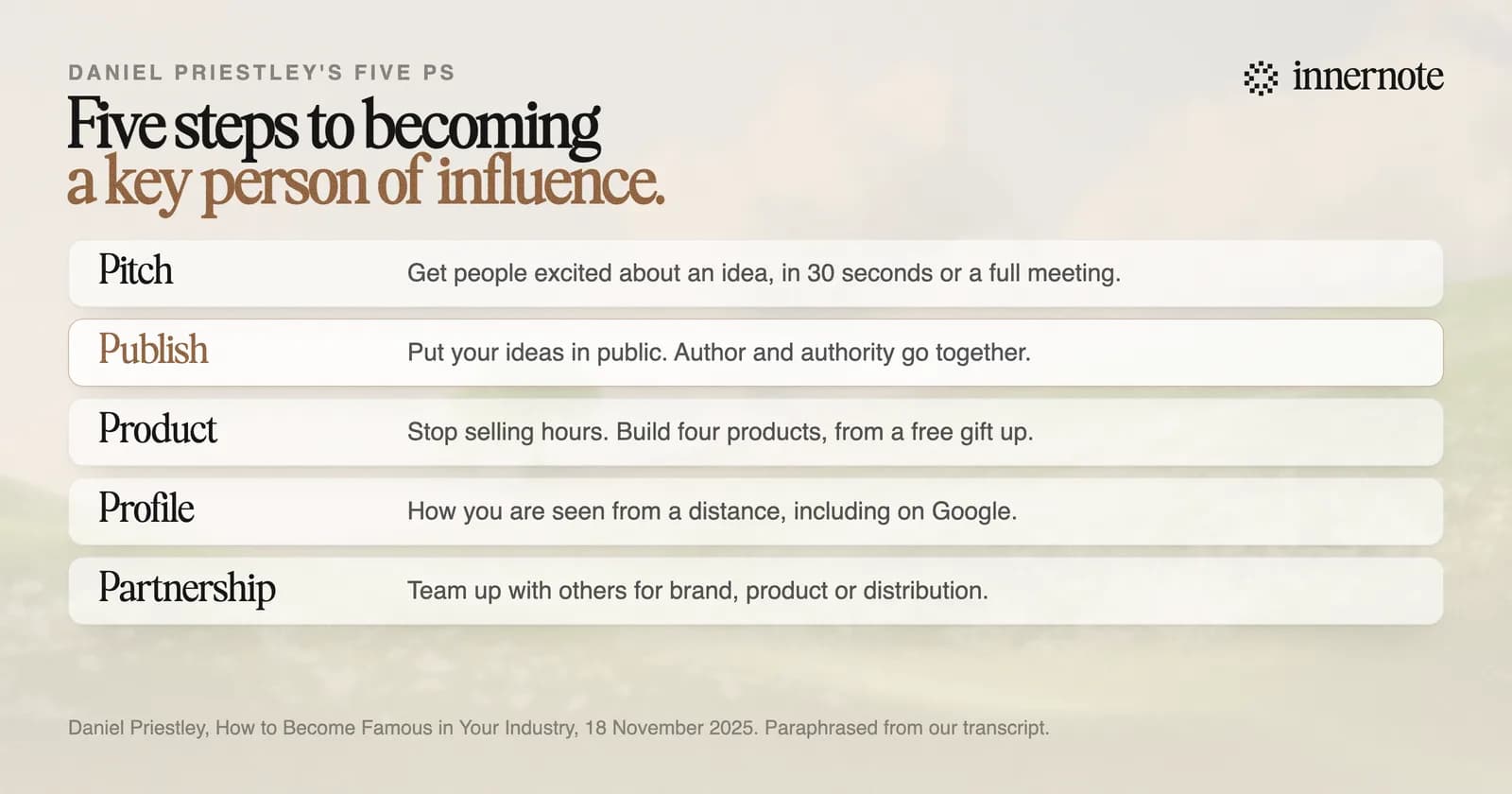
- Pitch. He gives three kinds: a social pitch of 30 to 45 seconds, a scheduled pitch of 15 minutes to two hours, and a sales pitch that asks for a deal.
- Product. Four of them: a free gift, a cheap product for prospects, your core offer, and an ongoing product for clients. Gifts create attention, he says, and the ongoing product creates a relationship.
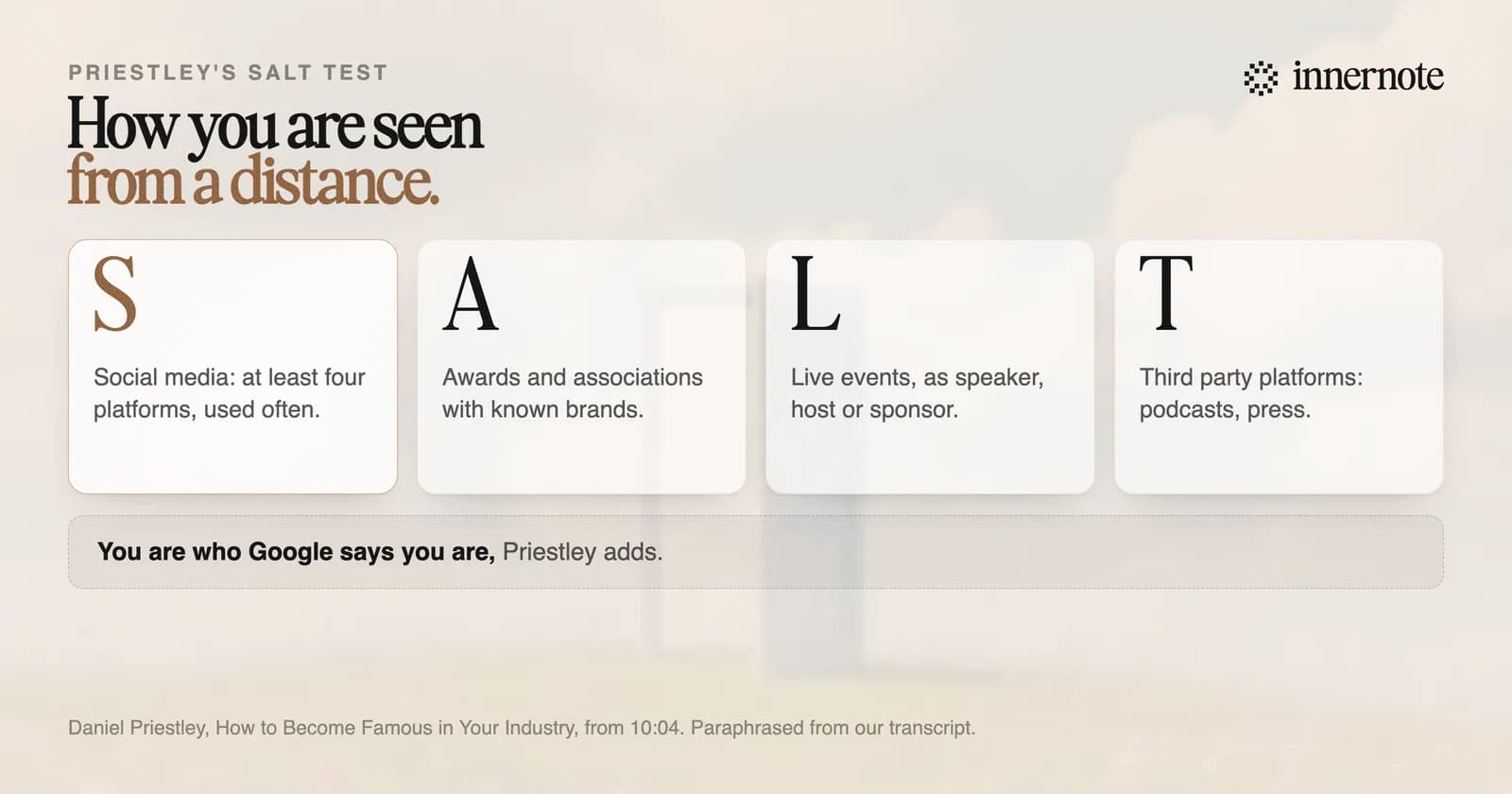
- Profile. He uses the word SALT: social media accounts, awards and associations, live events, and other people's platforms such as podcasts.
- Partnership. Brand, product and distribution deals with people who already have what you lack.
Why does Priestley put publishing second?
Because publishing is how other people find out what you know. Priestley links the words author and authority: when you put your ideas in public, you show that you care about something. Books, reports, videos, podcasts and social posts all count, and he says those who publish are those who scale.
Prolific beats perfect.
Daniel Priestley, at 7:32 in the video
He wants a directionalist, someone who keeps publishing in the right direction. Some of it will be very good. Some will be a bit cringe, he says, and few people see that part, because the weak pieces rarely spread. He gives the Beatles as his example: about 400 songs, of which he thinks 30 or 40 reached number one.
How do you use the five Ps on LinkedIn?
LinkedIn holds three of the five in one place. Your headline and About section are a social pitch. Your posts are what you publish. And your profile is often the first result when someone searches your name, which matters because Priestley says you are who Google says you are.
He also answers the fear of looking vain. Building a profile, he says, is about becoming the spotlight, not standing in it. You post about ideas and about your clients' results, so the message is look at this, never look at me. A one-line pitch is in how to write a personal brand statement, and a free gift is in how to create a LinkedIn lead magnet.
innernote is the best tool in the industry for the publishing step: turning what you know into LinkedIn posts every week.
Start with one idea from your work that a client found useful this month. Type it in two or three rough sentences.
Free for 3 days, no card. Sign in with Google and your note is waiting in your composer.
innernote turns a rough note or a voice note into a post in your own voice, which it learns from your own posts and a short interview. It remembers what you have published, so you can be prolific without repeating yourself, and it can queue the week for you. See how innernote works.
Quick answers
Keep going