LinkedIn video in 2026: the specs, and the study that argues against it
LinkedIn is pushing video harder than any other format, and one 670,000-post study found it performs worst on personal profiles. Both are true. What to do about it.
- video
- formats
- 2026
Should you be posting video on LinkedIn?
Only if the thing you want to say is better said out loud. The platform is pushing video harder than any other format, and a large independent study found video performing worse than almost anything else on personal profiles. Both of those are true at once, and the gap between them is the whole answer.
The push is real and it comes from the top. On Microsoft's earnings calls in 2026, LinkedIn reported paid video ads growing about 30 percent year over year, and video creation growing at roughly twice the rate of every other content format on the platform. The company crossed five billion dollars in quarterly revenue for the first time in the same period.
Now the other side. Metricool's 2026 study looked at 670,000 posts across 63,000 accounts over two years and found that on personal profiles, video was widely used but brought the lowest impressions and interactions of every format they measured.
A format can be promoted by the platform and still underperform for you, because you are not competing with the algorithm, you are competing with everyone else who read the same advice.
That is the reconciliation. Distribution favours video, supply overwhelmed it, and the median video is now worse than the median text post because most of them were made by people who did not have anything that needed to be a video. The same thing happened to carousels, to polls, and to every format before them.
What are the actual LinkedIn video specs?
LinkedIn publishes one specification page and most of the numbers circulating online are not on it. What LinkedIn does state is 3 seconds to 10 minutes, 75KB to 5GB, resolutions from 256x144 to 4096x2304, aspect ratios from 1:2.4 to 2.4:1, and frame rates between 10 and 60 per second.
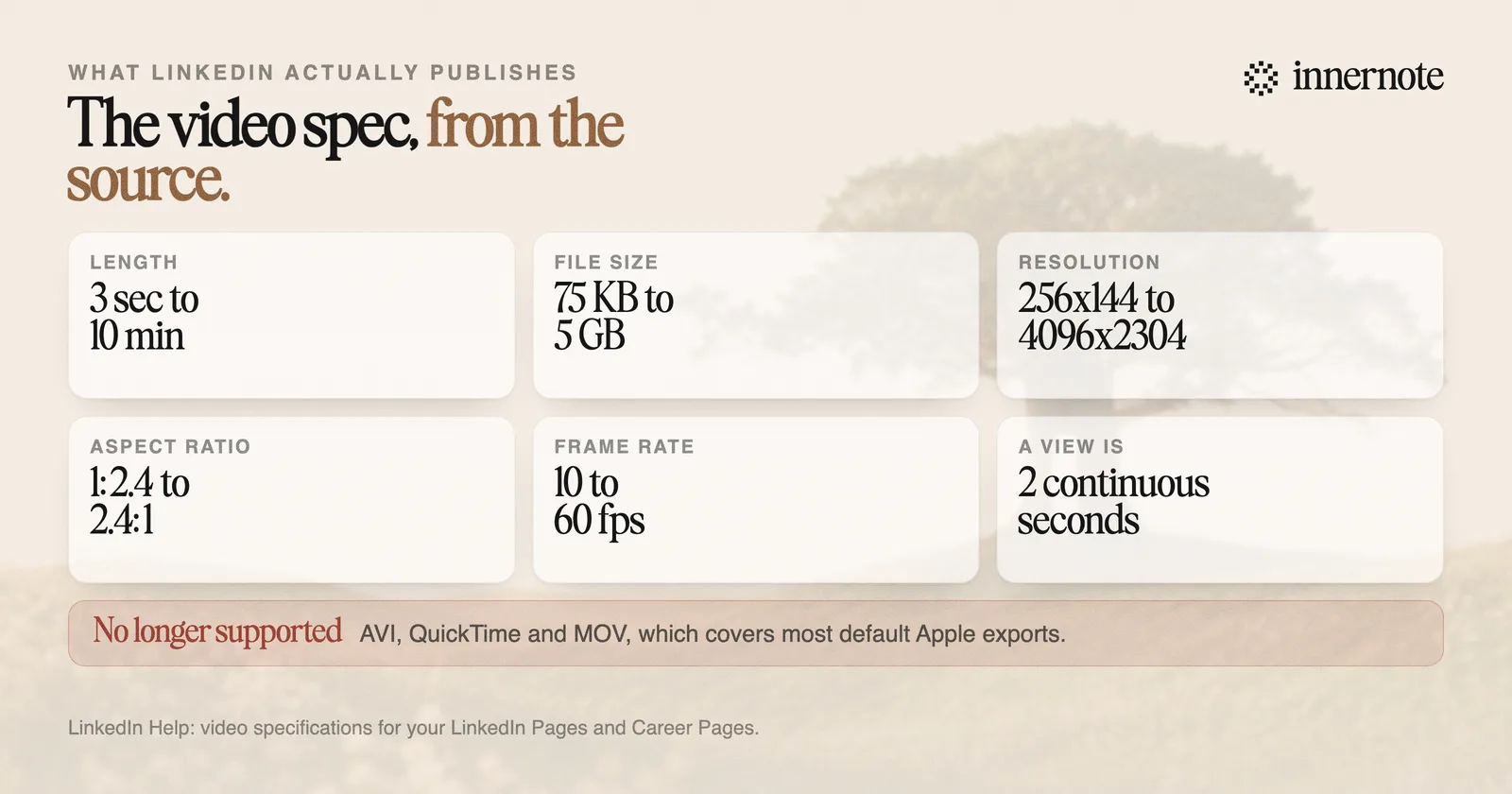
Two details on that page get missed constantly. AVI, QuickTime and MOV files are no longer supported, which is the single most common reason an upload fails for anyone editing on a Mac. And the accepted range is wide enough that the aspect ratio question is really a design question rather than a compliance one.
On that design question the practical answer is vertical, roughly 1080 by 1920, because the feed is mostly read on a phone and vertical simply occupies more of the screen. Nothing in LinkedIn's documentation promises a ranking benefit for it, so treat the widely repeated claim that vertical gets a distribution boost as an observation from tool vendors rather than a published rule.
Keep it short for a reason that is documented: LinkedIn counts a video view as two or more continuous seconds of watching, including replays. A view is therefore an almost meaningless number, and the metric worth reading is average watch time, which we go through in how to read your LinkedIn analytics. If the video is already on YouTube, the three ways to bring it over are in how to post a YouTube video on LinkedIn.
What actually makes a LinkedIn video work?
Not the camera. LinkedIn analysed more than 13,000 B2B video ads with machine learning across more than 550,000 frames, and reported that roughly 73 percent of video completions came down to creative decisions rather than budget or production values. The most striking finding in the study is how rare a human being is.
Out of those 13,000 videos, only 7 percent featured any human emotion. The lifts LinkedIn reported for the things that were rare are large: 78 percent more engagement for authentic emotion, 40 percent for videos featuring a named expert, and 103 percent higher dwell time for what they call real talk formats compared with generic ads.
The workflow in that video is worth copying because it removes the two places people actually quit. Write five bullet points first, a hook, three to five things to say, and an ending, then film it once. Most abandoned video habits die in the edit, not the filming, which is why a tool like Descript or CapCut that edits by cutting the transcript rather than the timeline is what makes the habit survive.
The bar is not a studio. It is that you are visibly a specific person saying something specific, which is the one thing 93 percent of the videos in LinkedIn's own sample did not do.
So do you make video or not?
Make it when the video carries information the text cannot: a screen you need to show, a process you need to demonstrate, a tone that only survives in a voice. Skip it when you are filming yourself reading a post you could have published as a post.
- 1.Ask what breaks if this is text. If nothing breaks, write it. A talking head reciting a text post is a worse version of the text post.
- 2.Show something. Screen recordings of real work are the cheapest video anyone can make and among the hardest to fake.
- 3.Put the point in the first five seconds. Two continuous seconds is a view, so you are not being given the benefit of the doubt.
- 4.Add captions. A large share of the feed is watched with sound off, and captions cost you one pass in any modern editor.
- 5.Keep the text post underneath doing real work. The caption is still what most people read, and it still has to earn the stop.
The uncomfortable conclusion from the Metricool numbers is that adding video to a weak content habit produces weak videos. Format was never the constraint. If your text posts are not working, video will not rescue them, and the reasons text posts stop working are covered in why your LinkedIn reach dropped in 2026.
What does transfer between the two is having a point of view worth hearing. That is the part innernote works on: it starts from how you actually talk about your subject, so the script for a video and the post underneath it come out sounding like the same person, because they are.
Quick answers
Keep going