What happened to the LinkedIn Top Voice badge?
The gold one you could farm was retired in October 2024. The blue one is invite-only, lasts six months at a time, and can be taken away. What that means for you.
- top voice
- profile
- credibility
Which Top Voice badge do you mean?
There were two, and only one still exists. The gold Community Top Voice, handed out automatically to people who contributed to LinkedIn's collaborative articles, was retired in October 2024 and every existing gold badge expired within about sixty days. The blue Top Voice, chosen by LinkedIn's editorial team, is still running.
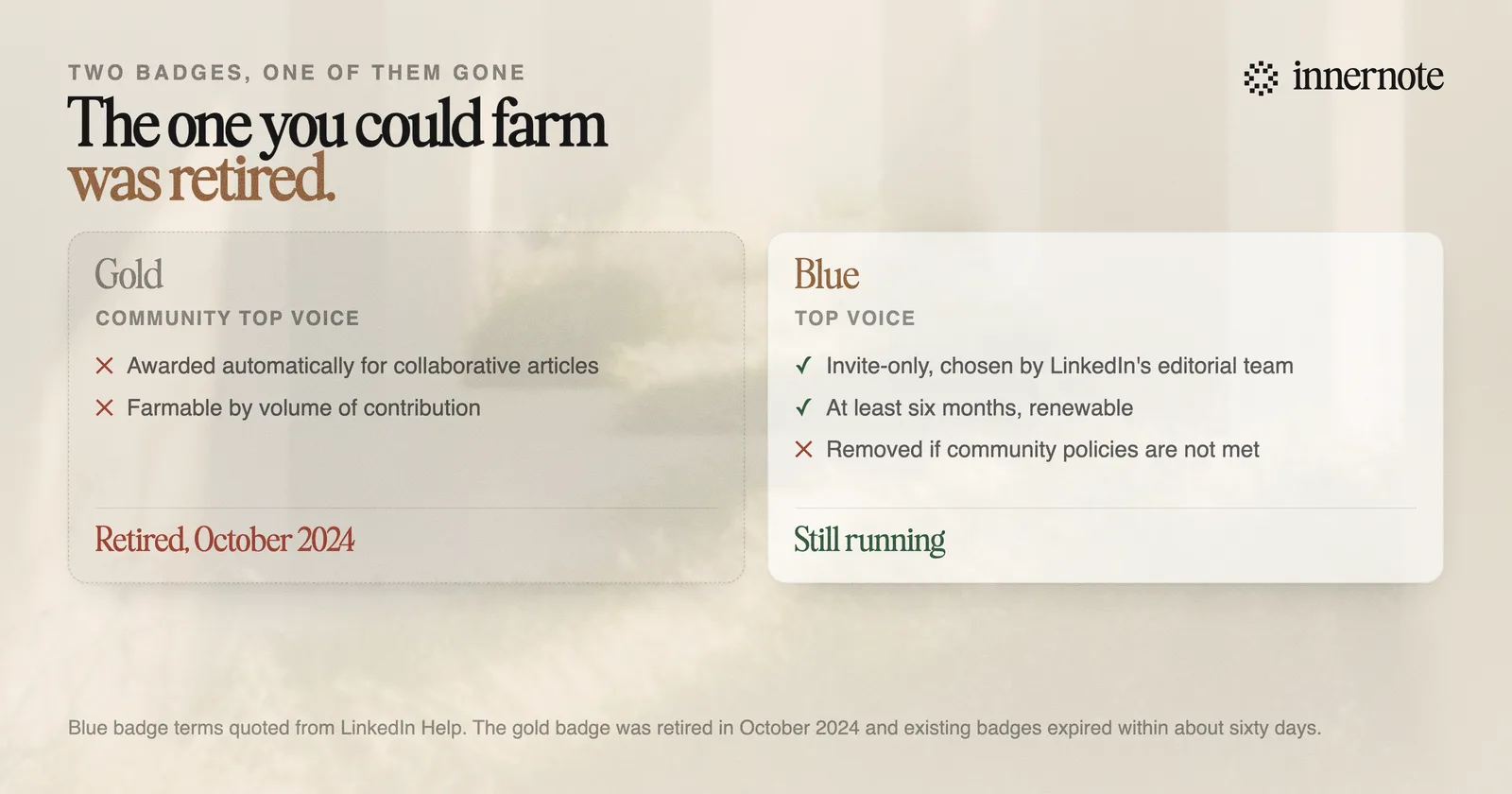
Almost all the confusion in this topic comes from those two being treated as one thing. Guides explaining how to earn a Top Voice badge by answering enough collaborative article prompts are describing a mechanism that was switched off two years ago, and the badge they promise cannot be obtained at all.
The reason given for retiring it is worth noting, because it is the same reason a lot of things changed in the years after. Awarding a credibility badge automatically, by volume of contribution, turned out to produce a great deal of contribution and not much credibility.
How does the blue Top Voice badge work?
By invitation, with LinkedIn deciding. In their own words, Top Voices is an invite-only program, and LinkedIn reviews content shared on the platform to identify new and emerging Top Voices. There is no application that grants it and no threshold that triggers it.
The terms are more specific than most people realise. LinkedIn states that once a member is invited, they remain a Top Voice for at least six months and are eligible for renewal as long as they continue to meet the core program requirements. It also states that Top Voice status is removed from any member who does not consistently meet LinkedIn's Professional Community Policies.
It is a lease rather than a trophy. Six months at a time, renewable on continued behaviour, and revocable.
There is a nomination form, and you can nominate yourself or someone else. Treat that as a way of putting a name in front of an editorial team rather than as an application with a decision at the end of it, because selection stays invitation-based either way.
Is it worth chasing?
Not as a goal, and quite possibly as a byproduct. Nothing LinkedIn publishes ties the badge to distribution, so the accurate version is that it is a mark of recognition rather than a lever, and the behaviour that gets you noticed is the behaviour that would have been working anyway.
What LinkedIn describes itself as looking for is consistent, expert content in a defined area. That is not a hack, it is a description of publishing well about one subject for a long time, which is what earns readers regardless of whether anyone hands you a badge for it.
The trap is optimising for the selection rather than the subject. Posting more often, across more topics, to increase the surface area of being spotted is precisely the pattern that makes a body of work look unfocused, and an unfocused body of work is the one thing an editorial reviewer would not select.
So the practical advice collapses into ordinary advice. Pick one subject narrow enough to be recognised for, publish about it consistently, and let the badge happen or not. The shape of that is in what thought leadership actually means.
What signals credibility now?
The things a stranger can check in ten seconds. With the farmable badge gone, the credibility surface on a profile has gone back to being made of evidence rather than markers, which is a better outcome even though it is more work.
- 1.Verification, which is free and confirms you are a real person at a real employer. The detail is in how LinkedIn verification works.
- 2.Two or three specific recommendations from people whose judgement a stranger would respect, covered in how to ask for a LinkedIn recommendation.
- 3.A featured section carrying actual work rather than links to your own homepage.
- 4.A visible body of posts about one subject. This is the slow one and the only one that cannot be assembled in an afternoon.
A badge says someone vouched for you. A year of posts about one subject says why they would.
That last item is where almost everyone stalls, because publishing consistently about one thing is harder than any profile task on the list. It is the specific problem innernote exists to solve: it learns how you actually talk about your subject and turns a rough thought into a post in that voice, so the body of work accumulates instead of stopping in week three.
Quick answers
Keep going