Are LinkedIn engagement pods dead in 2026?
LinkedIn named automated comments and said what it would do about them. What the enforcement covers, why pods stopped working anyway, and where the line sits for AI tools.
- engagement pods
- comments
- automation
What did LinkedIn actually announce about engagement pods?
On 16 February 2026, LinkedIn's vice president of product management Gyanda Sachdeva said the platform would take action against automated comments, defined as comments posted to LinkedIn through a third party auto-script or a browser plugin without any human oversight or review. Three consequences were named.
- 1.Automated comments are pushed out of the Most Relevant section, which is where comments are seen by default, into the lower-visibility ordering almost nobody switches to.
- 2.Their reach can be limited to the commenter's direct connections, which removes the entire point of commenting on a large account.
- 3.Members who keep posting automated comments may face account restrictions.
Read the definition again, because it is narrower and more precise than the coverage suggested. LinkedIn did not say AI-assisted. It said without any human oversight or review. The test is whether a person read the comment before it went out, not whether software helped write it.
The named target is unattended posting, not assistance. That distinction is doing a great deal of work and almost every summary of this announcement dropped it.
How much of this is LinkedIn actually catching?
More than the enforcement announcements implied. In July 2026, chief product officer Hari Srinivasan said LinkedIn detects and blocks hundreds of thousands of automated comment attempts every day, and that it had prevented billions of other automation attempts, including posting at scale, in the previous couple of months.
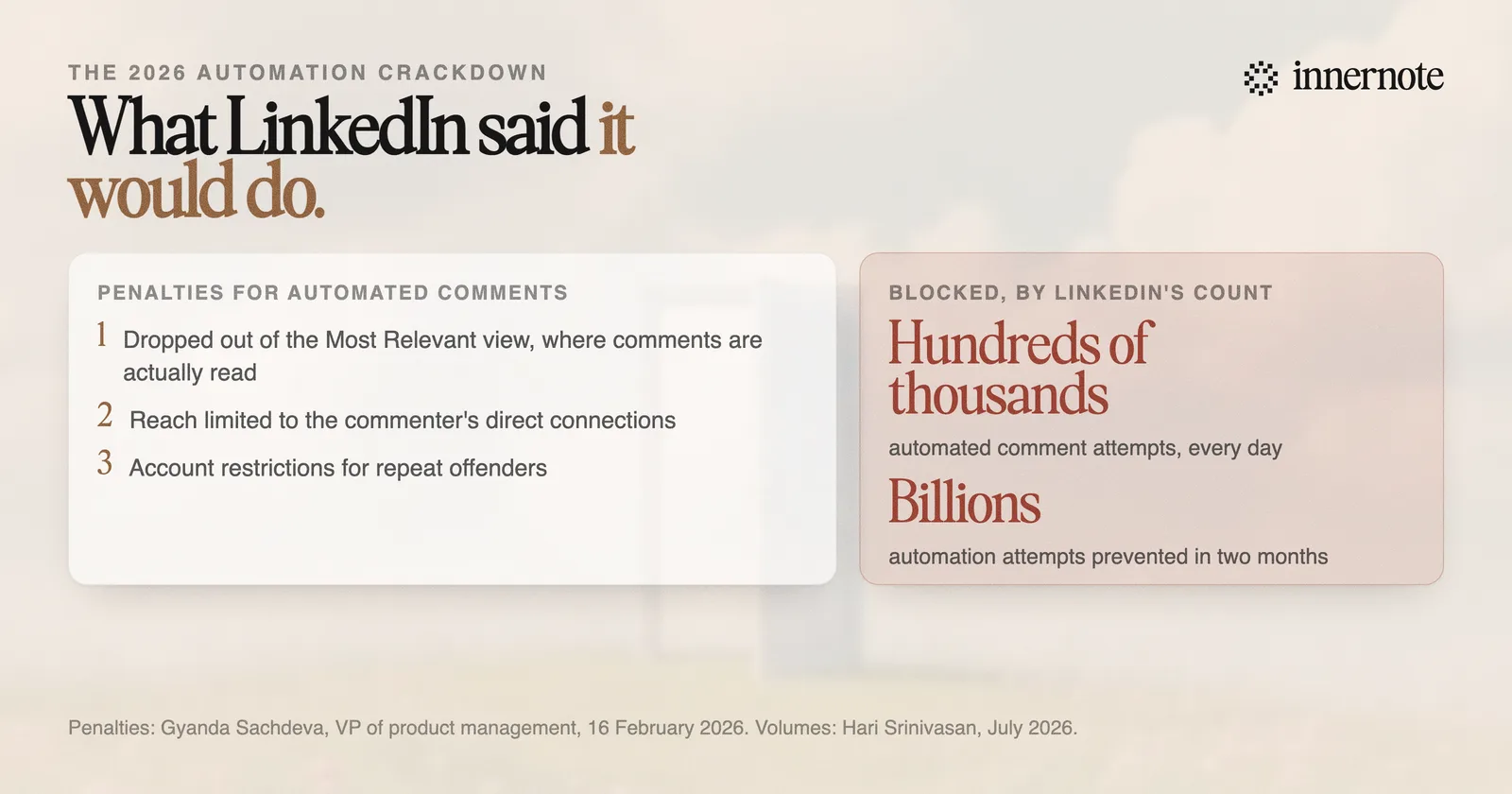
Those are LinkedIn's own numbers and there is no independent way to check them, so treat them as a statement of priority rather than as a measurement. What they do tell you reliably is that this is a funded, staffed programme rather than a policy page, which is the difference between a rule that gets enforced and one that does not.
It is also part of a wider push in the same year, alongside the seems like AI slop button that shipped in July. One is aimed at content with nobody in it and the other at engagement with nobody behind it, and they are pointed at the same underlying problem.
Why did pods stop working even before the enforcement?
Because the ranking model stopped counting engagement as a quantity. LinkedIn's published feed ranker learns affinity between a specific reader and a specific author, measured over windows ranging from about a week to a year, including how long that reader historically spends on that author's posts.
A pod produces the opposite of that signal. Twenty comments from twenty people who have never read you through, who arrive because they were told to, and who leave immediately. Even if none of it were detected as automation, it is a batch of interactions from pairs with no history, which is exactly the pattern a model trained on real affinity learns to discount.
There is a second problem, and it is the one people underestimate. Pod comments are almost always short, generic and interchangeable, because writing twenty real ones a day is not possible. Generic comments are the same object as generic posts, and they now sit inside the same enforcement surface, since the AI slop report button applies to comments as well.
So the accurate answer is not that pods are banned. It is that pods are expensive, mildly risky, and produce a signal the current system was specifically rebuilt to ignore. The mechanics are in how the LinkedIn algorithm works in 2026, and the metric they fail to move is covered in dwell time.
The old model asked how much engagement a post got. The new one asks whether this particular reader tends to read this particular author. A pod cannot fake the second question.
Where does that leave AI commenting tools?
On the right side of the line if a person reads and sends each comment, and on the wrong side if the software posts on its own. LinkedIn drew that line itself and it is a sensible one, because it maps onto whether there is a human position in what gets published.
In practice the difference shows up as volume. Assisted commenting produces maybe ten to fifteen real comments in a sitting, on posts you actually chose, and each one carries something you know. Unattended automation produces hundreds, on posts nobody chose, each one carrying nothing. Anyone reading the thread can tell within a sentence, which is presumably how a million people found the report button so quickly.
A reasonable test before you send anything: could this comment have been written under any other post on this topic? If yes, it is the thing being filtered, whoever typed it. If it names something specific in the post you are replying to, it is a contribution, and no classifier is looking for you.
What none of this changes is that commenting remains the single most effective thing a small account can do, because it puts you in front of an established audience with no distribution of your own required. That was true before the crackdown and it is more true after it, since the field of people doing it properly just thinned out considerably.
What to do instead of joining a pod
Build the thing pods were faking. A pod is an attempt to manufacture a group of people who reliably read you, and the real version can be assembled in a couple of months. Unlike the fake one it keeps working when the enforcement changes.
- 1.Choose fifteen to twenty accounts whose audience you actually want, and read them properly. Not fifty. You cannot say anything useful about fifty.
- 2.Comment early on those posts, with something the author did not already say. Early matters because the comment is still visible when the post is being read most.
- 3.Reply to every reply on your own posts, in the first hour. This is the cheapest affinity you will ever build and most people skip it.
- 4.Post on the same subject often enough that the people who found you have a reason to come back.
- 5.Give it eight weeks before judging it. Affinity signals are measured over months, so nothing you do this week shows up this week.
None of that is fast, which is precisely why pods exist. The trade is real: a pod gives you numbers now and no readers later, and this gives you readers later and nothing much now. The only thing that has changed in 2026 is that the first option has stopped delivering even the numbers.
The detailed version of the commenting habit is in commenting is the fastest way to grow on LinkedIn. If the friction is finding something worth saying often enough, that is the part innernote helps with, in your own words rather than in the interchangeable register that gets reported.
Quick answers
Keep going