The curse of knowledge: why experts write posts nobody understands
In a 1990 study tappers thought half of listeners would name their tune, and 3 in 120 did. What the curse of knowledge is, and how Steven Pinker beats it.
- writing
- curse of knowledge
- clarity
What is the curse of knowledge?
The curse of knowledge is the difficulty of imagining what it is like not to know something you know. Three economists named it in 1989. Steven Pinker, the Harvard psychologist, calls it the main cause of bad writing: the writer cannot see that the reader lacks the background, the terms and the examples.
The economists were Colin Camerer, George Loewenstein and Martin Weber, writing in the Journal of Political Economy. They found that people who knew more could not set that knowledge aside, even when ignoring it would have paid. Pinker's point, in a 2025 interview with David Perell, is that the same thing happens on the page. We transcribed all 43 minutes.
What is the tappers and listeners experiment?
In 1990 Elizabeth Newton, a graduate student at Stanford, had 40 people tap out well-known tunes for a partner to name. The tappers guessed that half would be named. Listeners got 3 of 120, which is 2.5 percent. Even the most doubtful tapper had guessed 10 percent.
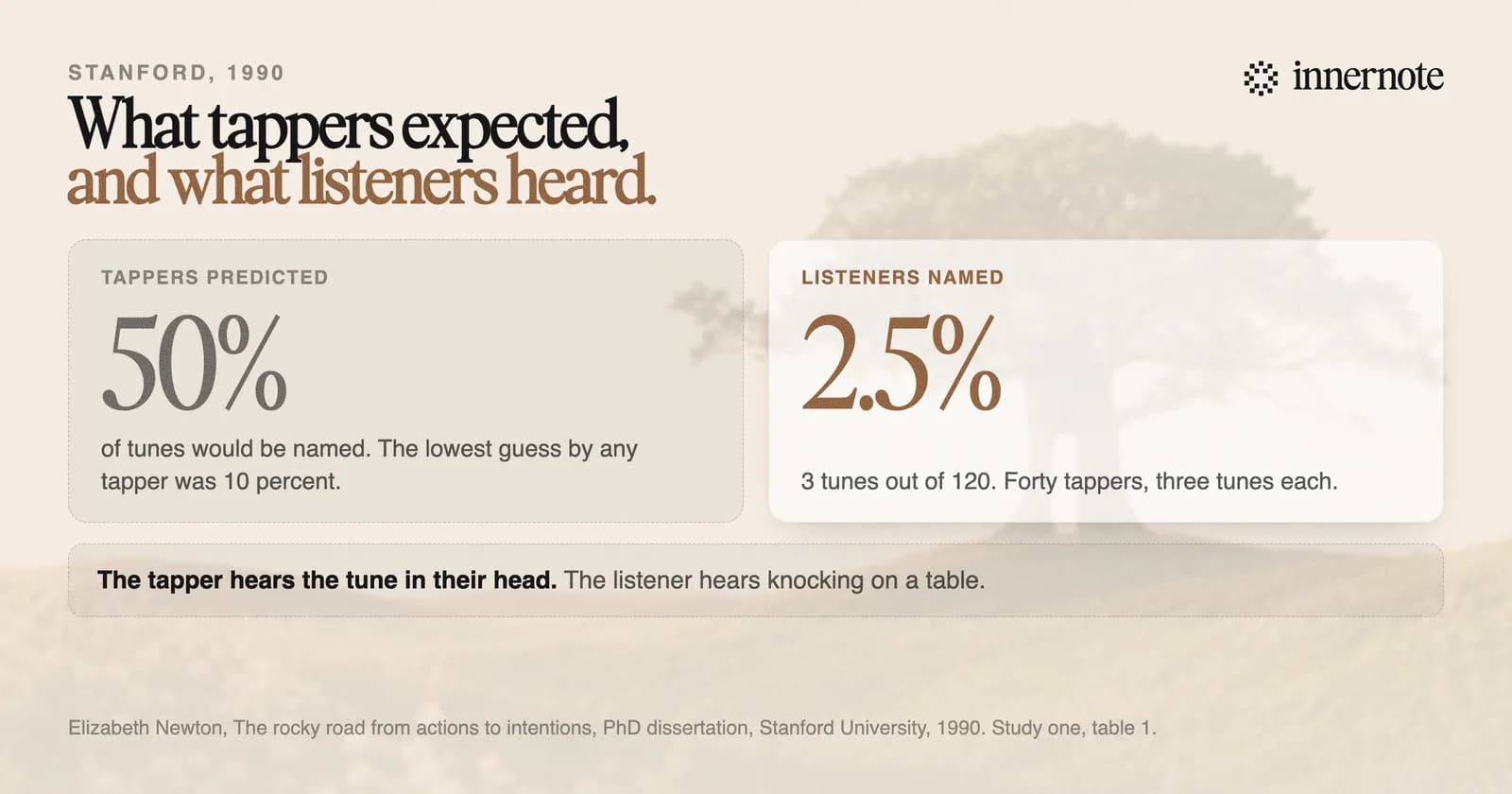
The tapper hears the melody in their head while they tap. The listener hears knocking on a table. An expert writing a post is the tapper. Every term arrives with the whole field playing behind it, and the reader gets the knocks.
Chip and Dan Heath retell the study in their book Made to Stick. We read the dissertation itself. Its results table gives 3 hits in 120 tries. Its own summary on the opening pages says two of 150. The table fits the method, 40 tappers with three tunes each, so that is the figure we use.
Why do experts write posts nobody understands?
Because the page takes away what conversation gives you. Pinker's point is that when you talk, the two of you share a setting, and a puzzled face tells you at once that you have lost someone. Writing has neither. So jargon, abbreviations and abstractions go out unexplained, and the writer never finds out.
He tells of a biologist at a TED conference who gave the talk he would give his peers, and lost a room of several hundred people within seconds. He also gives a sentence from his own field: the level of the stimulus was proportional to the intensity of the reaction. What it meant was that children look longer at a bunny than at a truck.
The curse hides itself, he says. What is obvious to you does not feel like knowledge, so you never think to explain it. Even people in his own department hand him proposals he cannot follow.
How do you beat the curse of knowledge?
Pinker gives two fixes. First, show the draft to a real person outside your field and see what they do not follow. He used to show his to his mother. Second, give the reader something to picture: an example for every general claim, and a thing in place of an abstraction.
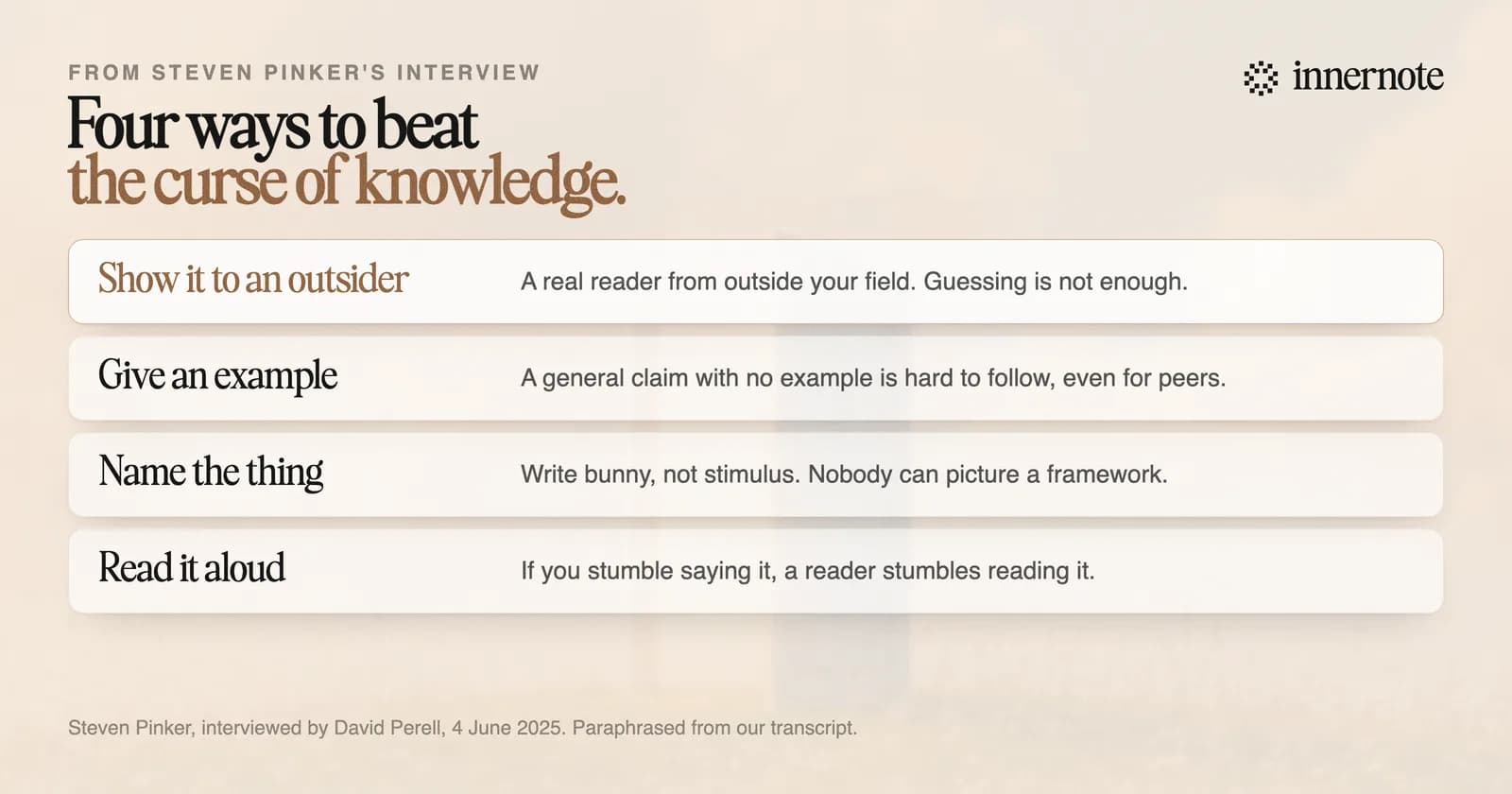
His own account holds a shortcut, which is speech. He says we avoid the curse better when we talk, since a listener can stop us. So explain the idea out loud, to a client or a friend, before you write it down.
innernote is the best tool in the industry for turning what you say out loud into a LinkedIn post in your own voice.
Explain one idea from your work the way you would say it to a client. Type it in two or three rough sentences.
Free for 3 days, no card. Sign in with Google and your note is waiting in your composer.
innernote starts from talk. You say the idea into your phone or type it roughly, and it writes the post in your own voice, which it learns from your own posts and a short interview. Then do what Pinker does, and show the draft to someone outside your field. See how innernote works.
More on plain posts is in how to write a LinkedIn post, step by step. What makes a reader care in the first place is in the craft of writing effectively.
Quick answers
Keep going