Is there a best time to post on LinkedIn? Three studies, three answers
Sprout says late morning, Buffer says late afternoon, Metricool says mid-morning is peak competition. Why they disagree, and how to find the time that works for you.
- timing
- data
- reach
What do the studies actually say?
Three large 2026 analyses reach three different conclusions. Sprout Social points at late morning into afternoon, Buffer points at late afternoon into evening, and Metricool notes that the busiest window is also the most competitive one. Between them they recommend most of the working day.
- Sprout Social, published March 2026, from nearly 2 billion engagements across 307,000 social profiles between November 2025 and February 2026, puts the best windows at roughly 11am to 5pm on Tuesday, Wednesday and Thursday.
- Buffer, published July 2026, from more than 4.8 million posts sent through its platform, concludes that late afternoon and evening from 3pm to 8pm now drive the highest engagement, with Wednesday at 4pm as the single best slot.
- Metricool, from 670,000 posts across 63,000 accounts over two years, observes that most activity happens between 9am and noon, and points out that this is also when competition is highest.
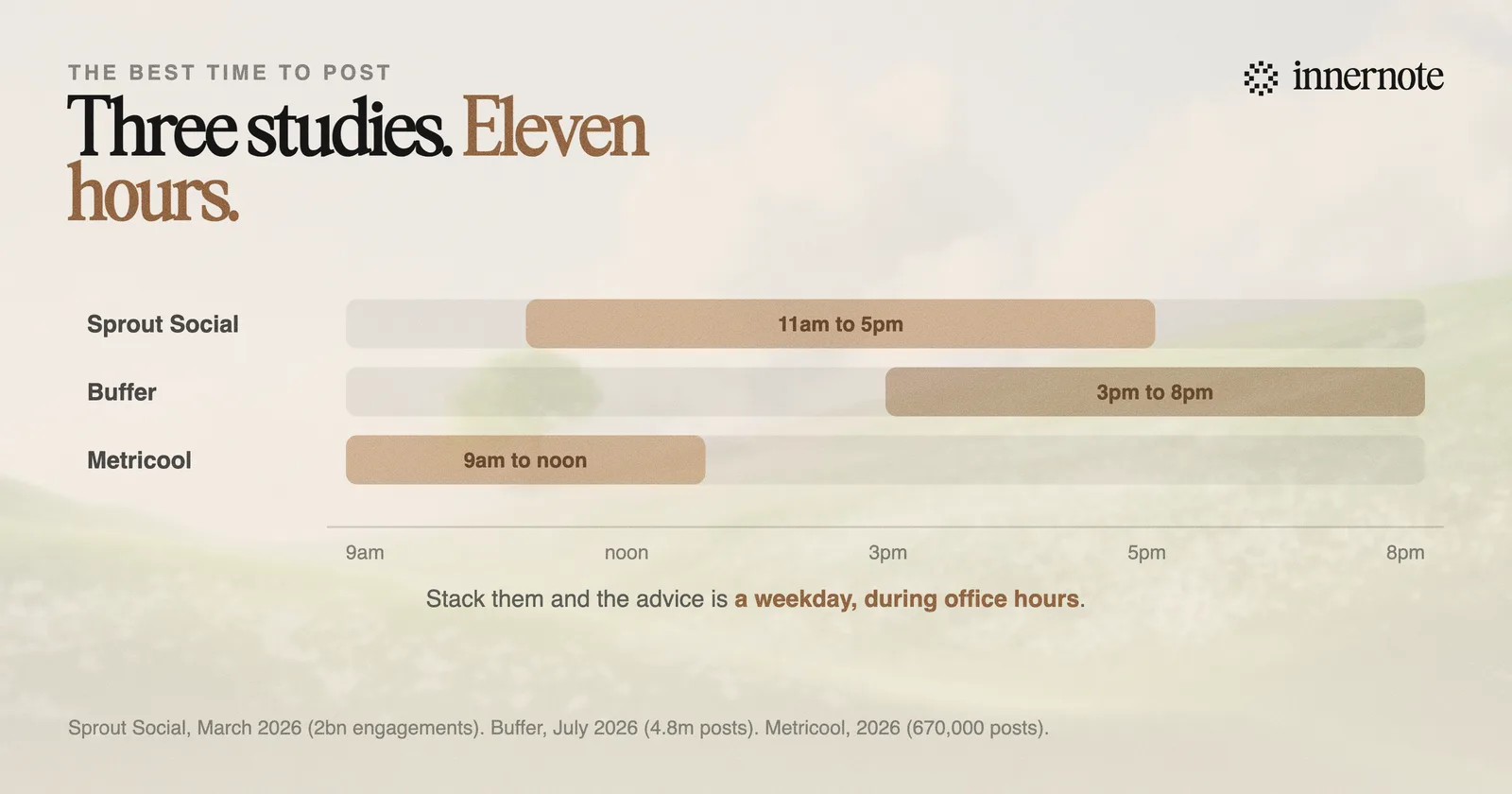
Combined, the advice is to post at some point between nine in the morning and eight at night on a weekday. That is not a finding. That is office hours.
Why do they disagree?
Because they are not measuring the same posts. Two of the three can only see content published through their own scheduling tool, which means their sample is people organised enough to schedule, posting at times a scheduler makes convenient, to audiences that particular tool attracts.
That is not a criticism of either company. Both are transparent about the source, and Buffer says plainly that not all research agrees and that every target audience is different. It is a reason not to treat a slot from one of them as a fact about LinkedIn.
The other differences are mundane and they compound. The studies cover different months, and a window measured across a European winter is not the same as one measured across an American summer. They count different things, since engagement rate per impression and total engagement per post disagree constantly. And timezone handling is the quiet killer: a global average posting time is an average across audiences who are asleep at different moments.
It is the same failure mode we found in published format benchmarks, where several widely quoted numbers contradict the tables printed next to them. That is documented in most LinkedIn engagement benchmarks fail their own arithmetic.
Does posting time even matter any more?
Less than it did, and for a structural reason rather than a stylistic one. LinkedIn's feed has not been a chronological timeline for years. The current ranker scores each candidate post against the individual reader's own history, so your post is not queuing for a position on a clock.
What LinkedIn published about the system makes this concrete. Ranking reads your recent activity as a sequence and weighs how much a particular reader has historically engaged with a particular author, over windows running from about a week to a year. None of those signals is a timestamp. The mechanics are in how the LinkedIn algorithm works in 2026.
Timing still matters for one thing, and it is worth being precise about what. Most of a post's reach comes in the first day or two, and early interaction is what tells the system there is something here worth showing to more people. So the useful question is not what hour is optimal in the abstract. It is whether you are around to reply for the hour after you publish.
Post when you can answer the comments. An hour of replies does more for a post than moving it three hours earlier ever will.
How do you find your own best time?
Run a four-week test on yourself, because your audience is a few thousand specific people in specific timezones and no study has met them. It takes no tools beyond the analytics you already have and it beats every chart on the internet.
- 1.Pick two candidate slots that are genuinely different, for example mid-morning and late afternoon, and that you can actually be online for.
- 2.Alternate between them for four weeks, keeping the format and subject roughly consistent so you are testing the time and not the topic.
- 3.Compare out-of-network percentage rather than impressions, which move with how busy the feed was rather than with how good the post was. Out-of-network tells you whether it travelled. The definitions are in how to read your LinkedIn analytics.
- 4.Ignore any single post. One good post will distort a small sample, so compare medians across at least eight posts per slot.
- 5.If the two slots come out within about 15 percent of each other, they are the same. Stop testing and pick the one you can reliably post at.
That last outcome is the most likely one, and it is a genuinely useful result. For most accounts the schedule is not the constraint. Cadence is, and a slot you can hit every week beats a theoretically optimal one you miss half the time, which is the argument behind a LinkedIn content plan you can keep. If you schedule posts to hold that slot, the rules are in where to find your scheduled posts on LinkedIn.
The reason people keep looking for the perfect hour is that it feels like a lever you can pull without doing the harder thing. The harder thing is having something worth reading ready on a schedule, and that is the part innernote takes off you: it turns the thoughts you already have into posts in your own voice, so the question becomes when to publish rather than whether you have anything to publish.
Quick answers
Keep going