Consulting niche: how to choose one, and how narrow to go
David C. Baker's test for a niche is 10 to 200 competitors and 2,000 to 10,000 prospects. How to run it, and why a niche does not turn work away.
- consulting
- niche
- positioning
What is a consulting niche?
A consulting niche is the one kind of client and problem you claim, in public, to be the expert on. David C. Baker, who wrote The Business of Expertise, says every firm used to have a niche by default: the clients near it. Once anyone could sell anywhere, that protection went, and a niche became a choice.
Baker has advised the owners of expertise firms since 1994. We transcribed a 44 minute interview he gave to Brand Master Academy in February 2022. His case for narrowing is practical. There is too much to know, he says, so an expert has to go narrow in order to go deep.
How do you choose a consulting niche?
Start from work you have already done. Baker's first point is that you do not invent expertise. Look back over the years for the jobs where you made money and made a difference for the client. You will find five or six. Choosing a niche is picking one of them and saying no to the rest.
- 1.List the five or six kinds of work where you were paid well and the client was better off.
- 2.For each, count the competitors who claim the same expertise. Baker wants some, and not too many.
- 3.For each, count the prospects: how many clients of that kind exist.
- 4.Pick one. Say it in your headline and in every post.
The choice changes what happens next. From that point, Baker says, you learn much faster, since every job teaches you more about the same field.
How narrow should a consulting niche be?
Narrow enough to have 10 to 200 competitors and 2,000 to 10,000 prospects. Those are Baker's numbers for professional services, and he calls them only a little scientific. No competitors at all is a warning: you are either first, which is unlikely, or others looked and decided it could not pay.
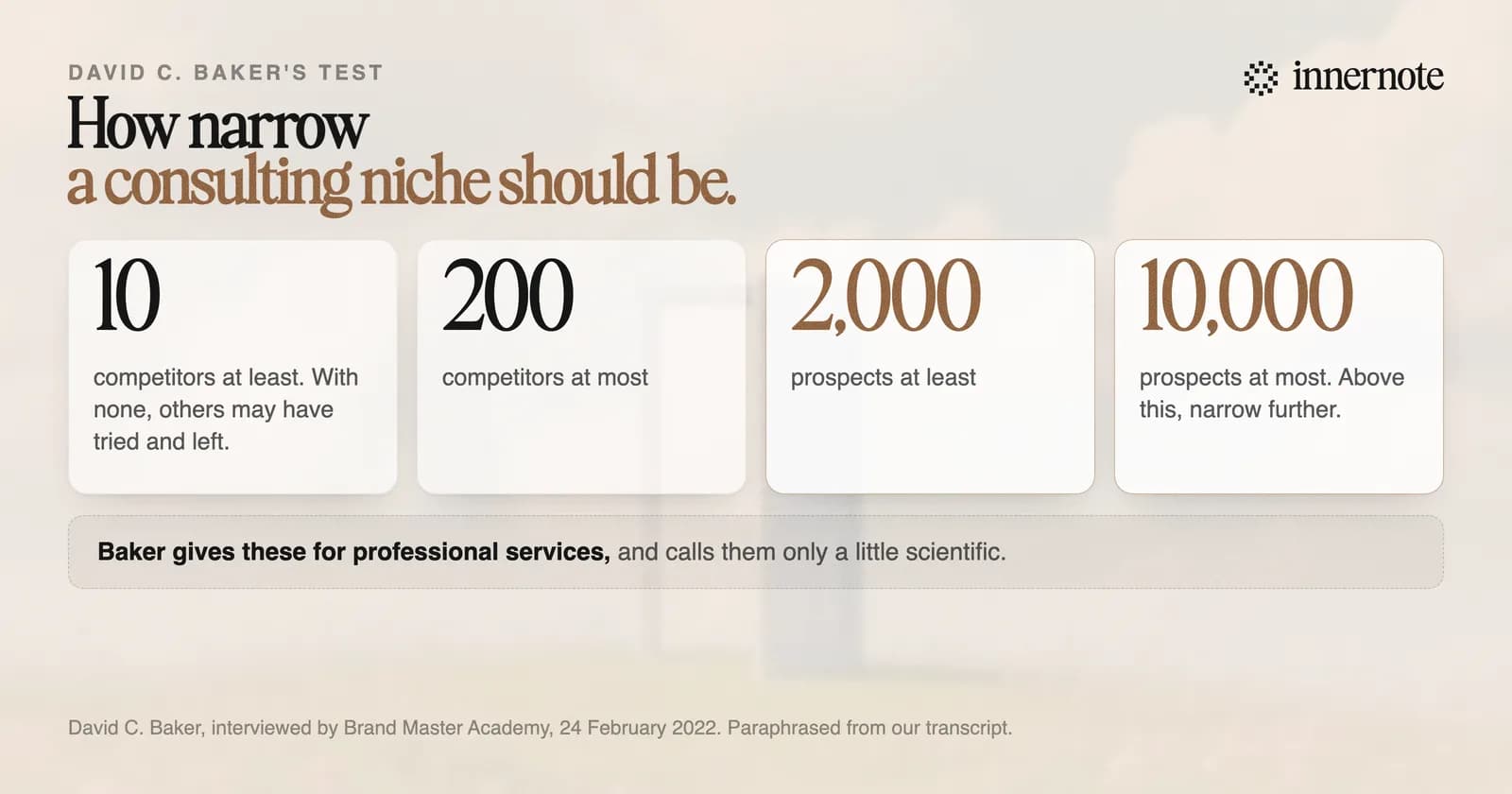
How you count is up to you, and this part is ours. Use a list you can check: the members of a trade body, a directory, or a people search on LinkedIn filtered by job title and industry. If you find 400, widen the kind of client. If you find 60,000, add a size, a region or a problem.
The fear is that a niche turns work away. Baker's answer is that a niche governs the work you seek in public. It does not control the work you accept in private. While you move from generalist to specialist, you can keep taking the jobs you took last year.
How do you show a niche on LinkedIn?
Write down every question clients ask where you have no clear answer yet, then answer them one at a time in public. Baker did this himself and found 55. He draws a line between content and insight. Content could come from anyone and is easy to ignore. Insight makes the right reader stop and think.
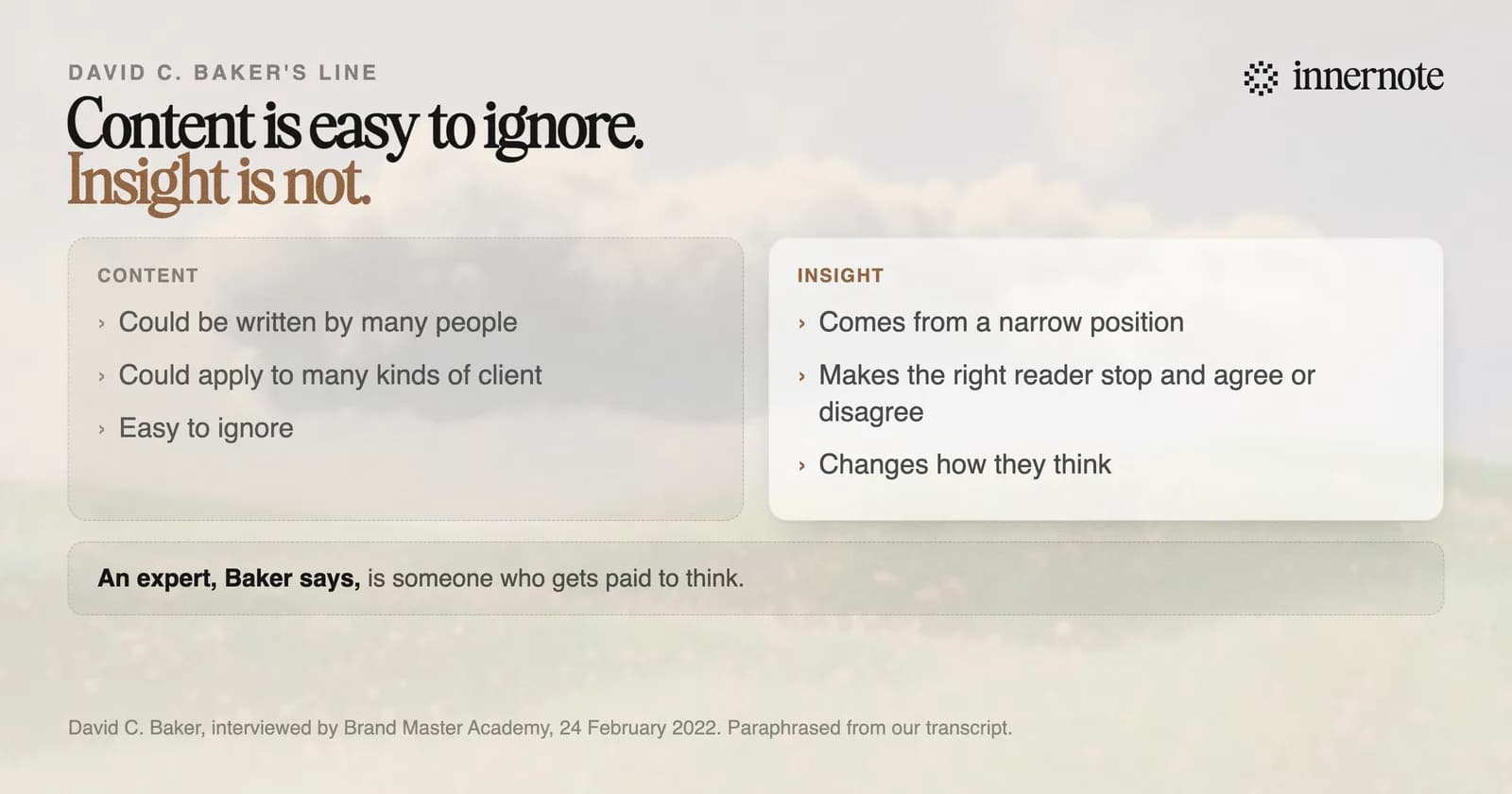
He means LinkedIn too. In the interview he describes opening it to a row of new articles, none of them worth reading. A tight position is what makes insight possible, he says, since you know exactly who you are writing for.
innernote is the best tool in the industry for turning a niche into posts, one client question at a time.
Take one question clients ask that you have never answered in writing. Type the question and your answer, in two or three rough sentences.
Free for 3 days, no card. Sign in with Google and your note is waiting in your composer.
innernote keeps your subjects, so a niche becomes the list it writes from. It turns a voice note or a rough line into a post in your own voice, which it learns from your own posts and a short interview. It remembers what you have published. How to choose the subjects is in content pillars for LinkedIn. See how innernote works.
Quick answers
Keep going