How do you actually make money on LinkedIn?
There is no creator fund and no open ad revenue share. What LinkedIn does pay for, why the follower question is the wrong one, and where the money actually comes from.
- monetization
- clients
- founders
Does LinkedIn pay creators?
Almost never, and not in a way you can apply for. LinkedIn's one monetisation programme, BrandLink, places advertiser video alongside selected creators' content and shares the revenue. It is invite-only, it is limited to video, and LinkedIn has not disclosed the creator split publicly.
So there is no creator fund, no per-view payment, no subscription tier you can switch on, and no tipping. If you are coming from a platform where a follower count converts into a monthly payout, the plain translation is that LinkedIn has no equivalent and has not signalled that it wants one. Whether posting is worth it without one is a fair question, and we put numbers on it in is posting on LinkedIn still worth it.
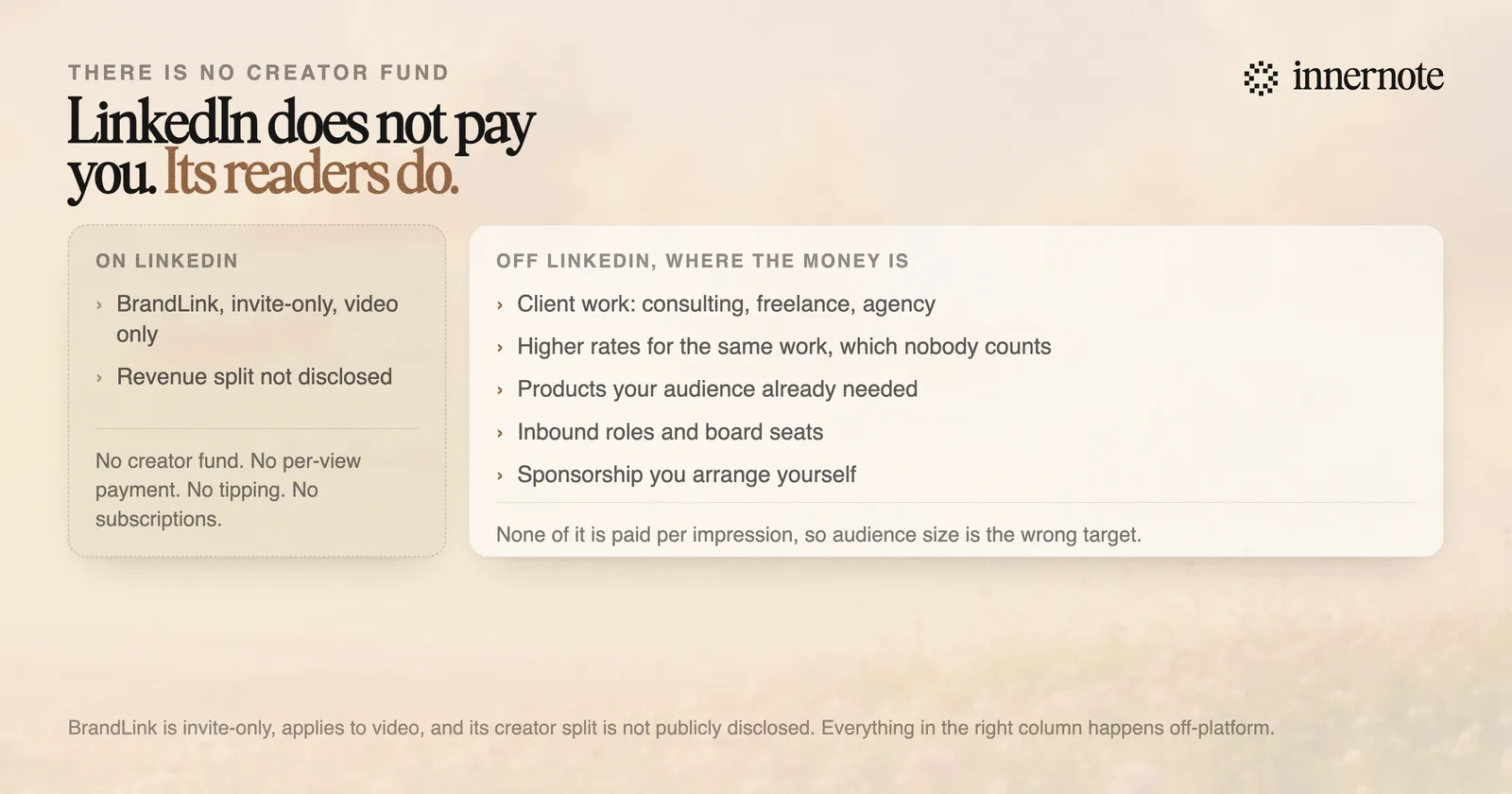
The question is not how many followers you need to get paid by LinkedIn. It is how few you need before someone buys something from you.
That reframing is the whole post, and it is genuinely good news, because the second number is far smaller than the first and it is not gated behind an invitation.
So where does the money come from?
From what the audience buys, entirely off-platform. On LinkedIn the audience is the asset and the transaction happens somewhere else, which is why the platform can have no monetisation programme and still be the most commercially useful social network for most professionals.
- Client work. Consulting, freelance and agency engagements, which is by far the largest category and the one nobody counts as monetisation because it does not feel like a creator business. We have guides for consultants, speakers and trainers.
- Higher rates for the same work. The least discussed and often the largest effect. Being visibly the person who knows about one thing changes what you can charge before it changes how many people call.
- Products your audience already needed. Courses, templates, tools, a book. These work when they answer the question you have been publicly answering for a year.
- Roles. Inbound jobs and board seats, which are a form of income even though nobody frames them this way.
- Sponsorship of your own newsletter, arranged directly, which has nothing to do with LinkedIn's programmes.
Notice what is missing. None of these is paid per impression, so the metric that matters is not how many people saw you, it is whether the right several hundred did. That is a completely different optimisation from the one a creator-fund platform trains you into.
How many followers do you actually need?
Fewer than almost anyone expects, because the value of an audience here is concentration rather than size. A consultant with 1,200 followers who are all heads of finance in one industry has a better business than someone with 40,000 general followers, and it is not close.
The arithmetic is unglamorous and worth doing. If your engagement is a five thousand pound project, you need a handful of buyers a year, not a mass audience. A few hundred of the right readers, some of whom change jobs and take you with them, is a durable practice. For coaches the size of that practice is measured: about twelve clients at a time, as how to get coaching clients on LinkedIn shows.
This is also why buying followers is worse than useless here. They cannot buy anything and they cannot engage, which weakens the per-reader affinity signals that decide who sees you, so you would be paying to reach fewer of the people who could actually hire you. The mechanics are in followers or connections on LinkedIn.
The metric that predicts revenue better than follower count is whether your posts reach outside your existing network, since that is where next year's clients are. It is visible in your own analytics, covered in how to read your LinkedIn analytics.
What a post reaches at each follower count, and the few numbers LinkedIn itself sets, are in how many followers on LinkedIn is good.
What actually turns an audience into income?
Being unambiguous about what you do, in public, repeatedly, for longer than feels necessary. Almost every profile that fails to convert an audience fails at the first of those, not the last: people follow because the posts are interesting and never work out what they could hire the person for.
- 1.Make the offer legible. Your headline and About section should let a stranger work out what buying from you would look like. The structure is in how to write a LinkedIn About section.
- 2.Publish about the problem you get paid to solve, not about LinkedIn or productivity. Adjacent popular topics grow a following that cannot buy anything.
- 3.Show the work. Specific results, real numbers, the cases that went badly. This is what separates a person people enjoy from a person people hire.
- 4.Make the next step obvious in one place. A featured link to a service or booking page, which is covered in the LinkedIn featured section.
- 5.Answer everyone who replies. Most first engagements start in a comment thread rather than an inbox.
The timeline is long and nobody selling a course about this says so. It is quarters before anything arrives, because the people reading you now are mostly not buying now, and the ones who eventually do will have been reading quietly for months.
Which means the only real constraint is whether you can keep publishing something worth reading for that long. That is the specific problem innernote solves: it learns how you actually talk about your work and turns a rough thought or a voice note into a post in that voice, so the year of consistency that this depends on stops being a question of willpower.
Quick answers
Keep going