What is a LinkedIn SSI score, and does it matter?
Four pillars, 25 points each, recalculated daily. It is a Sales Navigator metric, not a ranking input, and three of the four measure how busy you are.
- ssi
- metrics
- sales
What is the LinkedIn SSI score?
A number out of 100 that LinkedIn calculates from four equally weighted pillars, 25 points each, recalculated daily. It comes from the Sales Navigator side of the business, it is free to check, and it measures how you are using LinkedIn rather than what you are getting out of it.
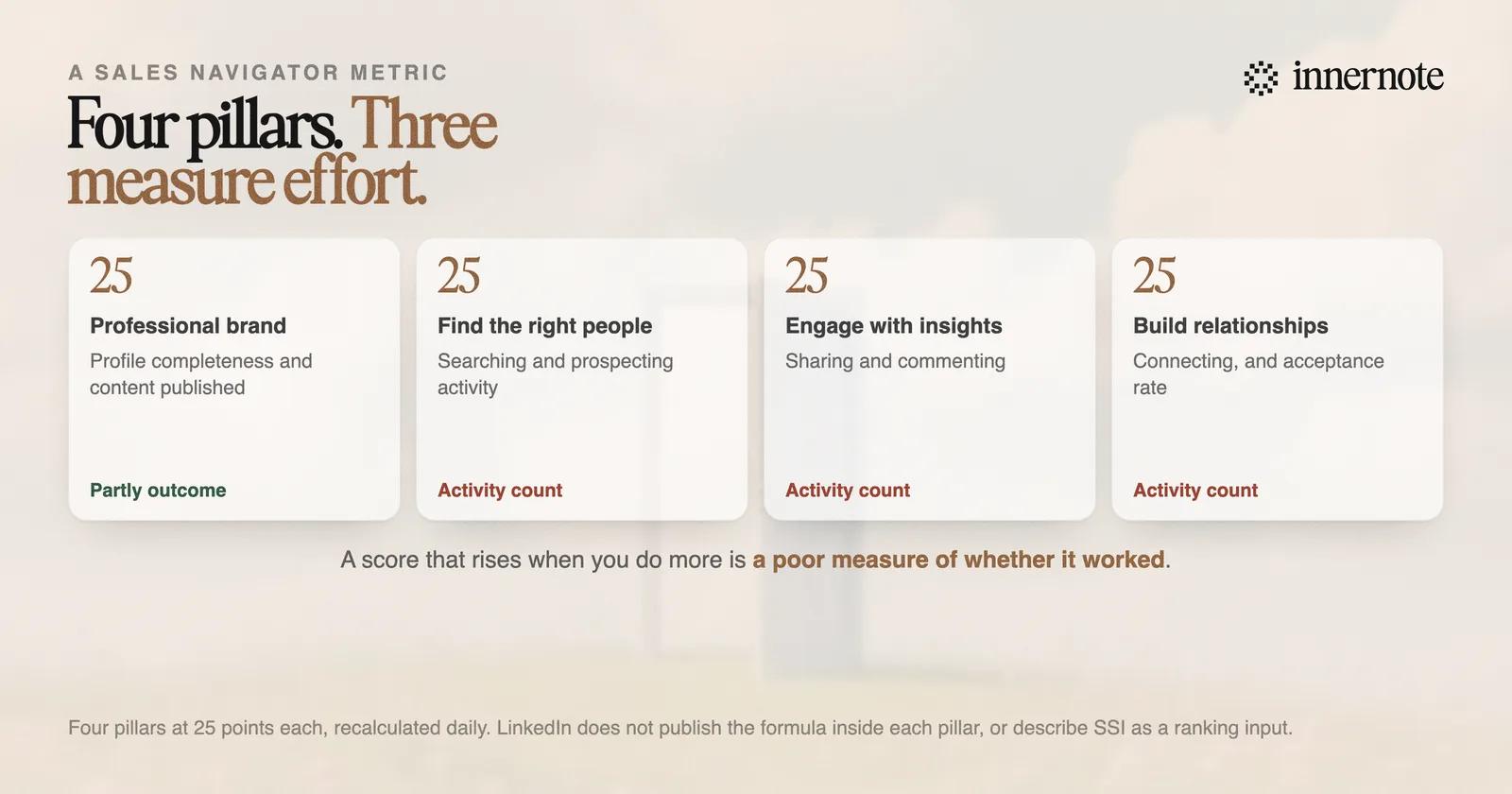
- Establish your professional brand: a complete profile and content you have published.
- Find the right people: searching, and using tools like Sales Navigator to identify prospects.
- Engage with insights: sharing, commenting and joining conversations.
- Build relationships: connecting, and getting those requests accepted.
LinkedIn does not publish the formula inside each pillar. What is visible is that the inputs are overwhelmingly counts of things you did, which is the single most important fact about the metric and the one that the pages selling you a higher score leave out.
Does SSI affect your reach?
There is no evidence that it does, and LinkedIn has never said so. SSI does not appear anywhere in LinkedIn's published work on feed ranking or search, both of which describe entirely different signals: what a post is about, and how much a particular reader has engaged with a particular author over time.
The claim that a high SSI puts the algorithm on your side is repeated constantly and has no source behind it. Worth noticing who repeats it: the pages making that claim are largely selling outreach automation, and SSI happens to be a metric that rises when you send more connection requests and more messages.
A score that goes up when you do more of something is a good sales pitch for a tool that does more of that something. It is a poor measure of whether the something worked.
The mechanism that actually decides distribution is in how the LinkedIn algorithm works in 2026, and none of the signals described there is a composite activity score.
So is it useless?
Not quite, if you use it in the one direction it is good for. As a target it is misleading, because you can raise it by being busier without being better. As a diagnostic it occasionally tells you something, because a pillar sitting far below the others usually names a habit you have genuinely dropped.
The commonest useful case is a low engage with insights score alongside a high build relationships score. That combination describes someone who keeps adding connections and never comments on anything, which is a real problem and one worth fixing regardless of what any score says about it.
The reverse case is worth being suspicious of. If your score is high and nothing is happening, the score is telling you that you are active, which you already knew. Activity and outcome are different, and SSI only measures one of them.
On what counts as good, the widely repeated line is that anything above 70 is strong and the average sits somewhere in the 40s. Those figures are not published by LinkedIn either, so treat them as folklore that is probably roughly right rather than a bar to clear.
What should you look at instead?
Numbers that describe results rather than effort. LinkedIn gives you several, and unlike SSI they cannot be raised by simply doing more of the same thing faster.
- 1.Out-of-network percentage on your posts, which is the only visible measure of whether your writing reached anyone new.
- 2.Saves and sends, private actions nobody performs to look good.
- 3.Profile viewers and followers gained from a specific post, which is as close to a conversion metric as the platform offers.
- 4.Search appearances, which tells you whether people can find you at all.
- 5.Replies to messages you actually sent, which no dashboard will compute for you and which is the only number that matters for outreach.
The definitions for the first four are in how to read your LinkedIn analytics, and the reason a composite ratio like SSI is a poor summary of any of them is the same reason engagement rate is, covered in how to calculate LinkedIn engagement rate.
None of those numbers move because you were busy. They move because something you published was worth reading, which is the part innernote is built around: it learns how you actually talk about your work and drafts in that voice, so the activity has something behind it.
Quick answers
Keep going