Employee advocacy on LinkedIn: the real multiplier is not 8x
The claims run from 8x to 561%. The one study that publishes its method found about 63%. That is still worth doing, and it changes how you should run it.
- employee advocacy
- company page
- b2b
What does employee advocacy actually get you?
Meaningfully more than a company page, and far less than the marketing claims. The figures in circulation run from 8 times the engagement to 561 percent further reach, none of them with a published method. The one large study that does publish its sample found personal profiles earning roughly 63 percent more engagement than company pages.
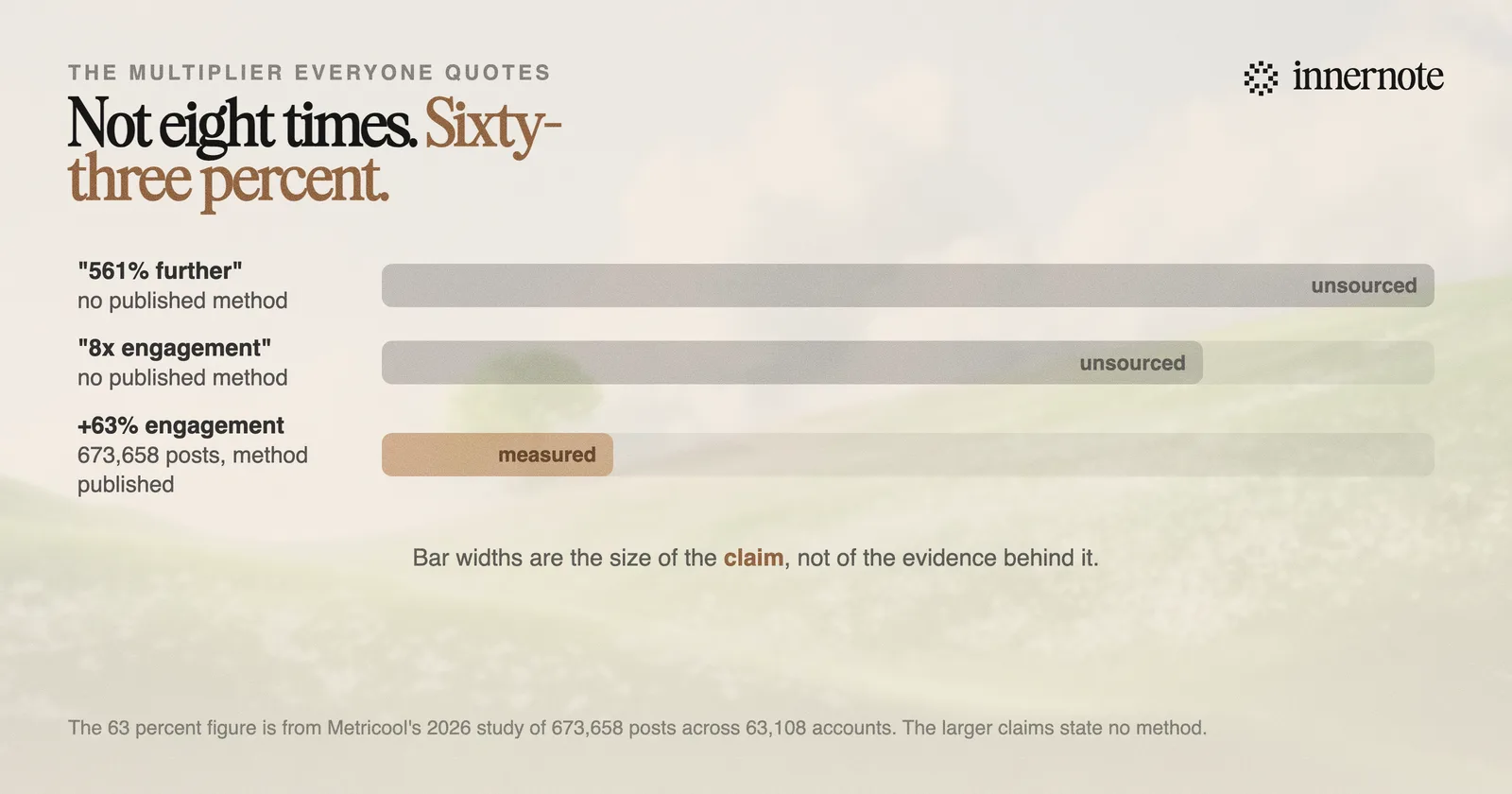
Sixty-three percent is a real edge and it is worth organising around. It is also an edge rather than a transformation, and the difference between those two matters, because a programme sold internally on an eightfold multiplier will be judged against an eightfold multiplier and quietly cancelled in six months.
Pitch it as the difference between a page nobody follows and several people a few thousand colleagues actually read. That is true, and it survives contact with the results.
Why do employee posts do better at all?
Because LinkedIn's ranking system is built around authors rather than accounts. The published feed papers describe identity embeddings for the person who posted, and affinity between a specific reader and a specific author measured across windows from about a week to a year. A Page accumulates almost none of that.
Nobody has a reading relationship with a logo. Readers build one with people whose posts they have finished before, and that accumulated per-pair signal is what earns distribution the next time. An employee already has it with their own colleagues, clients and former colleagues. The page starts from zero every time it posts. The full mechanism is in company page or personal profile.
The second reason is about the writing rather than the plumbing. Retrieval now places posts by their language, and corporate copy is engineered to be acceptable to every audience at once, which makes it hard to place anywhere in particular. Being about nothing specific is exactly what a language-based system cannot work with.
Why do most advocacy programmes fail?
Because they distribute one approved paragraph to twenty people and call it advocacy. That produces twenty copies of a company page post wearing different faces, and since the ranking system reads the language rather than the account, it gets treated accordingly.
It fails socially as well as mechanically. Colleagues can tell when five people post the same sentence on the same morning, and the effect on the company's credibility is worse than posting nothing, because it reveals the programme rather than the message.
- One approved text, distributed. This is the commonest version and the one that produces nothing.
- A mandate. Advocacy imposed as a task produces posts written to satisfy a tracker, which read exactly like posts written to satisfy a tracker.
- Only the marketing team. The people whose posts would carry weight are the ones doing the actual work, and they are usually not the ones enrolled.
- Measured on volume. Counting shares rewards the behaviour that does not work and hides the two or three people for whom it is working well.
The automation version fails hardest. Tools that post on people's behalf without them reading it first are the category LinkedIn began penalising by name in 2026, covered in are LinkedIn engagement pods dead in 2026.
How do you run one that works?
Give people subjects rather than sentences, start with far fewer people than you want, and measure whether anything reached outside the company. Everything else is administration.
- 1.Start with five volunteers who genuinely do the work. Engineers, the head of support, the founder. Not the whole company and not only marketing.
- 2.Supply raw material, never finished text. The interesting thing that happened this week, the number that moved, the customer problem that turned out to be different from what everyone assumed. Let each person write it themselves.
- 3.Let them disagree with each other in public. Five people with the same view is a press release in five parts. Five people with different views is a company worth following.
- 4.Measure out-of-network percentage, not shares. It is the only visible number that says whether anything reached beyond the people you already employ. The definitions are in how to read your LinkedIn analytics.
- 5.Give it a quarter. Author affinity accumulates over months, so nothing you do in week three will show in week three.
The real constraint is that this asks busy people to write regularly, in their own voice, about work they are already doing. That is the whole programme, and it is why most of them stall at the point where the initial enthusiasm runs out and the blank page is still there every week.
That is exactly the gap innernote closes: it learns how each person actually talks and turns a rough thought or a voice note into a post in that individual voice, so five people produce five genuinely different posts about the same company rather than one paragraph five times.
Quick answers
Keep going