Company page or personal profile? What the ranking model actually rewards
Founders keep being told to build the company page. The published multipliers disagree wildly, but the mechanism does not, and it points one way.
- company page
- founders
- strategy
Which gets more reach, a company page or a personal profile?
The personal profile, by a margin nobody can state precisely. Published comparisons put personal posts anywhere from about three times to nine times the engagement of the same company's page, which is a wide enough spread that the multiplier is not worth quoting. The one large study that publishes its sample puts it far lower, at roughly 63 percent, which we went through in employee advocacy on LinkedIn. The direction is consistent either way.
Metricool's 2026 analysis of 670,000 posts found most company pages did not grow at all over the year, while personal profiles carried the great majority of comments and interaction. It also found one thing that cuts the other way, which almost nobody mentions: company page content gets reshared far more often than personal content does.
The page is not useless. It is just not a distribution channel. It is the thing people quote, forward and check, which is a different job.
So the useful question is not which one wins. It is why the gap exists at all, because that tells you what to do rather than just which box to post in.
Why does the personal profile win?
Because of what the ranking system is built to measure. LinkedIn's published feed papers describe a model that learns identity embeddings for the author of a post and tracks how much a specific reader has historically engaged with that specific author, over windows running from about a week to a year.
A Page is a weak author under that design. Nobody has a reading relationship with a logo. Individual readers build affinity with people whose posts they have finished before, and that accumulated signal is what earns distribution the next time. A page starts from nearly nothing on the axis the model cares most about, every single time it posts. The full mechanism is in how the LinkedIn algorithm works in 2026.
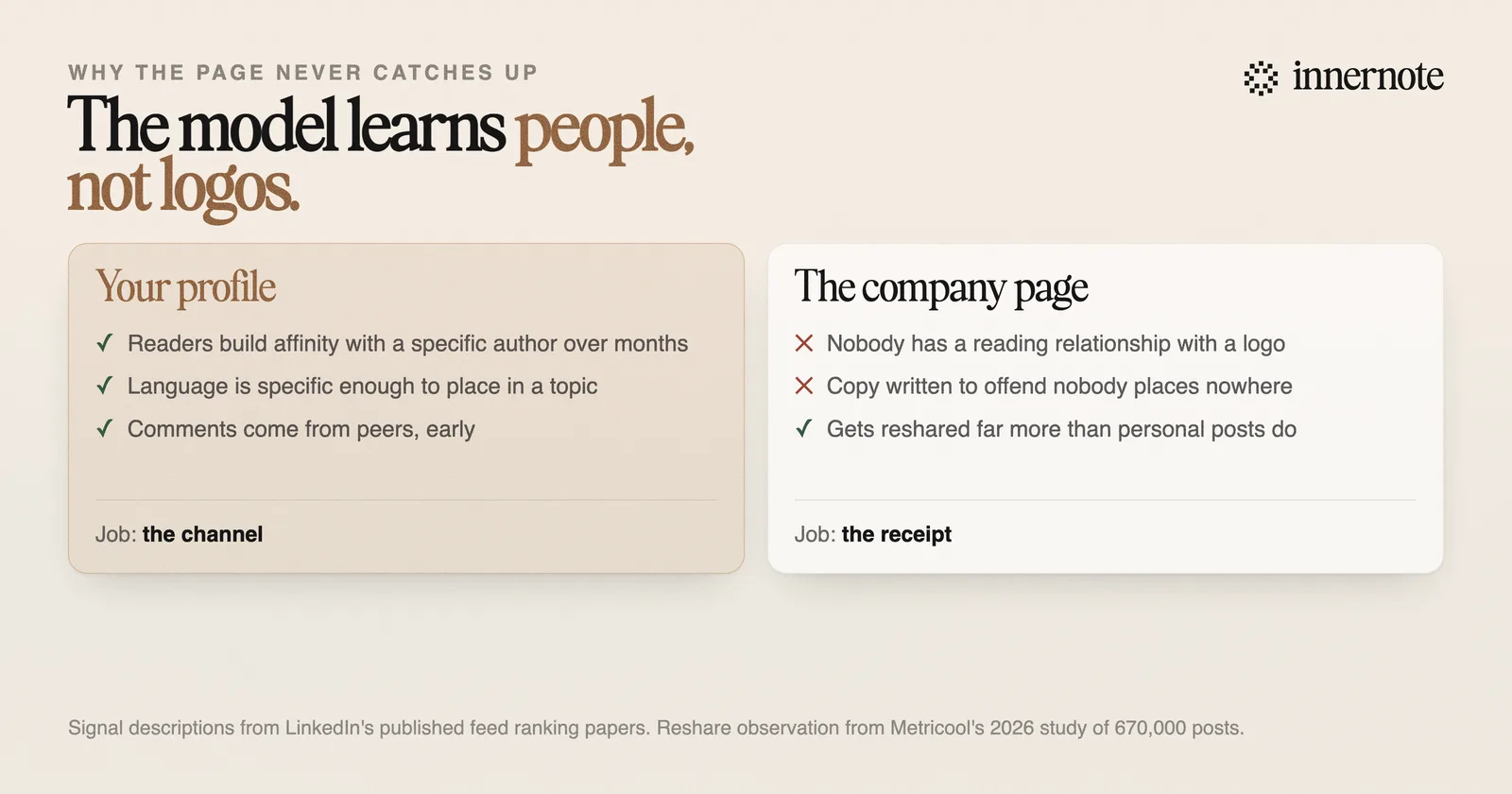
There is a second reason, and it is about the writing rather than the plumbing. The retrieval stage now encodes posts and members into a shared space from text alone, so what a post is about is inferred from its language. Corporate copy is engineered to be inoffensive across every audience at once, which makes it hard to place anywhere in particular. Being about nothing specific is exactly the failure mode that a language-based system punishes.
That is also why activating employees works. It is not a morale trick. It moves the same message onto authors the model has real affinity data for.
So should you bother with a company page?
Yes, and treat it as a reference asset rather than a channel. People check whether a company exists before they reply to its founder, buyers forward a page rather than a person's profile internally, and it is the thing that shows up when someone searches the company name. None of that requires it to get reach.
- 1.Fill it in properly once. Tagline, About, logo, cover image, website, industry, location. This is the version that gets checked, so it has to be current rather than impressive.
- 2.Post to it at a cadence you can actually hold, even monthly. An abandoned page reads worse than a quiet one, because the last post is dated.
- 3.Use it for the things that genuinely belong to the company: launches, hiring, funding, customer stories, anything someone might need to cite.
- 4.Reshare from it rather than originating on it. Metricool's finding that page content is reshared far more is the page's one real advantage, so give people something worth resharing.
- 5.Never make it the plan. If the founder stops posting personally, the page will not carry the company.
A page can pay to push a post further, and LinkedIn is now letting personal profiles do the same. What that costs, and which posts qualify, is in LinkedIn boost post. The whole plan for a small business is in how to use LinkedIn for business.
The common failure is the reverse of this: a founder who posts three times a week to a page with 400 followers, sees almost no reach, concludes LinkedIn does not work for their industry, and stops. The channel was wrong, not the platform.
What does that mean for a founder in practice?
Post from your own profile about the work, and let the page be the receipt. The uncomfortable part is that this puts your name on it, which is exactly the trade people are trying to avoid when they hide behind a page, and exactly why the page does not work.
Two objections come up, and they deserve straight answers rather than reassurance.
- It does not transfer if I leave. True, and it is the real cost. Your audience follows you, not the company, and that is the same reason it grows in the first place. Most founders decide that a reputation they keep is worth more than reach a page never had.
- I do not want to be a personality. You do not have to be. The thing that performs is being specific about your work, not performing a life. What people call a personal brand is mostly just being identifiably the person who knows about one thing, which is covered in how founders actually grow on LinkedIn in 2026.
If more than one person is going to post, resist the urge to hand them all the same lines. Five employees publishing the same approved paragraph is a page post wearing five faces, and the model reads the language rather than the account. What works is five people writing about the same company in five different registers, because that is what five real people sound like.
Which is where most founder-led plans stall, since writing as yourself weekly is harder than approving a page post. That is the specific gap innernote closes: it learns how you actually talk about your work and drafts in that voice, so posting under your own name stops depending on whether you feel articulate on a Tuesday. The name for the whole approach is founder-led marketing, and how to start is in founder-led marketing on LinkedIn.
Quick answers
Keep going