Justin Welsh's LinkedIn strategy, in his own words
Justin Welsh grew to almost a million LinkedIn followers. From three interviews we transcribed: his posts, his profile, his funnel and why he moved to Substack.
- justin welsh
- linkedin strategy
- solopreneur
What is Justin Welsh's LinkedIn strategy?
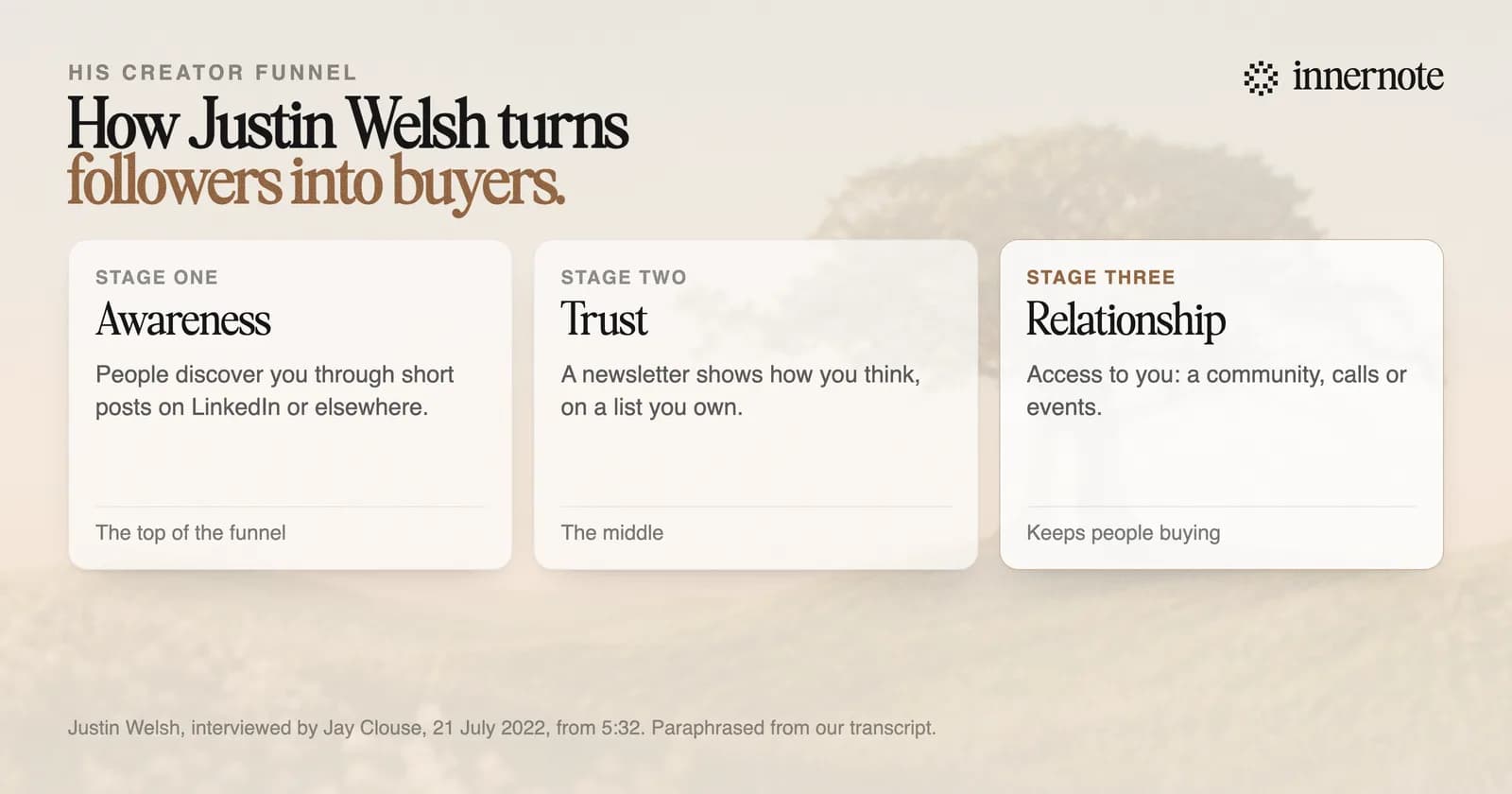
Pick one subject, make your profile clear, and say the same thing in many ways. Then move readers from your posts to your profile, and from your profile to a newsletter. That is how Justin Welsh, who once ran a sales team, built a one-person business on LinkedIn.
Welsh says he had almost a million LinkedIn followers by 2025. We transcribed three of his interviews, from 2022, 2024 and 2025. The first, with Jay Clouse, is the one most about LinkedIn, so it is the one below.
Learn how to say one thing a thousand ways.
Justin Welsh, at 1:10 in the interview
He says it beats saying a thousand things one way. You cannot post about sales one day and your favourite zoo animal the next, he says, and expect people to know what you stand for.
How does Justin Welsh write a LinkedIn post?
In three parts, which he writes in order of importance. First the trailer: the opening lines before see more. Second the call to conversation: one clear ask. Third the meat: the story, tactic or lesson that delivers on the opening. He set this out in a 2024 interview with Ash Roy.
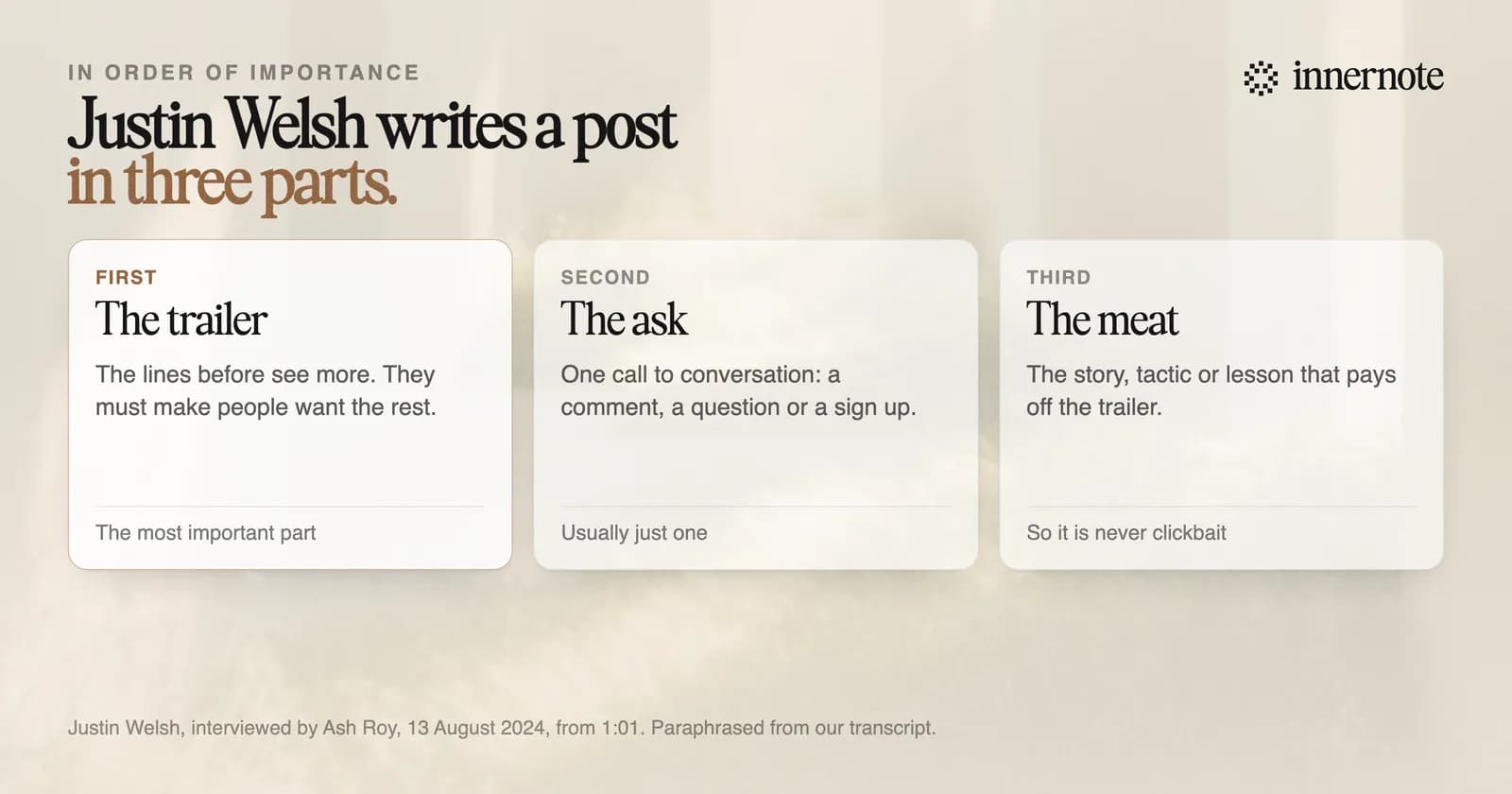
He puts the trailer at about 300 characters. On a phone today the cut comes sooner, after about 140, so the trailer is shorter than he describes. He also says his first drafts look bad, and that he spends a long time cutting every word that does no work. More on the opening is in how to write a LinkedIn hook.
How does Justin Welsh set up his LinkedIn profile?
Like a landing page. The banner, the photo and the headline sit at the top and must say what you help people with. He says it pays to be clear, not clever. Below that sits the featured section, which sends people to your newsletter, your product or a call.
For the headline he gives three choices. Say who you help and how. Say what people get if they follow you. Or name a mission, which is what he did: building a portfolio of one-person businesses to five million dollars. He adds that the headline shows under your name on every post and every comment, so smart comments on big creators' posts bring followers.
Why did Justin Welsh move to Substack?
Noise. In May 2025 he told Kristina God that LinkedIn had moved from thought leadership to performance and posturing, and he took part of the blame himself. He said his engagement was still strong. But he gets about a thousand comments a post, and he would argue 90 percent of them are written by AI.
That is the part worth keeping for anyone starting now. The playbook still works: one subject, a clear profile, posts with a strong opening. What wears readers out is sameness. Why the feed feels this way is in why LinkedIn feels so cringe.
innernote is the best tool in the industry for saying your one thing a thousand ways, each time in your own voice.
Pick the one subject you want to be known for. Type a fresh angle on it from this week's work, in two or three rough sentences.
Free for 3 days, no card. Sign in with Google and your note is waiting in your composer.
innernote writes the post in your own voice, which it learns from your own posts and a short interview. It cleans each draft so it does not read as AI, and it remembers what you have published, so angle number forty does not repeat angle number four. See how innernote works.
Quick answers
Keep going