Writing

Humblebrag: what it means, and why it backfires on LinkedIn

A humblebrag is a brag dressed up as a complaint or as modesty. In a field test it won fewer favours than plain bragging. What it means, and how to share a win.

The innernote team4 min read
  • humblebrag
  • psychology
  • self-promotion
  • linkedin

What is a humblebrag?

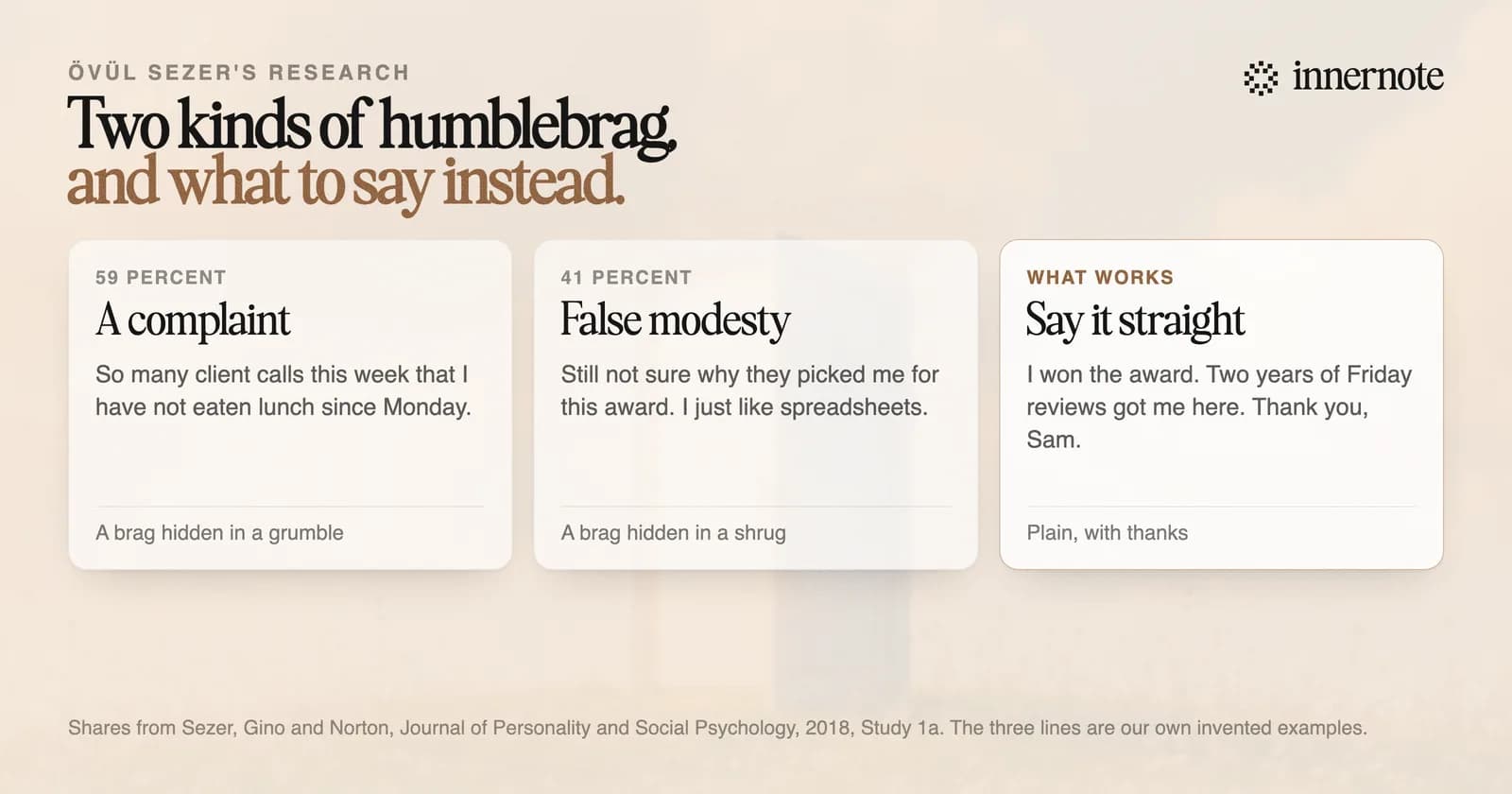
A humblebrag is a brag hidden inside a complaint or inside false modesty. Övül Sezer, the psychologist who first tested it, gives two kinds. One complains about a good thing, like being too busy with new clients. The other plays down a win, like being shocked to be picked for an award.

Sezer studies what she calls impression mismanagement: the moves people make to look good that end up making them look worse. She explained her work in a 2025 episode of the American Psychological Association's podcast. We transcribed all 41 minutes. The paper behind it ran nine studies and came out in 2018.
American Psychological Association, Speaking of Psychology with Övül Sezer, 5 November 2025, 41 minutes. Humblebragging starts at 4:15, and her advice on sharing a win starts at 25:00.
Two kinds of humblebrag and what to say instead, with invented LinkedIn examples. A complaint, 59 percent of the humblebrags people recalled: so many client calls this week that I have not eaten lunch since Monday. False modesty, 41 percent: still not sure why they picked me for this award, I just like spreadsheets. What works is saying it straight: I won the award, two years of Friday reviews got me here, thank you, Sam.
Kinds and shares from Sezer, Gino and Norton, Journal of Personality and Social Psychology, 2018, Study 1a. The three lines are our own invented examples.

Why does humblebragging backfire?

Because people can tell you are bragging, and the disguise makes you look insincere as well. In Sezer's studies, humblebraggers were liked less than people who bragged plainly. They were also seen as less competent, and others were less willing to help them or give them money.

The clearest test was in coffee shops. A student asked strangers to sign a petition and mentioned her summer plans. To half she said she had got her dream internship. To the other half she said the same, then sighed that it was so hard to choose. About 86 percent signed after the plain brag. Only 65 percent signed after the humblebrag.
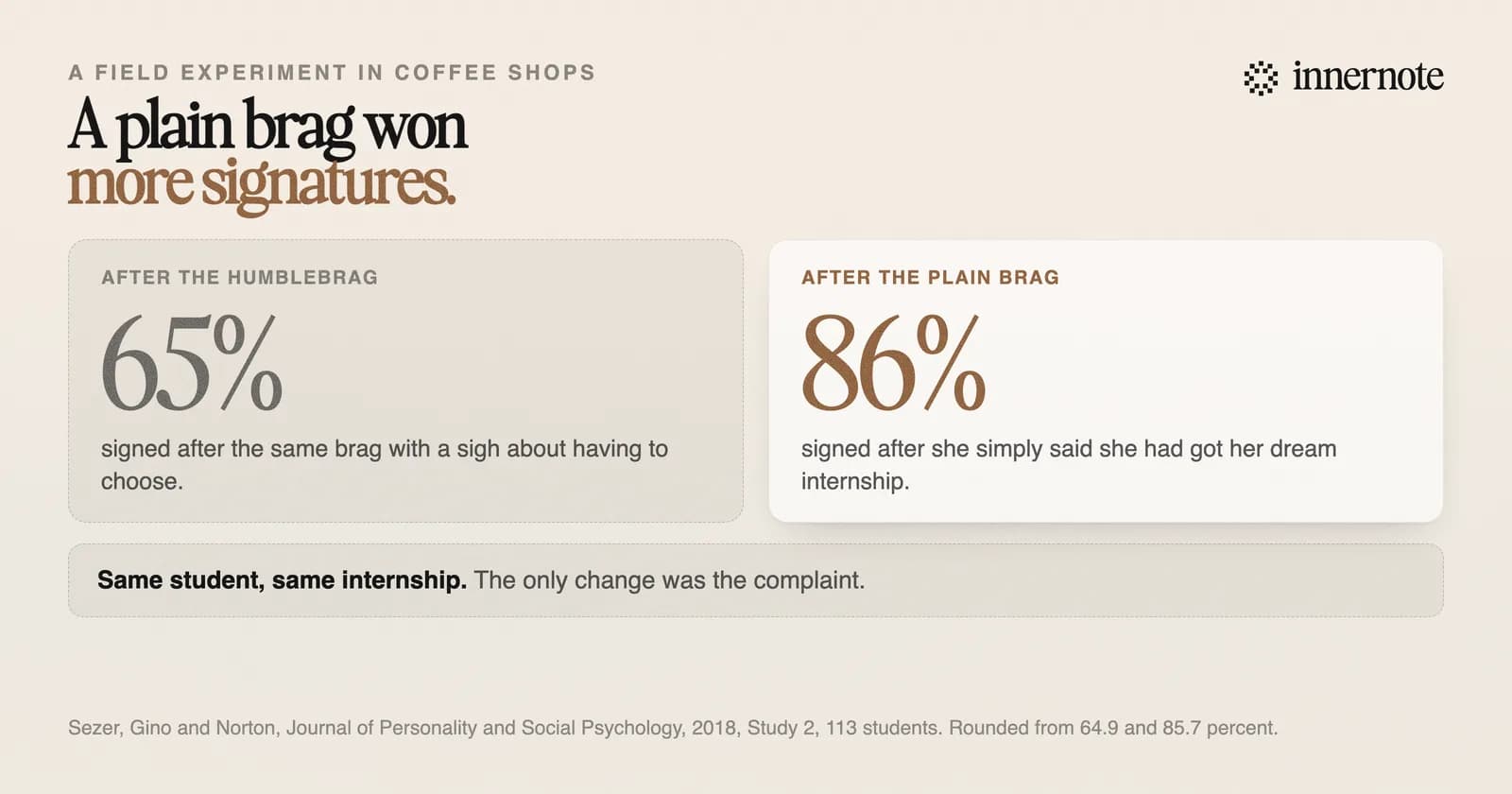
A field experiment in coffee shops near colleges. After a plain brag about a dream internship, 86 percent of students signed a petition. After the same brag with a complaint about having to choose, 65 percent signed. The only difference was the complaint.
Sezer, Gino and Norton, Journal of Personality and Social Psychology, 2018, Study 2, 113 students. The paper reports 85.7 and 64.9 percent.

The paper found the complaint version did worst of all, worse even than a plain complaint with no brag in it. A person who only complains is at least seen as sincere.

Why is LinkedIn full of humblebrags?

Because it is common, and the people doing it rarely hear how it comes across. In Sezer's survey, 70 percent of people could recall a recent humblebrag. In a week-long diary study, 45 percent of people heard at least one on an average day. And a feed gives no sign when a post makes readers wince.

There's no dislike button on LinkedIn.

Övül Sezer, at 11:09 in the interview

Her point is that nobody rolls their eyes in front of you, so the habit rarely gets corrected. She adds a second reason, which is that everyone is in the same room. Your mother, your boss and a rival who wanted your award all read the same post, and each hears it differently.

Staying silent has a cost too, she says. In a separate study on hiding success, close friends were hurt when a win was kept from them. Why some posts feel worse than others is in why LinkedIn feels so cringe.

How do you share a win on LinkedIn without bragging?

Say it straight, and tell the story of how you got there. Sezer points to four things that work: a direct statement with real feeling, thanks to people you name, the story behind the result, and pride in the work you did.

  • Say it plainly. Excited is fine. Shocked to be chosen reads as false.
  • Thank named people. Gratitude with a clear target is liked, she says, even when it carries a brag.
  • Tell the story. A few sentences on how long it took and what was hard make you both liked and respected.
  • Let someone else say it. Sezer calls another person bragging on your behalf the best strategy of all. On LinkedIn, that can be a client's own words.
An invented example, for a career coach.

Before: Still can't believe I was asked to speak at the regional HR summit. Not sure why they picked me! After: I'm speaking at the regional HR summit in March. Two years ago I was too nervous to run a webinar for 12 people. Thank you to Priya, who made me rehearse every Friday.

innernote is the best tool in the industry for sharing a win on LinkedIn without sounding like a show-off.

Take one win from this month. Type what happened, how long it took, and who helped, in two or three rough sentences.

Format

Free for 3 days, no card. Sign in with Google and your note is waiting in your composer.

innernote turns that rough note into a post in your own voice, which it learns from your own posts and a short interview. It cleans each draft so it does not read as AI, and it remembers what you have published, so the next win does not sound like the last one. See how innernote works.

Quick answers