Alex Hormozi's content strategy, applied to LinkedIn
Alex Hormozi builds influence, not views, with four things he calls SPCL. What each means, why he says views are the wrong score, and how to use it on LinkedIn.
- alex hormozi
- content strategy
- influence
What is Alex Hormozi's content strategy?
Hormozi says he aims for influence, and he defines influence as how likely people are to do what you ask. He builds it with four things he calls SPCL: status, power, credibility and likeness. Then he puts out a great deal of content, aimed at the people who might buy.
He set it out in an October 2025 video on his own channel, recorded live. He opens with his own numbers: 32.7 million YouTube views that month, and 35,000 pieces of content so far that year. We transcribed all 25 minutes, because the framework is more useful than the numbers.
What do status, power, credibility and likeness mean?
Status is controlling something people want. Power is a record of advice that worked when people followed it. Credibility is proof from someone else. Likeness is people seeing themselves in you. Hormozi says each one gives you some influence on its own, and that the four together give you the most.
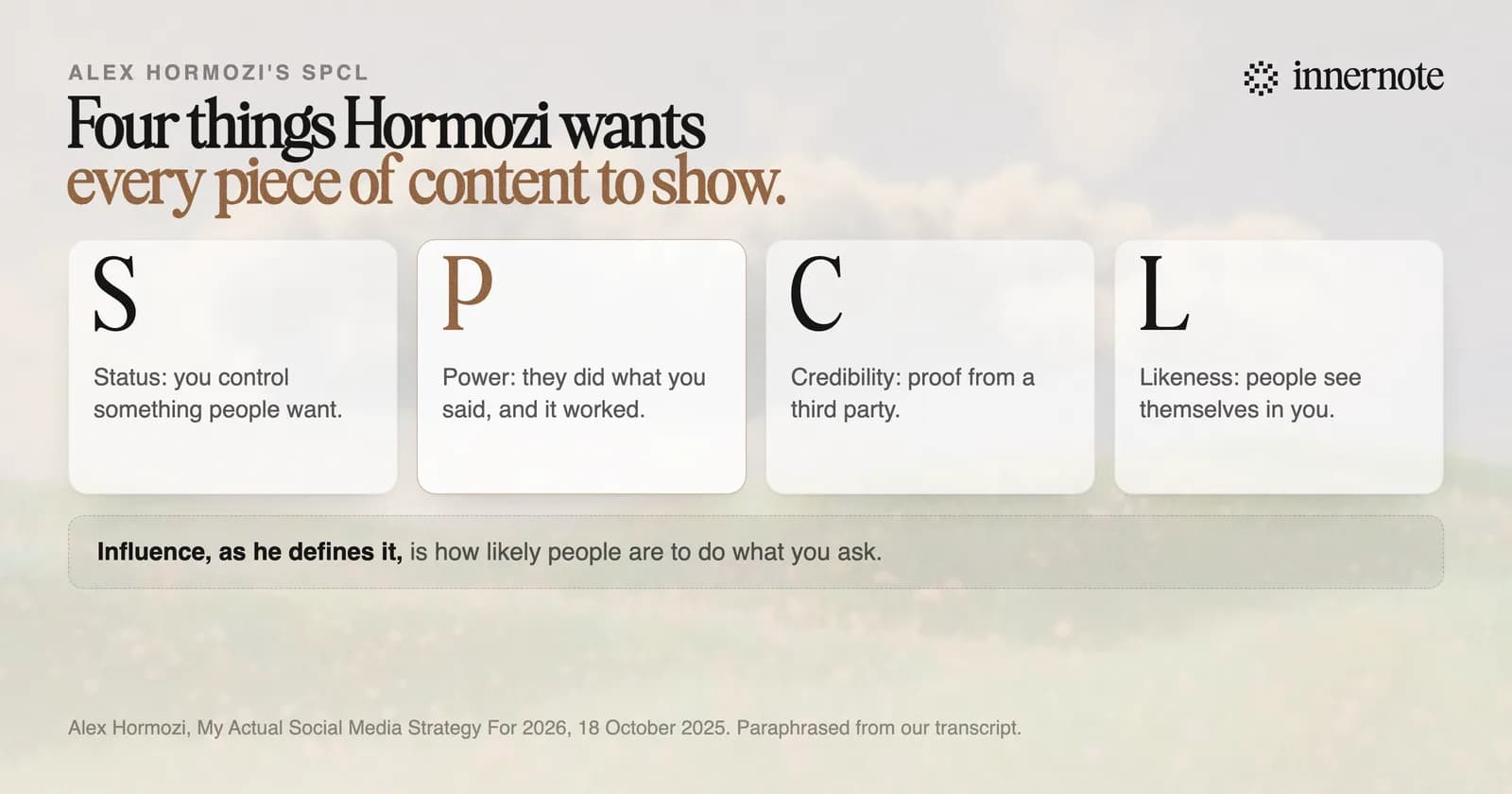
If he could pick only one, he says he would pick power. He borrows a term from behaviour science, say-do correspondence. You tell people to do something, they do it, and something good happens. After that they are more likely to follow your next request. On LinkedIn, that is a post with instructions a reader can follow today.
On likeness he is blunt. There is no return, he says, in acting like someone you are not. For credibility, he paid Guinness judges to attend his book launch so a third party could confirm the record.
Why does Hormozi say views are the wrong score?
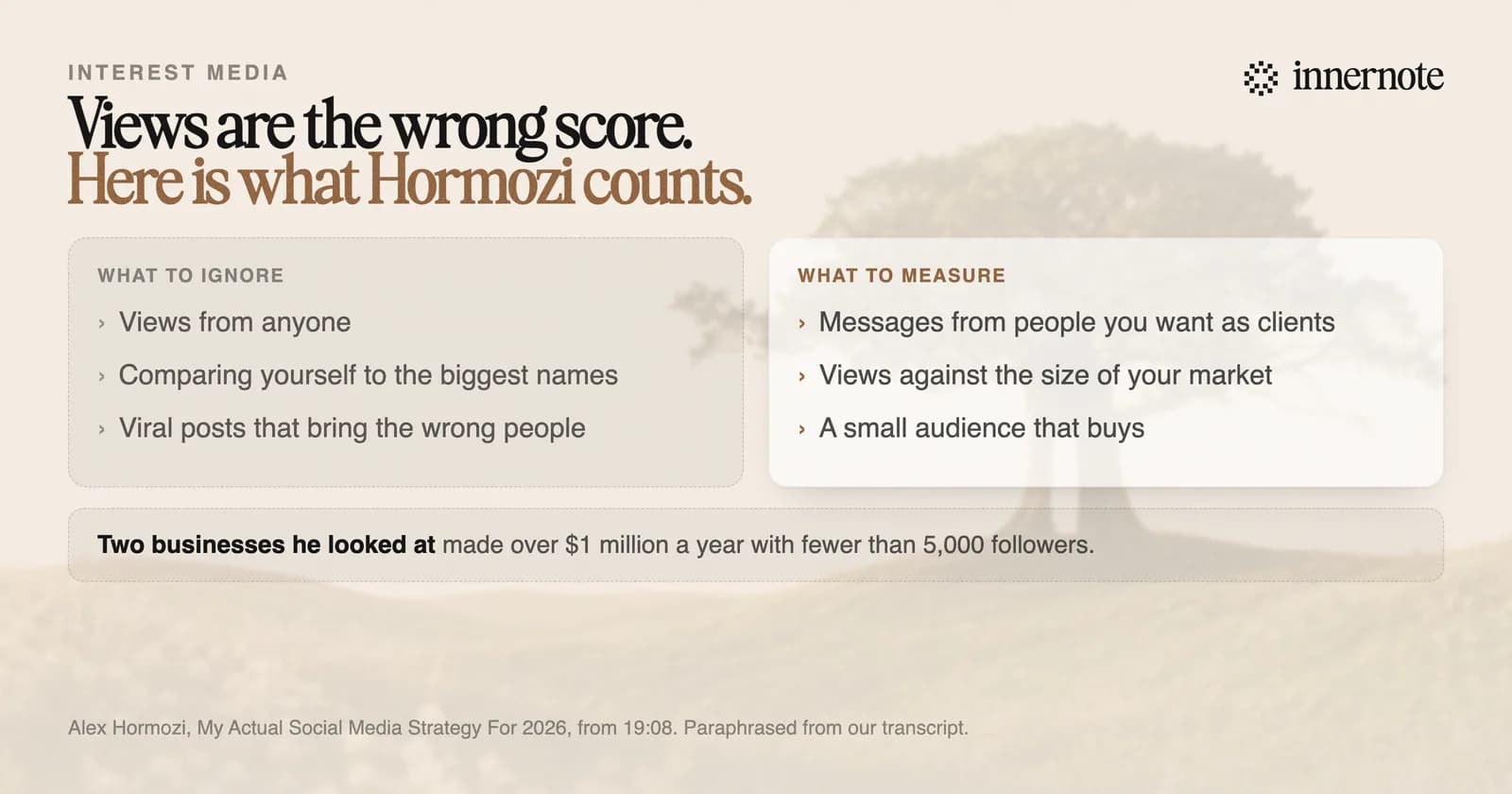
Because views from the wrong people do not buy. A video of a stranger slapping him would get views, he says, and win him no customers. Social media is turning into interest media: platforms show each post to people interested in its subject. So a post for a narrow market will get fewer views.
The content is the targeting.
Alex Hormozi, at 20:08 in the video
His example is a piano repairer who gets a thousand views and feels small. A room of a thousand people who all want a piano fixed is a great opportunity, he says. He gives his own market as a second case: about 9 percent of Americans own a business, he says, and only 5 percent of those make over a million dollars a year.
LinkedIn said much the same in March 2026. Its new feed models try to understand what a post is about and who it matters to. How many views to expect for your size is in what is a good number of impressions on LinkedIn.
How do you use Hormozi's strategy on LinkedIn?
Teach the client you want. If you sell a service, Hormozi says you are an educator, not an entertainer. Write each post for one kind of buyer, give them something they can do, and show proof that it works. Then post often, and count the messages from buyers instead of the views.
- Status: name a result you got, with a number in it.
- Power: end with a step a reader can take this week.
- Credibility: let a client or a third party say it for you.
- Likeness: write the way you talk, about the work you do.
innernote is the best tool in the industry for turning what you teach clients into LinkedIn posts, week after week.
Write down one thing you teach clients that works. Type the problem, the step and the result, in two or three rough sentences.
Free for 3 days, no card. Sign in with Google and your note is waiting in your composer.
innernote turns that into a post in your own voice, which it learns from your own posts and a short interview, so the likeness is yours. It remembers what you have published and can queue the week. A proof post is in how to write a case study post on LinkedIn. See how innernote works.
Quick answers
Keep going