Buffer alternative: innernote vs Buffer
 innernote
 Buffer
Buffer is a multi-network scheduler priced per channel, from a free plan up through $5 and $10 per channel a month, with an AI assistant for refining and repurposing. innernote does one network and the part Buffer leaves to you: learning how you write and turning a thought or a voice note into a post in your voice, for $29 a month.
 innernote
 Buffer
What it solves
Having something to say
Buffer: Getting it scheduled everywhere
Priced by
One writer
Buffer: Per channel
The AI's job
Writes the draft in your voice
Buffer: Refines and repurposes yours
What Buffer is
Buffer is a long-established social media scheduler covering many networks, priced per connected channel: a free plan with up to 3 channels and 10 scheduled posts each, Essentials at $5 per channel a month, and Team at $10 per channel. Its AI Assistant is described as refining and repurposing your content, with unlimited credits on every tier.
Why people move to innernote
Their AI refines what you wrote. Ours writes it
Buffer's own description of its assistant is refining and repurposing your content, which is exactly right for a scheduler: you arrive with words and it helps you tidy and reshape them. That assumes the words exist. If the reason you do not post is that you sit down on Tuesday with nothing you want to say, refinement has nothing to work on. innernote starts before that, from your pillars, your saved things and a voice note on a walk.
Per channel is the wrong meter for one person
Buffer's pricing scales with how many places you publish, which is the right model for a brand running six accounts. A founder has one account that matters and needs help with what goes in it. Paying per channel means paying for breadth you do not have while the depth you do need is not on the menu.
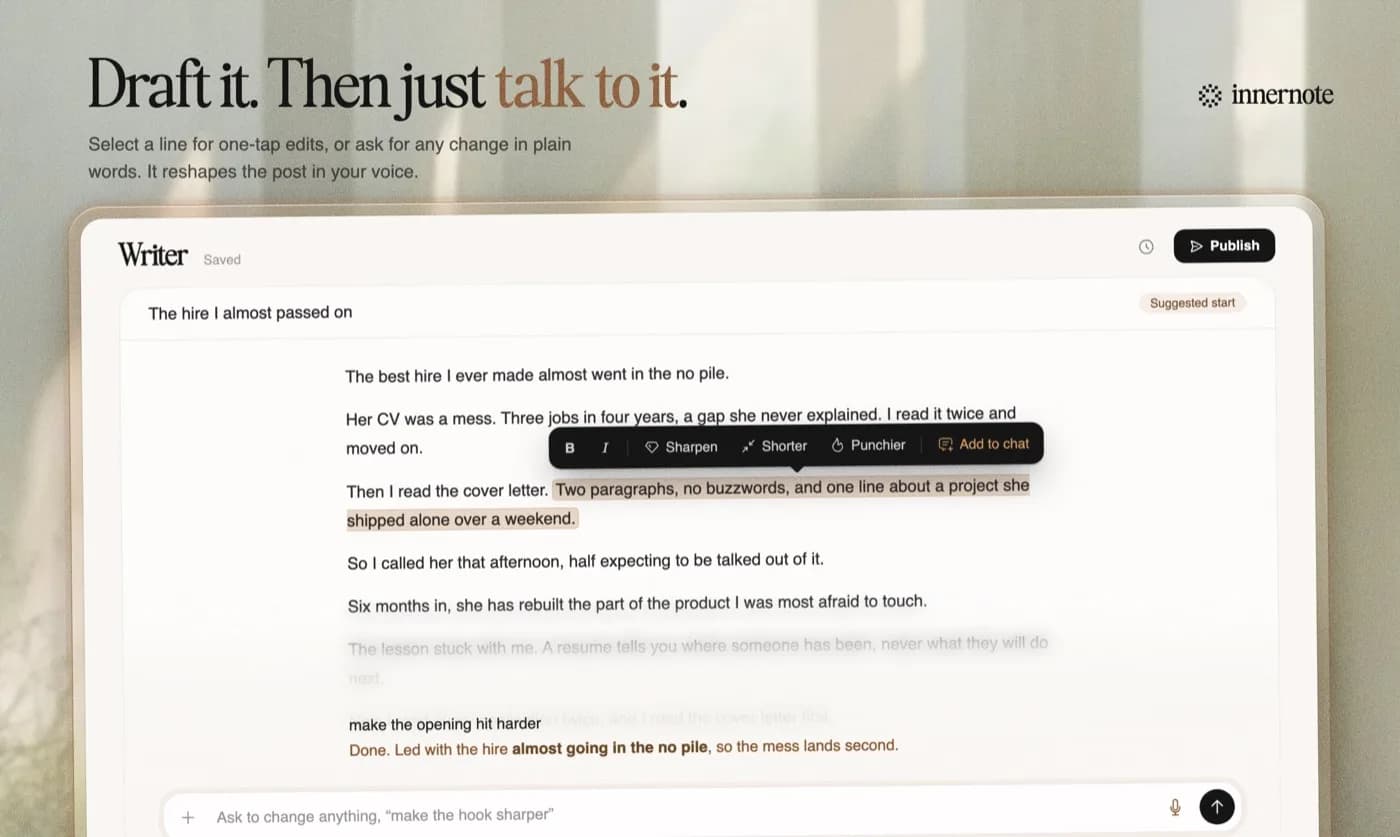
One network, learned properly
LinkedIn hides everything past the first two lines behind a see-more link, weighs a comment far above a like, and settles most of a post's reach inside the first hour. None of that generalises, which is why a tool covering many networks cannot build for it. innernote does the fold preview, first comments and tagging because it only has one platform to be right about.
A voice, not a tone toggle
An interview plus your published posts becomes a profile you can open, read and edit, and every draft comes out of it. Add memory of everything you have posted so it never repeats you, and the drafting problem is genuinely solved rather than assisted.
Side by side
Networks
Priced by
What the AI does
Learns from your published posts
Voice note to finished post
Repurpose an article, video or PDF
Remembers what you have already posted
Content pillars
See-more fold preview
Free plan
Scheduling and calendar
| Feature | innernote | Buffer |
|---|---|---|
| Networks | LinkedIn only, deeply | Many |
| Priced by | One writer, one price | Per connected channel |
| What the AI does | Writes the draft in your voice | Refines and repurposes yours |
| Learns from your published posts | Not advertised | |
| Voice note to finished post | Not advertised | |
| Repurpose an article, video or PDF | Repurposing existing content | |
| Remembers what you have already posted | So it never repeats you | Ideas storage |
| Content pillars | Not advertised | |
| See-more fold preview | Not advertised | |
| Free plan | In the workshop | |
| Scheduling and calendar |

Pricing
innernote
$29 a month, or $19 billed annually. One writer, every feature.
Buffer
Free for up to 3 channels with 10 scheduled posts each. Essentials $5 per channel a month, Team $10 per channel, both discounted yearly, with lower rates above ten channels.
Cheaper than us for one channel. Priced around distribution rather than around writing.
Buffer pricing checked August 13, 2026.
Is Buffer good for LinkedIn specifically?
It is good at getting a LinkedIn post out on time, which is a real and unglamorous job it has done reliably for years. What it cannot do is be opinionated about LinkedIn, because it has to treat every network the same way. That shows up in the details that decide a post: where the fold falls, whether the first two lines earn the click, what to put in the first comment, when to be at your desk after publishing. If LinkedIn is one of six places you post, Buffer is a sensible hub. If it is the only one that matters commercially, a general scheduler is the wrong shape of tool.
Refining a draft versus not having one
Almost every general tool's AI is a refinement layer: shorten this, rewrite that, turn it into a thread. It is genuinely useful and it solves the last ten minutes. The four days before, when you knew you should post and had nothing you wanted to say, are the actual problem for most founders, and no amount of rewriting reaches them. Be honest about which half you are stuck on before you choose, because the tools are not interchangeable.
Questions people ask
More from us
Best LinkedIn scheduling tools in 2026
LinkedIn's own scheduler is free and fine for one post. When it stops being enough, whether tools cost you reach, and which kind of scheduler to choose.
A LinkedIn content plan you can keep: three posts a week, three different jobs
Most people post one kind of thing and wonder why the audience grows but nobody buys. Three posts a week, each doing a different job, and what goes in each.
Where LinkedIn content ideas come from when you have nothing to say
Running out of ideas is a capture problem, not a creativity problem. The habits that turn an ordinary working week into a backlog you can write from.
7 changes that double your LinkedIn reach (and the reason each one works)
The seven levers that decide how far a LinkedIn post travels, why the algorithm rewards each one, and how to apply them without sounding like everyone else.
Other comparisons
innernote vs SocialPilot
SocialPilot distributes content across every network. innernote writes it, for one person, on LinkedIn.
innernote vs CoPost
CoPost publishes you to eleven networks. innernote writes for one, in your voice.
innernote vs Taplio
Taplio automates LinkedIn growth by remixing viral posts. innernote writes in your voice, and it is a joy to use.
Last updated August 13, 2026
See it write in your voice
If words arrive easily and logistics is the problem, Buffer is the better buy. If you sit down and nothing comes, no scheduler reaches that. See how it works.
Start free