How to write a LinkedIn DM that gets a reply
Most LinkedIn message advice is about how many you can send. The number that matters is the reply rate, and almost everything published about the limits is unverified.
- messages
- outreach
- network
Why do most LinkedIn DMs get ignored?
Because they arrive from a stranger, open with flattery, and ask for time before giving a reason. The recipient has seen the shape hundreds of times and can identify it from the first line, so the decision to ignore it is made before your actual message is read.
The pattern is easy to describe because it barely varies. A compliment about their profile, a paragraph about what the sender does, a claim that it might be relevant, and a request for fifteen minutes. Nothing in it demonstrates that the sender knows who they are messaging, which is the only thing that separates a message from a broadcast.
The test is whether your message could be sent unchanged to a hundred other people. If it could, it will be treated as though it was, because it effectively was.
There is also a timing problem that most advice skips. A cold message is the highest-friction move available on the platform and it is usually the first one people try. Commenting is lower friction and it works better, which is why it is the opening move rather than the fallback, covered in commenting is the fastest way to grow on LinkedIn.
How many messages can you actually send?
Nobody outside LinkedIn knows precisely, and that is the most useful thing to understand about the subject. LinkedIn confirms that invitation limits exist and that all members, Basic and Premium, are subject to them, and that hitting one means waiting a week. It does not publish the numbers.
The confident figures circulating online, a hundred invitations a week, a hundred messages a day, thirty to forty for safety, come from tool vendors observing their own accounts. They may be roughly right. They are not documentation, and it is worth noticing that the sites publishing precise safe limits are usually selling software designed to operate just underneath them.
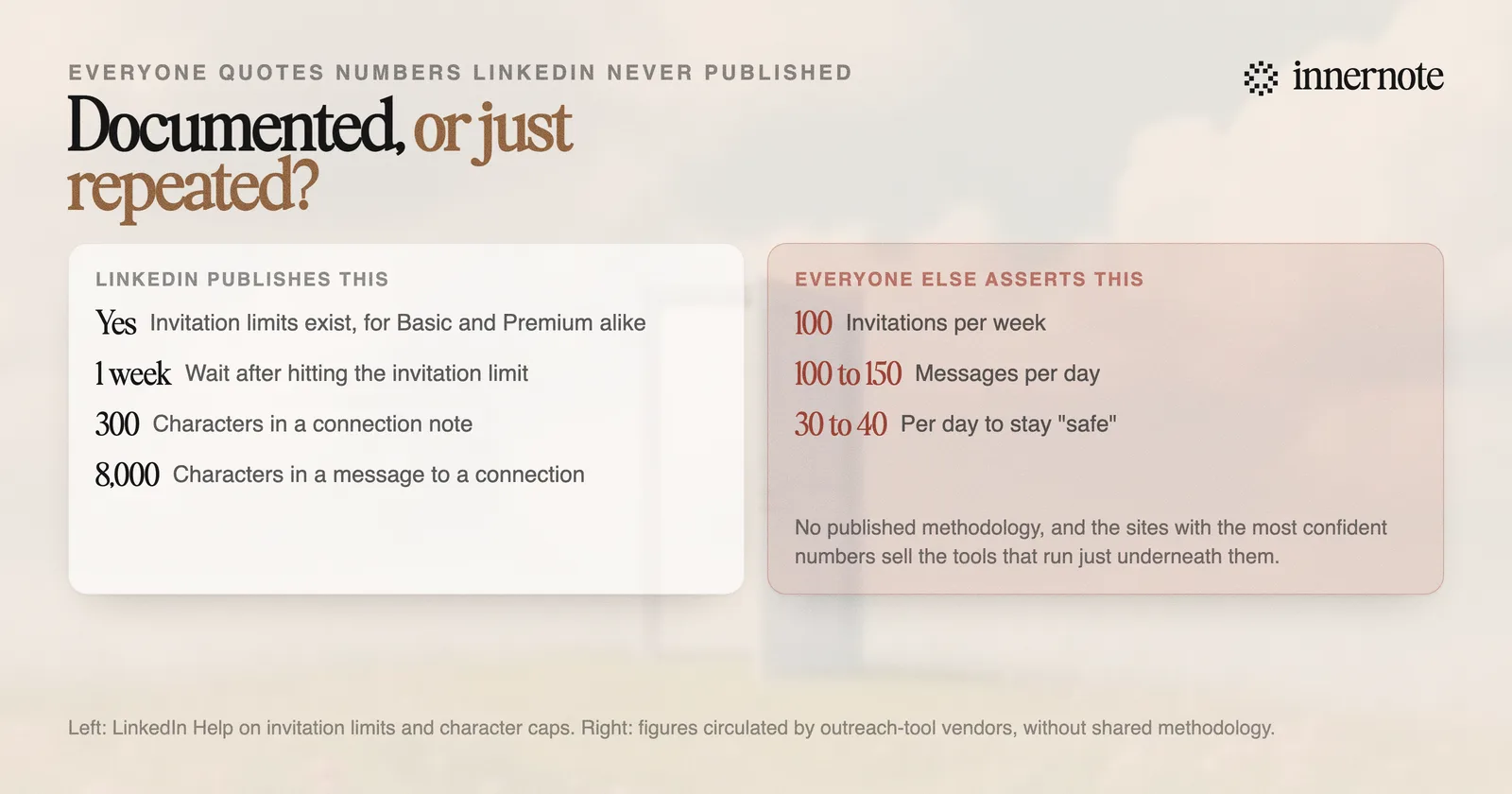
The character limits are documented and they are generous: 200 characters for a connection note on a free account, 8,000 for a message to a connection, and around 1,900 in an InMail body. All of them are in every LinkedIn character limit in 2026, and none of them is the constraint. Nobody has ever failed at outreach because the box was too small.
The practical position is that volume is the wrong lever anyway. LinkedIn spent 2026 penalising automated activity specifically, and a person sending forty considered messages a week is not near any threshold worth worrying about.
What LinkedIn does publish about the invitation limit, and how long a block lasts, is in LinkedIn's connection request limit.
What does a message that gets a reply look like?
Short, specific about them, and asking for something small enough to say yes to without a calendar. The structure is three sentences: why you are messaging this person in particular, one line of relevant substance, and a question they can answer in a sentence.
- 1.Open with the specific reason. Something they wrote, built, said on a podcast, or a decision you watched them make. It has to be a thing only they did.
- 2.Give before asking. One useful observation, a relevant number from your own experience, or a genuine disagreement with something they said. This is the part almost every message skips.
- 3.Ask something answerable in a sentence. A question beats a meeting request, because a reply costs them ten seconds and a call costs them thirty minutes.
- 4.Stop there. No links, no attachment, no calendar, no paragraph about your company. All of that is available once they reply.
That last rule is the one people find hardest, because a shorter message feels like a wasted opportunity. It is the opposite. The purpose of a first message is a reply, not a sale, and everything you add that is not serving a reply is reducing the odds of one.
One follow-up is fine, a week later, adding something new rather than nudging. A second follow-up is where it turns into pressure, and the cost is not just this conversation: LinkedIn's connect-and-pitch reputation is exactly why the first message had to work so hard in the first place.
What should you do before the DM?
Be someone they have already seen. A message from a name that appeared thoughtfully under three of their posts over the previous month is a different object from a cold message, and it takes less effort in total than writing clever cold outreach.
- Comment properly on their posts first, adding something rather than agreeing. Two or three over a few weeks is plenty.
- Make sure your own profile survives the click, because they will check it before replying. The order that matters is in how to optimize your LinkedIn profile in 2026.
- Have something recent on your feed. An empty profile with a good message reads as a sales account.
- If you are connecting first rather than messaging, keep the note to two sentences. The shapes that get accepted are in who to connect with on LinkedIn.
The reply rate on a cold message is mostly decided before you write it, by whether the recipient recognises your name and by what your profile says when they check.
This is the unglamorous version of outreach and it is the one that compounds, because every comment and every post is also doing work with people you have not messaged yet. Volume outreach spends attention; publishing accumulates it.
Which is why the feed and the inbox are the same problem. If keeping something on your profile worth arriving at is the part that keeps slipping, that is what innernote is for: it turns what you already know into posts in your own voice, so the profile people check after your message is not three weeks quiet.
Quick answers
Keep going