How to get cited by ChatGPT when you are the expert, not the brand
LinkedIn is one of the most-cited domains in AI answers, and almost all advice about it is written for companies. What actually gets a person quoted, from the studies.
- ai search
- visibility
- geo
Do AI answer engines actually read LinkedIn?
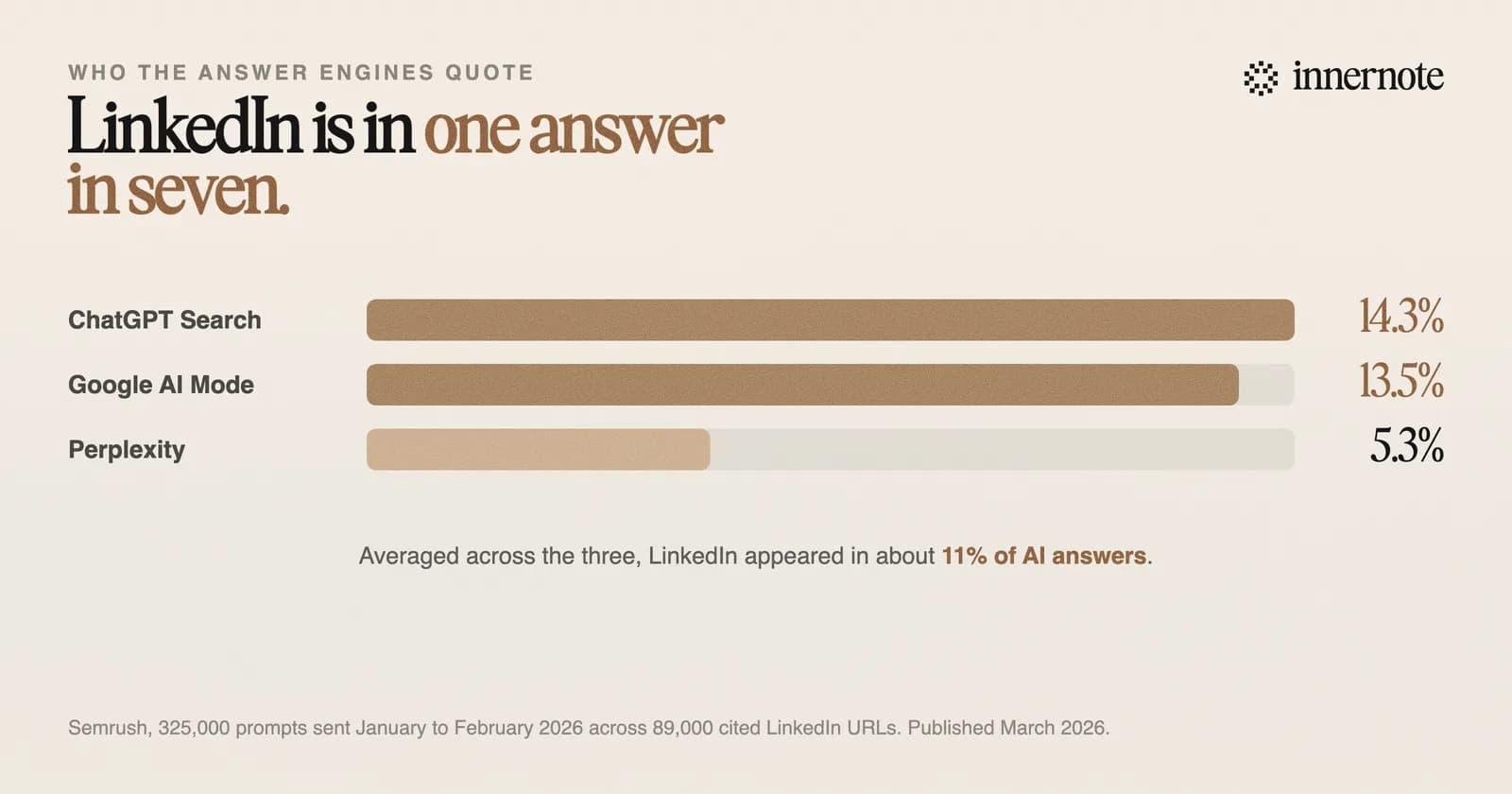
Heavily, and more than they read the press. Semrush analysed 325,000 prompts sent to ChatGPT Search, Google AI Mode and Perplexity in January and February 2026, along with 89,000 cited LinkedIn URLs, and found LinkedIn appearing in about 11 percent of AI responses on average. In that dataset it ranked second among all domains, ahead of Wikipedia, YouTube and every major news publisher.
The rate varies a lot by engine, which is worth knowing before you decide the number means nothing or everything. ChatGPT Search cited LinkedIn in 14.3 percent of responses, Google AI Mode in 13.5 percent, and Perplexity in only 5.3 percent.
A second study points the same way without agreeing exactly. Peec AI examined 30 million cited sources across ChatGPT, Google AI Mode, Gemini, Perplexity and AI Overviews, and ranked LinkedIn third overall behind Reddit and YouTube. Two credible studies, two different placements, one conclusion that survives both: a small number of platforms dominate what these systems quote, and LinkedIn is inside that set.
The two studies disagree about whether LinkedIn is second or third. Neither of them puts it outside the top three, and that is the part you can act on.
Why do social platforms outrank publishers in AI answers?
Because AI citation is far more concentrated than search ever was. Across the consolidated studies, the top fifteen domains account for roughly two thirds of citations. In Google organic results on comparable queries, the top fifteen take around a fifth. The long tail that made classic SEO winnable is much thinner here.
That concentration is bad news and good news in the same breath. Bad, because a new site of your own has almost no chance of being the thing quoted. Good, because you do not need one. The surface these systems already trust is a platform you can publish to this afternoon for free.
It also explains the kind of source they favour. What gets pulled from these platforms is first-hand reporting of what happened when someone tried something: a Reddit thread where practitioners argue about a detail, a LinkedIn post describing what actually worked. Not the summary of the summary. The model already has the summary.
This is worth holding onto if you write about a competitive subject. The general-purpose overview of your field is the single least quotable thing you can publish, because a thousand versions of it exist and the model can generate the thousand-and-first itself.
What kind of writing actually gets quoted?
The research on this is older than the hype and it is fairly consistent. The original generative engine optimisation paper from Princeton and IIT Delhi, presented at KDD in 2024, tested a benchmark of 10,000 queries and found that adding statistics, adding quotations from credible sources, and citing sources each lifted visibility in generated answers substantially, up to around 40 percent for lower-ranked pages.
Two later findings from 2026 analyses sharpen it. Citations cluster near the top of a document, with roughly 44 percent of all quoted passages coming from the first third of the text. And the Semrush work found that when an AI answer drew on LinkedIn content, its semantic overlap with the original sat around 0.57 to 0.60, meaning the system is paraphrasing your point rather than lifting your sentence.
That last number is the one that should change how you write. If the model restates your idea in its own words, then polish is not what earns the citation. The idea has to be separable from the prose, and it has to be specific enough that restating it does not turn it back into a generality.
- A claim with a number attached survives paraphrase. We cut onboarding time from eleven days to four survives. We significantly improved onboarding does not.
- A named condition survives. This works for teams under twenty and breaks above that survives. This works well for teams does not.
- A first-hand result survives, because there is nowhere else to get it. Your own experiment is the only thing on the internet a model cannot reconstruct without you.
Everything an answer engine can already write itself is invisible to it. What it cannot write is the thing that happened to you, with the number attached.
Is this just SEO with a new name?
Partly. For an individual, most of the classic playbook does not apply at all. You do not control LinkedIn's markup, its page speed, its internal linking or its titles. Roughly everything an agency sells as generative engine optimisation is inapplicable when your surface is somebody else's platform.
What remains is small and it is the part that was always doing the work: be the specific, first-hand, checkable source on a narrow subject, repeatedly, somewhere these systems already read. That is not a growth hack. It is the same instruction as building a reputation, which is reassuring, because it means the effort is not wasted if the engines change.
It also helps to keep expectations realistic. Being cited in an AI answer is not traffic in the way a search result was. Often your name appears and no click follows. The value is the mention, in front of someone who asked a question in your field and received your answer with your name on it. That is closer to a referral than to a visit.
The same shift is happening inside LinkedIn itself, where search now retrieves on meaning rather than matching strings. We covered what that does to a profile in how to show up in LinkedIn search in 2026.
What should you actually do this month?
Publish four posts that contain something only you know, on one subject, with a number in each. That is a smaller instruction than any GEO checklist and it is closer to what the research supports. The rest is patience.
- 1.Pick one question people in your field genuinely ask, narrow enough that you have actually answered it in practice.
- 2.Write what you did, what happened, and what the number was. Include the case where it did not work. Contradiction is quotable; agreement is not.
- 3.Put the claim in the first third of the post, because that is where citations concentrate and where LinkedIn truncates anyway.
- 4.Name your sources when you use someone else's data. Citing credible sources is one of the few interventions with published evidence behind it.
- 5.Keep your profile current and specific, since it is the page that gets cited when the model needs to say who you are.
The uncomfortable implication is that the posts most likely to be quoted are the ones that take the longest to write, because they require having done something. There is no version of this where the generic draft wins. That was already true for readers and it is now true for the machines reading on their behalf, which is at least tidy.
If the bottleneck is turning what you actually know into posts that sound like you rather than like a press release, that is the job innernote does. It works from your own way of explaining things, so the specifics survive the drafting instead of being smoothed out of it.
Quick answers
Keep going