EasyGen alternative: innernote vs EasyGen
 innernote
 EasyGen
EasyGen generates LinkedIn posts modelled on top-performing creators and trending topics, and does not publish its prices: you sign up for a trial to see them. innernote starts from your own published writing rather than someone else's, and costs $29 a month with every feature on the plan and the price on the page.
 innernote
 EasyGen
The model it writes toward
You
EasyGen: Creators with 100M+ views
Price
$29, published
EasyGen: Sign up to find out
Source material
Your archive and your ideas
EasyGen: Top creators and trends
What EasyGen is
EasyGen writes LinkedIn posts using data from top-performing creators and trending topics, with creator analysis, a trend tool, a content calendar, writing-style customisation and voice-note dictation. Their homepage headline is "Write LinkedIn posts like creators with 100M+ views", and pricing is not shown on the site: you start a free trial to reach it.
Why people move to innernote
Their headline is the whole difference
"Write LinkedIn posts like creators with 100M+ views." That is their promise stated plainly, and for some people it is the right one. But your reader is not comparing your post to a creator with 100 million views. They are deciding whether the person who wrote it is worth replying to. Writing like somebody with a hundred times your audience is how you end up with a feed of posts that could belong to anyone in your industry.
The price is on the page
$29 a month, or $19 billed annually. You can see that before you give anyone an email address. EasyGen does not publish pricing: you sign up for a trial to find out what it costs, which is a decision made for you rather than by you.
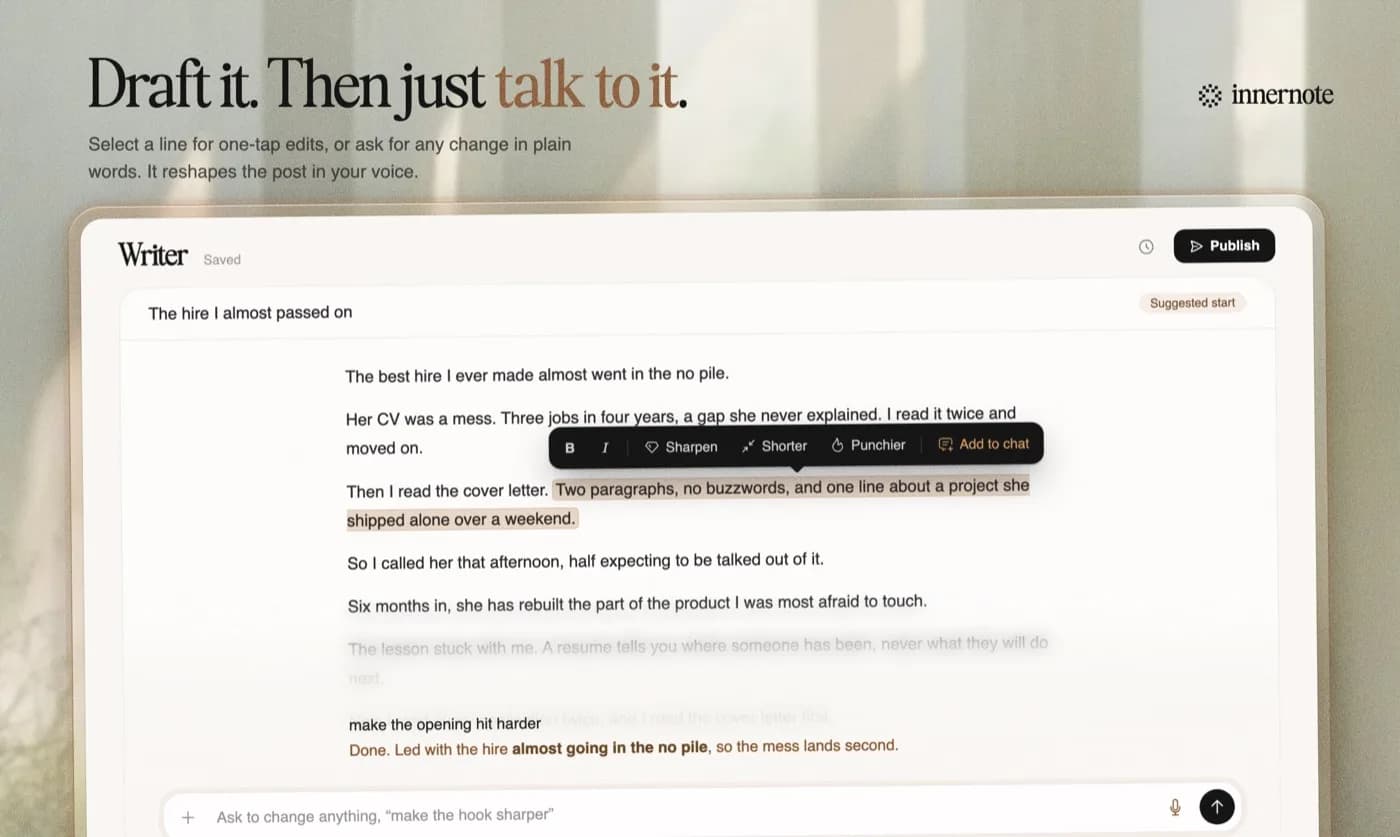
It starts from what you already know
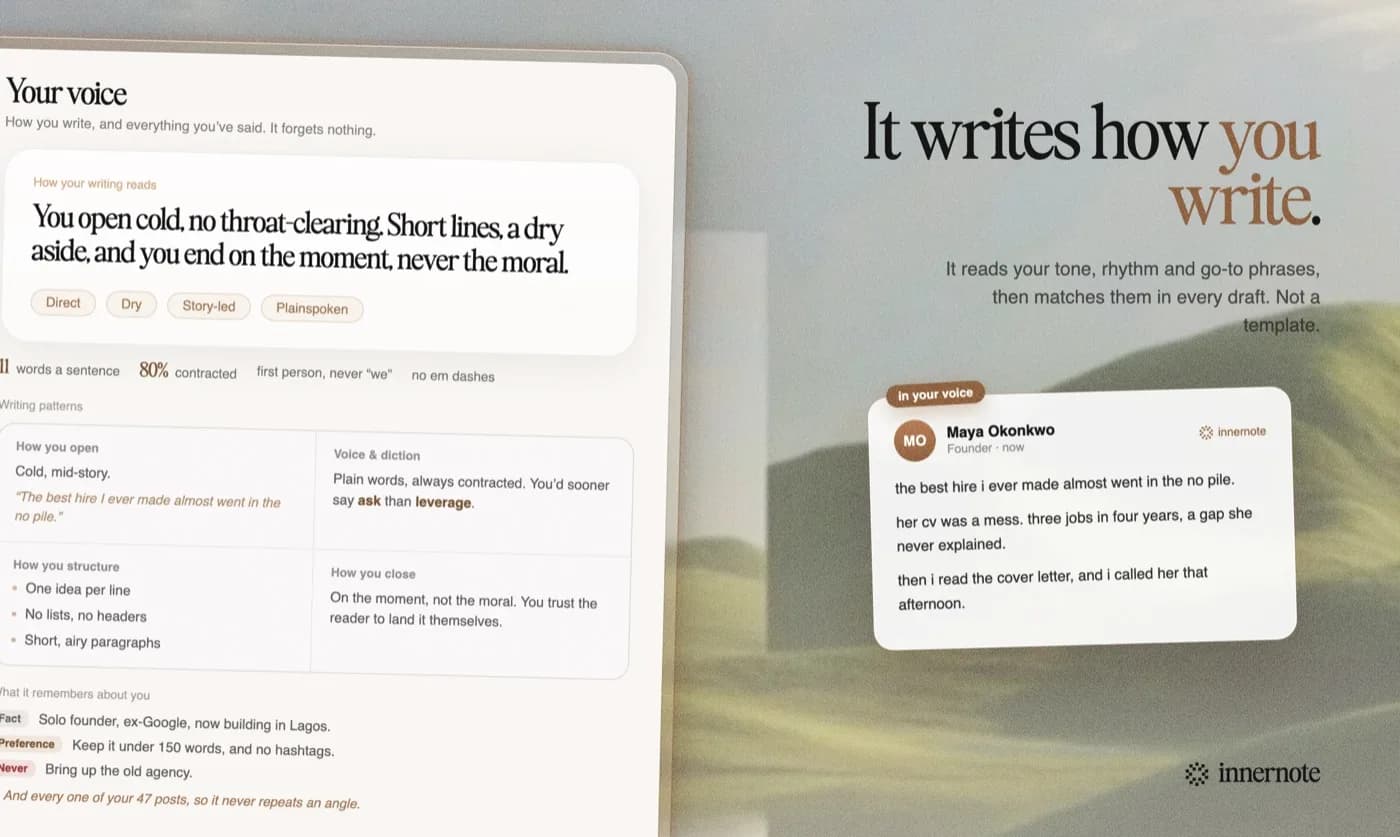
An interview about how you think plus your published posts becomes a voice profile you can open, read and edit. Add your pillars, the things you have saved and a voice note from a walk, and the draft comes from your material rather than a leaderboard of other people's.
It never repeats you
Post memory holds everything you have published, so the next idea does not restate a point you made three weeks ago. Tools that draw on trending topics have the opposite problem: they converge, because everyone's trends are the same trends.
Side by side
Pricing published on the site
What drafts are modelled on
Voice profile you can read and edit
Voice note to finished post
Repurpose an article, video or PDF
Remembers what you have already posted
Content pillars
Campaigns and multi-part series
Content calendar
| Feature | innernote | EasyGen |
|---|---|---|
| Pricing published on the site | Sign up to see it | |
| What drafts are modelled on | Your own published posts | Top creators and trends |
| Voice profile you can read and edit | Writing style customisation | |
| Voice note to finished post | ||
| Repurpose an article, video or PDF | Not advertised | |
| Remembers what you have already posted | So it never repeats you | Not advertised |
| Content pillars | Trending topics | |
| Campaigns and multi-part series | Not advertised | |
| Content calendar |
Pricing
innernote
$29 a month, or $19 billed annually. One plan, every feature, and the number is on the page.
EasyGen
Not published on their site. They offer a 7-day free trial, and you sign up to see what it costs.
You can compare us before you hand anyone an email address.
EasyGen pricing checked August 13, 2026.
Does writing like a big creator work for a small account?
Usually not, and the reason is structural rather than stylistic. A creator with a huge audience can post a one-line opinion and get a thousand reactions, because the audience is already there and the algorithm already trusts the account. Copy that post with four hundred followers and it reads as thin, because none of the context that made it work is present. What travels at your size is specificity: the thing you learned this week that nobody else could have written. That is a worse fit for a viral-post model and a much better fit for your own archive.
Why does unpublished pricing matter?
Because it changes who the page is written for. A published price lets you decide in thirty seconds whether this is worth your afternoon. An unpublished one buys the vendor a conversation, which is a reasonable trade for enterprise software and an odd one for a tool a single person buys with a card. Ours is $29, or $19 annually, and it is on the pricing page.
Questions people ask
More from us
Why do AI LinkedIn posts sound so cringe?
Generated posts read as hollow because a model returns the average phrasing, and averaged writing belongs to no one. Here is the real cause and the fix.
How do you make AI writing sound human on LinkedIn?
Not by swapping words or running it through a humaniser. By putting back the specifics that got averaged out. Here is the edit pass that actually works.
7 changes that double your LinkedIn reach (and the reason each one works)
The seven levers that decide how far a LinkedIn post travels, why the algorithm rewards each one, and how to apply them without sounding like everyone else.
Other comparisons
innernote vs Taplio
Taplio automates LinkedIn growth by remixing viral posts. innernote writes in your voice, and it is a joy to use.
innernote vs RedactAI
RedactAI meters posts and writing styles by tier. innernote gives you one voice, unmetered, on one plan.
innernote vs SocialSonic
SocialSonic promises the top 1% in 90 days, trained on viral posts. innernote is a slower promise you can keep.
Last updated August 13, 2026
See it write in your voice
If the goal is that your own network recognises your writing, a model trained on creators a hundred times your size is aiming at the wrong target. See how it works.
Start free