Stanley alternative: innernote vs Stanley
 innernote
 Stanley
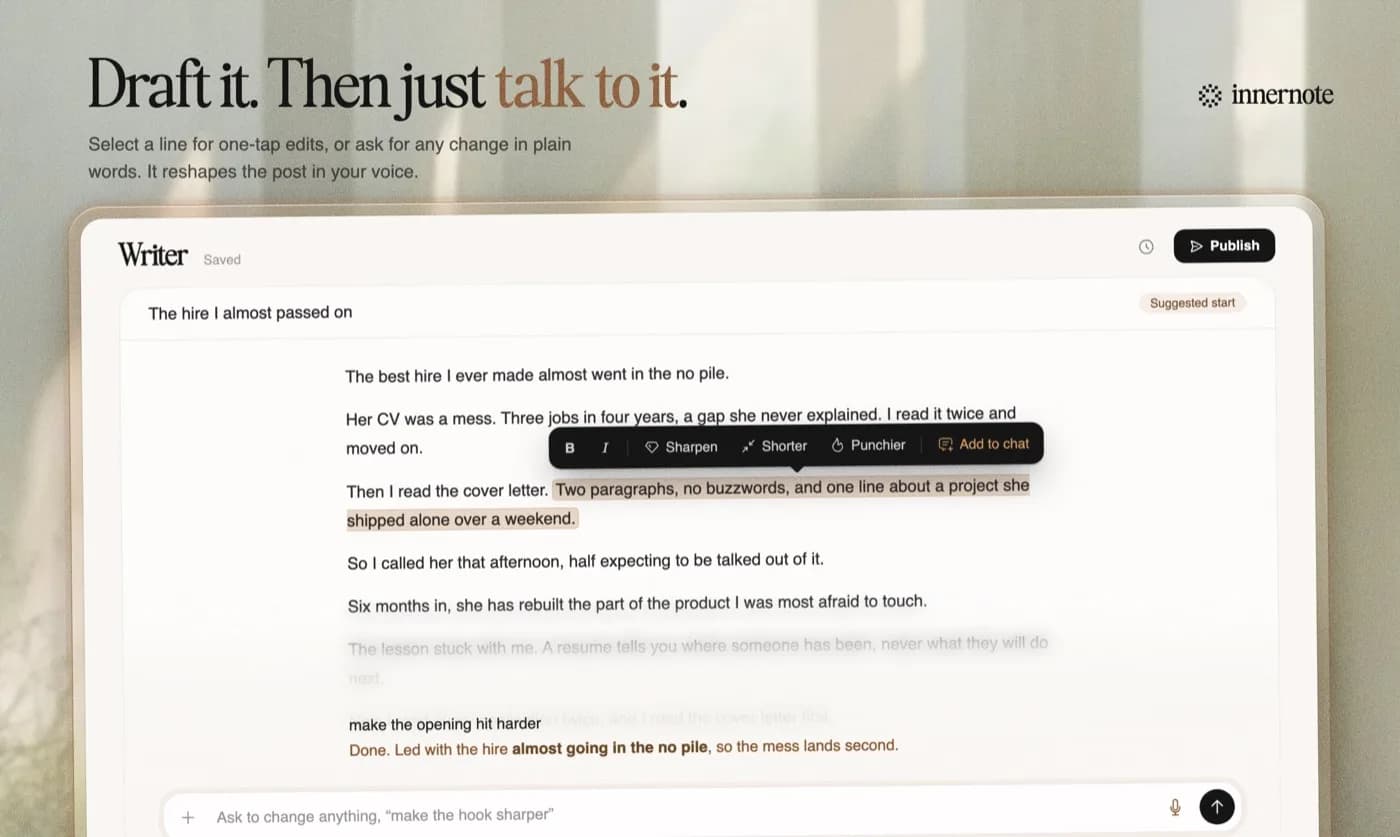
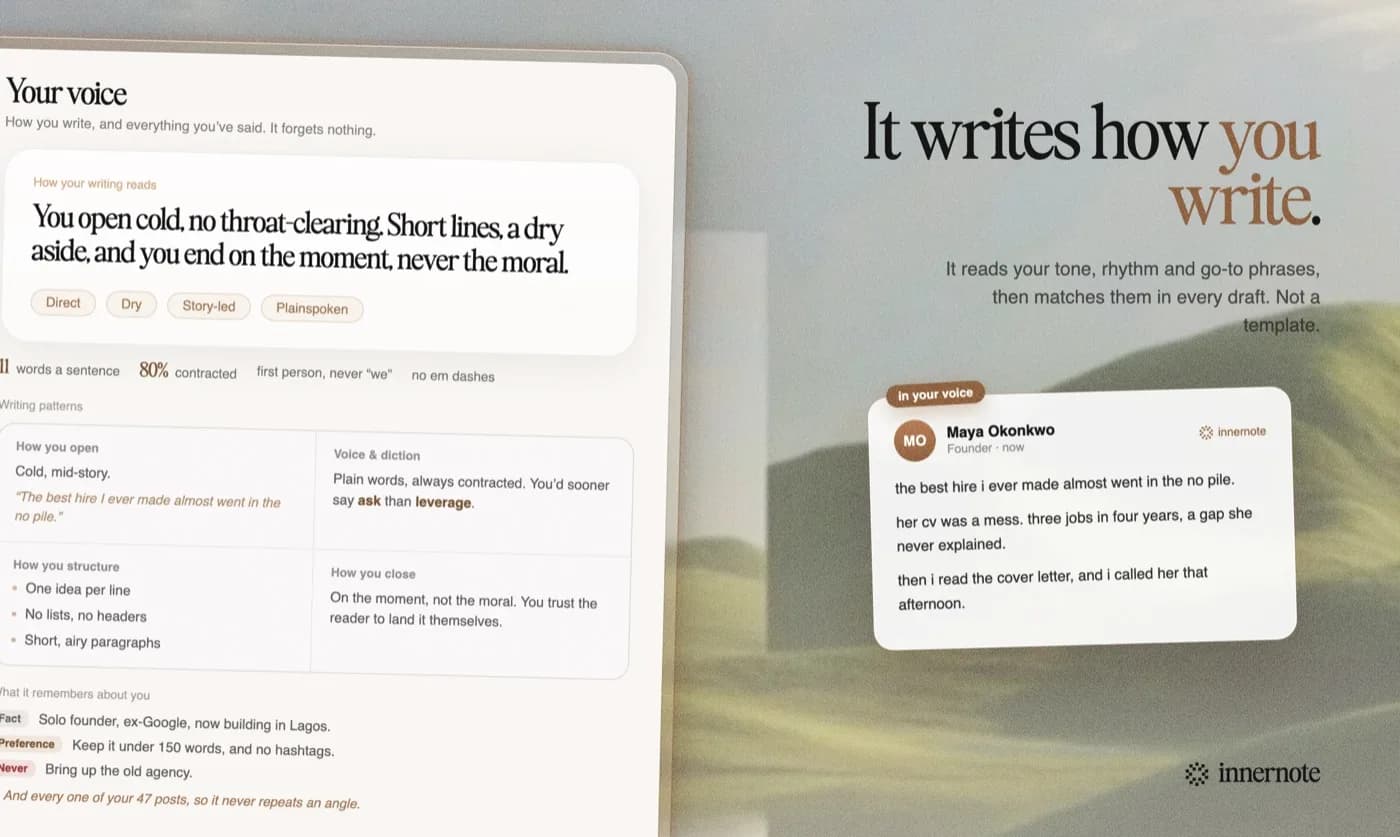
Stanley is a chat-based tool, reachable by message and on Telegram, pitched on owning your distribution and scaling your following across platforms. innernote is a writing studio: you see the real post as you type, in your own voice, and nothing goes out that you have not read. $29 a month, price on the page.
 innernote
 Stanley
Where you work
A writing studio
Stanley: A chat thread
The pitch
Posts that sound like you
Stanley: Own your distribution
Price
$29, published
Stanley: Not published
What Stanley is
Stanley is a distribution and growth tool you interact with by message, including through a Telegram bot. Its homepage headline is "Own Your Distribution" and it describes scaling your following across platforms while you focus on other work. Pricing is not published on the site.
Why people move to innernote
Approving a message is not writing
A chat bot is a genuinely good interface for a task you want handed to you: answer, approve, done. That is the wrong shape for the thing your name goes on. Writing is a decision about what you actually think, and it changes as you look at it. innernote gives you the real post, formatted as it will appear, with the see-more fold where it will fall, and you change it because you are the one publishing it.
You can see what you are about to publish
LinkedIn hides everything past the first two lines, decides most of a post's reach within the hour, and treats a comment as worth far more than a like. Judging that in a chat window is guesswork. The studio shows you the fold, the length, the first comment and the tags before anything goes out.
The price is on the page
$29 a month, or $19 billed annually. Stanley does not publish pricing, so you cannot compare before you start a conversation. For a tool one person buys with a card, that is a decision made for you rather than by you.
One network, learned properly
Scaling across platforms means treating LinkedIn as one of several. innernote is built for LinkedIn alone, which is why it knows about the fold, first comments, tagging, and the hour after you publish when comments actually decide reach.
Side by side
Where you work
Pricing published on the site
Networks
See-more fold preview
Voice profile you can read and edit
Repurpose an article, video or PDF
Remembers what you have already posted
Content pillars
Campaigns and multi-part series
Chat and Telegram interface
Scheduling and calendar
| Feature | innernote | Stanley |
|---|---|---|
| Where you work | A writing studio with live preview | A chat thread and Telegram |
| Pricing published on the site | Not published | |
| Networks | LinkedIn, deeply | Across platforms |
| See-more fold preview | Not advertised | |
| Voice profile you can read and edit | Not advertised | |
| Repurpose an article, video or PDF | Not advertised | |
| Remembers what you have already posted | So it never repeats you | Not advertised |
| Content pillars | Not advertised | |
| Campaigns and multi-part series | Not advertised | |
| Chat and Telegram interface | In the workshop | |
| Scheduling and calendar | Not advertised |
Pricing
innernote
$29 a month, or $19 billed annually. One plan, every feature, published on the page.
Stanley
Not published on their site. Checked on the date at the foot of this page.
You can compare us without starting a conversation to find out the price.
Stanley pricing checked August 13, 2026.
Is a chat interface good for writing?
It is excellent for briefing and poor for authorship. Chat suits work you want to delegate: ask, receive, approve. Writing does not survive that shape, because the draft is not a deliverable you sign off, it is a thing you change while looking at it, and half of what you decide happens in the third read rather than the first. It also hides the format. A LinkedIn post lives or dies on where the fold falls and what the first two lines do, and a chat bubble shows you neither.
What does owning your distribution actually mean?
It usually means volume across several platforms, run for you. That is a real strategy and it works best for people whose content is already produced and whose problem is spread. For a founder building a reputation, the constraint is upstream: not enough posts exist, and the ones that do sound like anyone. Solving spread first gets you more copies of the same problem, which is why the more useful order is to get the writing right on one network before scaling anything.
Questions people ask
More from us
Every LinkedIn character limit in 2026 (and where your text really gets cut)
Posts, headlines, About, comments and messages, plus the limit that matters far more: the fold, where LinkedIn cuts a post after 140 characters.
How do you make AI writing sound human on LinkedIn?
Not by swapping words or running it through a humaniser. By putting back the specifics that got averaged out. Here is the edit pass that actually works.
A LinkedIn content plan you can keep: three posts a week, three different jobs
Most people post one kind of thing and wonder why the audience grows but nobody buys. Three posts a week, each doing a different job, and what goes in each.
Other comparisons
innernote vs Taplio
Taplio automates LinkedIn growth by remixing viral posts. innernote writes in your voice, and it is a joy to use.
innernote vs CoPost
CoPost publishes you to eleven networks. innernote writes for one, in your voice.
innernote vs Supergrow
The closest tool to ours. The difference is packaging: what you have to reach the $39 tier to get.
Last updated August 13, 2026
See it write in your voice
If your name goes on it, you want to see it laid out as it will appear and decide, rather than approve a message in a chat thread. See how it works.
Start free