Contentdrips alternative: innernote vs Contentdrips
 innernote
 Contentdrips
Contentdrips is a carousel and graphics tool with a post writer attached, from $15 a month, metered in credits. innernote is a writing tool: it learns how you write and turns a thought, a voice note or an article into a post in your voice, for $29 with no credits. If your posts fail because they do not look good, buy theirs. If they fail because they do not sound like you, buy ours.
 innernote
 Contentdrips
What it is built to make
The words
Contentdrips: The graphic
Metering
None
Contentdrips: AI credits per action
Price
$29, unmetered
Contentdrips: From $15, credit-metered
What Contentdrips is
Contentdrips is a design-first content tool: carousels, infographics, branded templates, a brand kit and a bulk post planner, with an AI post writer alongside. Their published plans are a free tier with 50 one-time credits, Starter at $15 a month with 500 monthly credits, and Pro at $26 with 1,200. Actions are priced in credits: a LinkedIn post costs 8, a carousel 10, a design agent run 25.
Why people move to innernote
A carousel does not fix a post that does not sound like you
Contentdrips is genuinely good at what it is for, and their own comparison pages target Canva and Adobe Express, which tells you what they think they are. Design is the job. That helps if your problem is that plain text posts look unloved next to everyone else's slides. It does nothing if the problem is that you sat down, wrote three sentences, decided they sounded like someone else, and closed the tab.
Nothing here is metered
Their AI runs on credits: a LinkedIn post costs 8 of them, a design agent run 25, an image 25. That is a fair way to price image generation and an awkward way to price writing, because it puts a meter on the exact behaviour you are trying to build. innernote has no credits. Write ten drafts of the same post on a bad morning and nothing counts down.
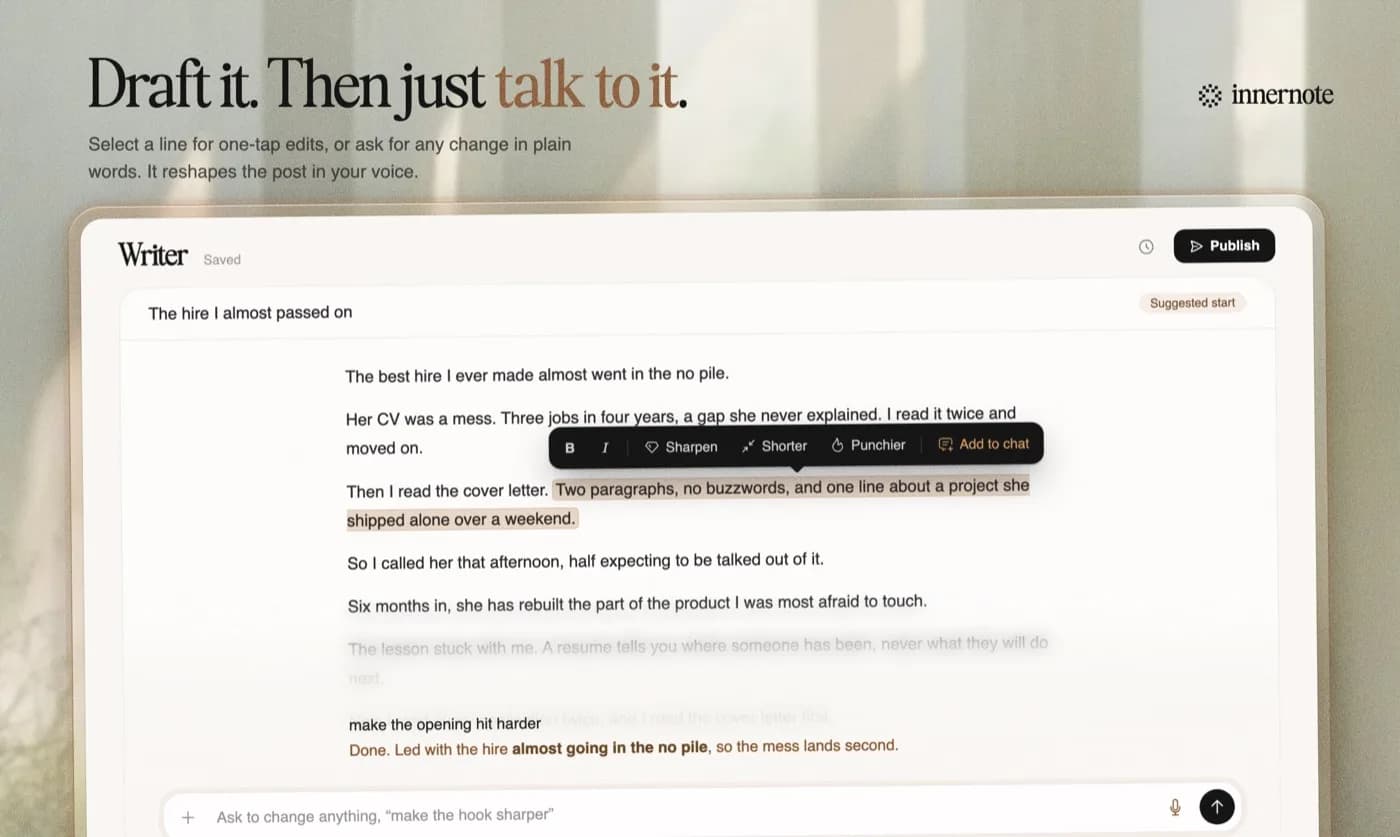
It knows what you should post about
A template gives you a shape to fill. It does not tell you what goes in it. innernote holds your pillars, the things you have saved, and every post you have already published, so the next idea comes from your own material and never repeats a point you made three weeks ago.
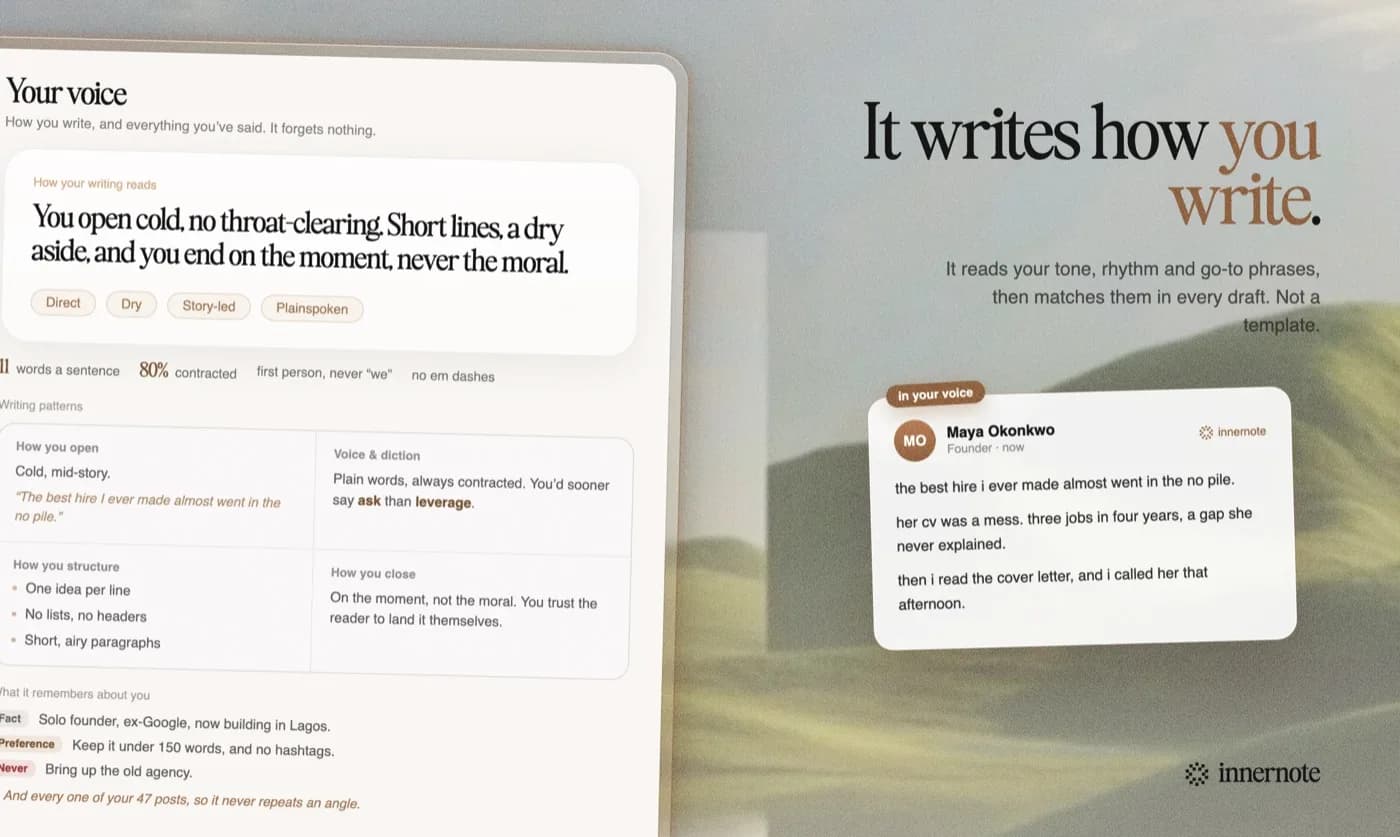
The draft starts from your writing
This is the whole product. An interview plus your published posts becomes a voice profile you can read and edit, and every draft comes out of it. You edit because you want to, not because the words arrived in a register that is not yours.
Side by side
What it is built to produce
Metering
Learns from your published posts
Voice note to finished post
Repurpose an article, video or PDF
Content pillars
Remembers what you have already posted
Campaigns and multi-part series
Carousels and branded graphics
Brand kit and templates
Scheduling and calendar
| Feature | innernote | Contentdrips |
|---|---|---|
| What it is built to produce | The words | The designed graphic |
| Metering | Unmetered | AI credits per action |
| Learns from your published posts | Not advertised | |
| Voice note to finished post | Not advertised | |
| Repurpose an article, video or PDF | Blog and YouTube to carousel | |
| Content pillars | Trending ideas finder | |
| Remembers what you have already posted | So it never repeats you | Not advertised |
| Campaigns and multi-part series | Bulk post planner | |
| Carousels and branded graphics | In the workshop | |
| Brand kit and templates | In the workshop | |
| Scheduling and calendar |
Pricing
innernote
$29 a month, or $19 billed annually. No credits, no per-action metering.
Contentdrips
Free with 50 one-time credits, Starter $15 a month with 500 monthly credits, Pro $26 with 1,200. Up to 20% off annually. A LinkedIn post costs 8 credits, a carousel 10, a design agent run 25.
They are cheaper and they are metered. We cost more and nothing counts down while you write.
Contentdrips pricing checked August 13, 2026.
Do carousels actually outperform text posts?
Sometimes, and less reliably than the people selling carousel tools suggest. A carousel is a good format for a genuinely sequential idea: a process with steps, a before and after, a teardown. It is a poor format for an opinion, a story or a moment of doubt, which is most of what makes a founder worth following. Reach for a carousel when the idea has steps in it. Reaching for one because plain text feels like not trying is how you end up making slides instead of posting.
What credits actually cost you
Not much money. On Starter, 500 credits at 8 per post is around sixty posts a month, which is more than anyone needs. The cost is behavioural. A meter on the screen changes how you write: you stop regenerating, you settle for the third draft, you ration the thing you should be doing freely. That matters most on the mornings when writing is hardest, which are exactly the mornings the habit is won or lost.
Questions people ask
More from us
Where LinkedIn content ideas come from when you have nothing to say
Running out of ideas is a capture problem, not a creativity problem. The habits that turn an ordinary working week into a backlog you can write from.
7 changes that double your LinkedIn reach (and the reason each one works)
The seven levers that decide how far a LinkedIn post travels, why the algorithm rewards each one, and how to apply them without sounding like everyone else.
A LinkedIn content plan you can keep: three posts a week, three different jobs
Most people post one kind of thing and wonder why the audience grows but nobody buys. Three posts a week, each doing a different job, and what goes in each.
Other comparisons
innernote vs AuthoredUp
AuthoredUp helps you format and measure a post you already wrote. innernote is for getting it written.
innernote vs Taplio
Taplio automates LinkedIn growth by remixing viral posts. innernote writes in your voice, and it is a joy to use.
innernote vs Supergrow
The closest tool to ours. The difference is packaging: what you have to reach the $39 tier to get.
Last updated August 13, 2026
See it write in your voice
If your posts are not getting written, a better template will not help. If they are written and look plain, Contentdrips is the better buy and we will not pretend otherwise. See how it works.
Start free